

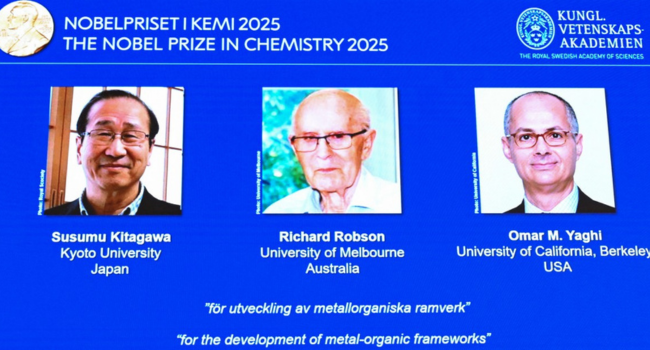
Three scientists have been awarded the 2025 Nobel Prize in Chemistry for pioneering work on metal–organic frameworks (MOFs), materials with diverse applications such as carbon capture and water extraction from desert air.
Japan’s Susumu Kitagawa, UK-born Richard Robson, and American-Jordanian Omar Yaghi were recognised for their groundbreaking research spanning from the late 1980s to the early 2000s.

The Royal Swedish Academy of Sciences noted that their discoveries have enabled chemists to create tens of thousands of different MOFs, some of which could help tackle major global challenges, including removing PFAS from water, breaking down pharmaceutical residues in the environment, and harvesting moisture from arid air.
“Imagine chemistry being used to design entirely new materials with unprecedented properties,” said Hans Ellegren, the Academy’s secretary general, illustrating the significance of their achievement.
A Breakthrough in Crystal Design
In 1989, Robson, now 88, experimented with the unique properties of atoms using copper ions. The resulting bonds formed a highly ordered, spacious crystal — “like a diamond filled with countless cavities,” according to the Nobel committee. Although Robson recognised its potential, the structure lacked stability.
Kitagawa, a professor at Kyoto University, and Yaghi, a professor at the University of California, Berkeley, later provided the scientific foundation needed to stabilise and advance the technique. Between 1992 and 2003, working independently, they made a series of revolutionary contributions.
Kitagawa demonstrated that gases could flow through MOF structures and predicted that they could be made flexible. Yaghi created a highly stable MOF and showed how it could be customised through rational design to gain new and valuable properties.
From Humble Beginnings to Scientific Glory
Kitagawa said he was “deeply honoured and delighted” by the recognition. Yaghi, who received the news while changing flights, described himself as “astonished, delighted, overwhelmed.”
Born into a family of refugees in Amman, Jordan, Yaghi grew up in poverty, sharing a small room with his family and livestock. His parents had limited education, and he found refuge in school, where he first encountered molecular structures at the age of 10 after sneaking into a locked library. He moved to the United States at 15 to pursue his studies.
“Science is the greatest equalising force in the world,” Yaghi reflected.
Nobel Season Continues
The chemistry prize follows this year’s physics award to John Clarke, Michel Devoret, and John Martinis for their work advancing quantum technology. On Monday, Mary Brunkow, Fred Ramsdell, and Shimon Sakaguchi received the Nobel Prize in Medicine for their research into the human immune system.
The Nobel literature prize will be announced on Thursday, followed by the peace prize on Friday. The prize for economics concludes the 2025 Nobel season on 13 October.
Each Nobel laureate receives a diploma, a gold medal, and a $1.2 million prize, shared if there are multiple winners in a category.