
Special Report: How overcrowded classrooms, unmotivated teachers and students impact education quality in Nigeria
...With added reports from Alagbe Elisha, Esther Adekanla, Khadijat Adelani

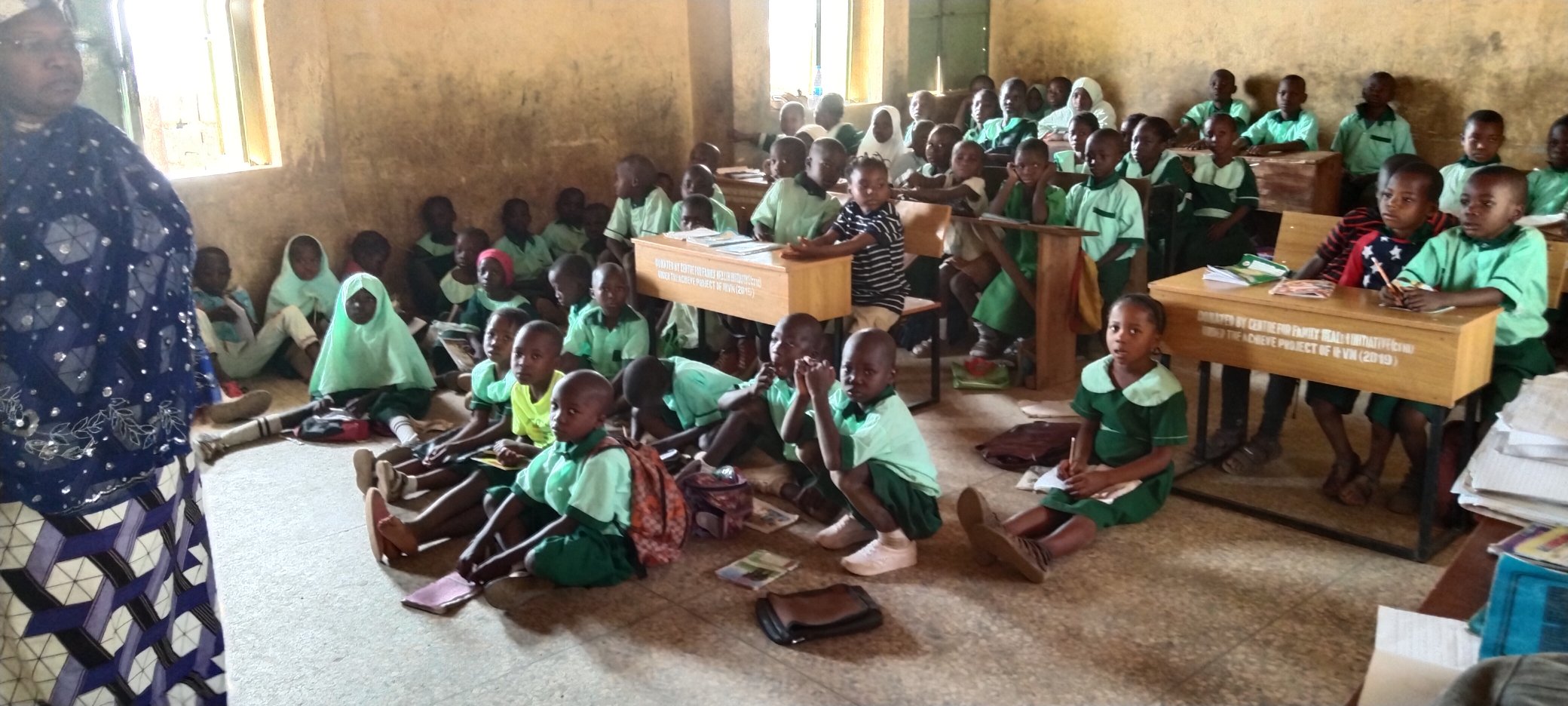
The United Nations Educational, Scientific and Cultural Organisation (UNESCO) and Nigeria’s Federal Ministry of Education have jointly recommended clear standards for classroom sizes across the country — standards that many public and some private schools are now struggling to meet.
According to the National Policy on Education (2013), which aligns with UNESCO’s international guidelines, a standard classroom in Nigeria should not exceed 25 pupils at the pre-primary level, 35 pupils at the primary level, and 40 students at the secondary level.

UNESCO’s global recommendation averages one teacher to 30 pupils for effective basic education. However, investigations by NewsClick Nigeria revealed current realities in many Nigerian schools paint a different picture. In some urban and rural areas alike, classrooms hold as many as 60 to 100 learners, forcing teachers to improvise and manage beyond capacity.
A study conducted by the University of London pointed out that teachers “feel there is a moral imperative operating at the heart of their work – every child has the right to the attention and support which they need. This is difficult to attain under all circumstances and create a tension for the teacher, which increases as class size grows.”
Failure to achieve the ideal of meeting every pupil’s needs produces negative feelings towards the teachers’ works with the university’s study adding, “The size of the class contributes to the severe criticism which some teachers express about their own teaching.
“In a sense, once the class size passes a certain point, the teachers are bound to ‘fail’ because the demands on their time cannot be met,” the report stated.
Overcrowding makes learning mechanical rather than meaningful – Stakeholders
Education experts and stakeholders who spoke with NewsClick Nigeria could not conclude less from the foregoing. According to them, In line with the foregoing, overcrowding undermines teaching quality, hinders individualized attention, and fuels student indiscipline.
“When a class exceeds 40 students, teachers lose control and students lose focus,” said Dr. Akinbobola, an experienced education consultant based in Lagos. “Learning becomes mechanical rather than meaningful.”
Reports from the Federal Ministry of Education also highlight that most states, particularly in the South-West and North-Central regions, are grappling with infrastructure shortages and teacher deficits. Many schools operate with limited classrooms, leading to the merging of streams and overstretching of facilities.
A recent UNESCO review emphasized that overcrowded classrooms not only reduce learning efficiency but also increase teacher burnout and student absenteeism. The agency insists that countries like Nigeria must invest in classroom construction, digital tools, and teacher recruitment to meet the Sustainable Development Goal 4 (SDG-4) — which seeks to ensure inclusive and equitable quality education for all by 2030.
Across Nigerian schools, classrooms designed for 30 pupils now hold twice or even thrice that number. From the nation’s capital (Abuja) to Ogun to Lagos, and down to Uyo, teachers and education experts are raising alarm over worsening overcrowding — a crisis that is crippling effective teaching and learning in both public and private institutions.
In Ogun State, Mrs. Akinwunmi, a public primary school teacher, says she teaches about 45 pupils in one class — a number she describes as “beyond what one teacher can effectively manage.” The tight space, she explains, makes it hard to move freely or attend to every child.
“Sometimes, I can’t even walk between desks,” she laments. “The children sit too close, and I can’t give each of them the attention they deserve.”
According to her, overcrowding stems from a shortage of teachers, lack of classrooms, and Nigeria’s growing population. The impact, she adds, is far-reaching — from increased teacher workload to health risks among pupils.
“When a class is overcrowded, teaching slows down, and some learners are neglected. Diseases spread faster too,” she says.
While large classes may encourage teamwork and group projects, she insists the disadvantages outweigh the benefits. Her coping strategies include setting class rules and enforcing discipline, but she admits it’s only a temporary solution.
“The government must build more schools, provide digital facilities like projectors, and employ more teachers,” she appealed.
President of the Institute for Governance and Economic Transformation, Kingsley Moghalu in a recent submission said inadequate financing is one of the major challenges the education sector faces.
“The World Bank and UNESCO have disclosed that a minimum of 20 percent of teachers in public basic education institutions in Nigeria lack the necessary qualifications,” he said.
Moghalu also pointed out that the quality of Nigeria’s education system suffers due to poor infrastructure.
“The classroom environment should encourage active participation, inquiry-based learning, and critical reflection while also fostering student engagement through cooperative learning structures, Socratic questioning techniques, and experiential activities.”
We’re teaching nearly 80 students in a room meant for 40 – Teachers
In Lagos, Mr. Adewale, a secondary school teacher, faces an even tougher challenge — seventy-eight students packed into a classroom designed for forty. Some students share desks, while others stand.
“We can’t give proper attention to slow learners,” he explains. “Marking assignments takes forever, and maintaining discipline is almost impossible.”
His colleague, Mrs. Okonkwo, who teaches senior secondary students, has about eighty-five learners in her class. The noise, she says, is deafening.
“Sometimes I spend more time shouting to control the class than actually teaching,” she admits, her voice weary. “It’s physically draining.”
Both teachers attribute the crisis to inadequate infrastructure and rapid population growth. They called for more classrooms, teacher recruitment, and even a shift system in congested schools.
“Until facilities match the number of learners, teaching will remain a struggle,” says Mr. Adewale.
Speaking further, Dr. Akinbobola warns that overcrowding is not just a challenge but a violation of best practices.
“A normal class should not exceed twenty students if learning is to be effective,” she noted.
She blames both private and public institutions. Many private schools, she explains, operate from converted residential buildings with limited space, while public schools suffer from underfunding and unchecked enrolment.
“An overcrowded classroom is not learner-friendly,” she cautions. “It encourages mismanagement, fatigue, and poor academic performance.”
Her solution? Stricter monitoring and penalties for schools that exceed approved class capacities, combined with government investment in infrastructure and teacher training.
School heads provide temporary relief with public address systems
In another Lagos school, Mrs. Nkocha, headmistress of Emmanuel Nursery and Primary School, manages 45 to 50 students per class. She describes the situation as “draining and disheartening.”
“You can’t give every child individual attention,” she says. “It becomes a battle to maintain order, not to mention keeping them all engaged.”
Her coping strategies include grouping pupils for discussions and using peer teaching, but she admits these efforts barely scratch the surface. She recommends more classrooms, better funding, and teacher recruitment.
Similarly, Mrs. Nwachukwu, principal of Mustard Seed School in Ikotun, says overcrowding combines poor ventilation with limited resources.
“It’s difficult to manage so many students with different behaviors in one space,” she says. “We’ve had to divide classes into groups and assign student leaders.”
She advocates for admission quotas, class streaming, and stricter control of enrolment numbers.
For Mrs. Adebowale, Principal of Ijegun High School, the situation is dire.
“We sometimes have up to a hundred students in one class,” she confides. “That’s not teaching — that’s crowd control.”
To cope, her school uses sound systems for better audibility and employs hands-on group discussions. She believes combining multiple teaching methods helps sustain engagement even in such crowded settings.
Corps Member’s Perspective: “It’s Exhausting, But Competition Keeps Students Active”
In Uyo, Akwa Ibom State, Mr. Adebayo Akorede, a National Youth Service Corps (NYSC) member teaching at a community secondary school, says each of his three classes has about fifty students.
“Overcrowding causes distraction and fatigue,” he says. “But one good thing is that it creates healthy competition among learners.”
To manage attention, he positions himself centrally in class, uses storytelling, and asks challenging questions to keep students alert. His school, he says, is renovating abandoned rooms to create more learning spaces. He recommends expansion, more teachers, and shift systems for densely populated schools.
For Miss Oyindamola, a class teacher at Mission Height Nursery and Primary School, Ijegun, smaller is better. Her class of fifteen to twenty pupils represents what she calls the “ideal range” for meaningful learning.
“When a class gets too big, young children suffer the most,” she explains. “They need one-on-one attention, and overcrowding takes that away.”
Her school enforces strict admission limits and assigns teaching assistants to support large classes. She urges other schools to do the same.
“It’s not about how many students you have, but how well they learn,” she insists.
Political class responsible for poor education state in Nigeria – NUT
Meanwhile, the National Union of Teachers (NUT) has heaped blames for dwindling education standards on th political class.
Secretary General of the Union, Dr Mike Ene, decried the failure of some states to access the fund set aside by the Universal Basic Education Commission (UBEC).
Ene in a recent interview with The PUNCH said: “When you want to fix a problem, you do not start from the middle but you go to the root. Now we understand that the Senate is probably looking at the issue of out-of-school children but even if you want to bring those children back to the classroom where do you want to fix them?
“The statistics available will shock you. We have congested classrooms, dilapidated buildings, teachers who are not well-paid, and the likes.
“When I was a board member of UBEC, you would see the funds set apart by the Federal Government and then states would not pay their counterpart funds to access this intervention fund. How will classrooms be fixed? Some states don’t even care and they feel that nothing will happen.’’
“In Nigeria, the statistics on out-of-school children are very scary. Even when you go to war-torn countries, I doubt you will have such figures. We can no longer afford to neglect education, particularly at the basic level.’’
What we are doing to reduce overcrowding in schools – FG, Lagos Government
The Federal Ministry of Education has announced that it intends to reduce and subsequently eliminate the menace of overcrowding in schools by automating the admission quota so schools do not admit more than they can cater for at every academic session.
The government said it is starting with its 110 Federal Unity Colleges across the country. It noted that admission into the colleges are now fully automated and must be conducted strictly within the approved carrying capacity of each school.
In a statement on September 5, the ministry said the move was part of efforts to curb sharp practices, ensure transparency, and promote merit-based selection in the admission process.
It explained that the automated system would eliminate manual interference, reduce irregularities, and guarantee fairness for all applicants seeking placement into Junior Secondary School one (JSS1) in the colleges.
According to the ministry, the era of admitting students above the approved capacity — a practice that often resulted in congestion and overstretched facilities — has come to an end.
The statement read in part, “All admissions into Federal Unity Colleges will henceforth be processed through the automated system and limited strictly to the carrying capacity of each school. This is to maintain quality teaching and learning while upholding the integrity of the process.”
The ministry also urged parents and guardians to resist attempts by individuals or groups to influence admission outside the automated platform, warning that violators would be sanctioned.
The Lagos State Government on its part said it has commenced the maiden NEEDS Assessment Project for all public primary schools across the state.
According to a statement on by the Deputy Director, Information, Lagos State Universal Basic Education Board (LASUBEB), Abe Adunola, the initiative, spearheaded by the Board was unveiled during a stakeholders’ engagement session.
The NEEDS Assessment Project is an evidence-gathering exercise designed to identify gaps in infrastructure, teaching capacity, and learning resources in public schools. It provides government with data to plan targeted interventions and allocate resources more effectively.
According to the board, the project will cover 1,238 public primary schools, vocational centres, inclusive units, and Local Government Education Authorities.
Board member of LASUBEB, Owolabi Falana, said the exercise was a major step in strengthening the foundation of basic education in Lagos.
Delivering the keynote address on behalf of the Deputy Chief of Staff, the Executive Assistant to the Governor on Project Implementation and Monitoring, Mr. Olusegun Sanwo-Olu, noted that the initiative reflected the state government’s resolve to drive education reform with data-driven interventions.
“This project is about clarity and intentionality. By understanding the realities in our schools, we are laying a solid foundation for smart planning, equitable resource allocation, and sustainable reforms. It is a bold step that will ultimately improve the quality of teaching, enhance learning outcomes, and prepare Lagos children to thrive in this fast-changing world,” he said.
LASUBEB Chairman, Dr. Hakeem Shittu, described the initiative as the first in a series of continuous exercises aimed at transforming Lagos public schools.
“This maiden edition of the Needs Assessment Project is only the beginning. It will be sustained as a continuous initiative to ensure our schools, teachers, and learners are never left behind,” he affirmed.
Highlighting the project’s benefits, Shittu explained that the assessment would lead to safer classrooms, improved facilities, empowered teachers, and better learning outcomes for pupils.
“The future of Lagos depends on how much we invest in our children today. This initiative gives us the clarity and direction to act decisively,” he said.
He further stressed that the project was not only about identifying gaps but also about developing practical solutions that would create conducive learning environments, improve teachers’ working conditions, and strengthen administrative capacity across schools.
Shittu also commended the contributions of teachers, administrators, and Local Government Education Authorities, while emphasising collaboration with the Project Implementation and Monitoring Unit for credible data collection.
He urged teachers, parents, and community leaders to support the exercise.