

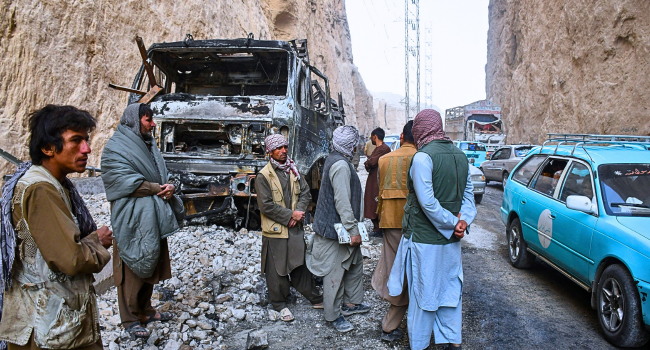
At least 20 people have died after a strong earthquake struck northern Afghanistan overnight, officials confirmed on Monday. The disaster comes only months after another powerful tremor left the country struggling to recover.
According to the US Geological Survey, the 6.3-magnitude earthquake occurred at a depth of 28 kilometres (17 miles), with its epicentre near the city of Mazar-i-Sharif.

Health ministry spokesman Sharafat Zaman said, “So far, 534 people have been injured, and more than 20 bodies have been taken to hospitals in Samangan and Balkh provinces.”
Residents of Mazar-i-Sharif, one of Afghanistan’s major northern cities, fled into the streets in panic. The city’s historic Blue Mosque, a 15th-century landmark celebrated for its vivid blue tiles, sustained serious damage as parts of its minaret collapsed.
The tremor was also felt in Kabul, around 420 kilometres to the south. Poor communication networks and weak infrastructure have once again hindered rescue efforts, leaving emergency workers struggling to reach remote mountain villages.
The Taliban’s defence ministry announced that it had reopened the main road linking Mazar-i-Sharif and Kholm after clearing debris and rescuing people trapped overnight. “Many homes have been destroyed, causing major material losses,” said deputy spokesman Hamdullah Fitrat on X.
This latest earthquake adds to a series of natural disasters that have struck Afghanistan since the Taliban took power in 2021. The government has faced three major quakes during a time when international aid — once a key lifeline for the economy — has sharply declined.
In August, a shallow 6.0-magnitude quake in eastern Afghanistan destroyed entire villages and killed more than 2,200 people, with the World Bank estimating damages at $183 million.
Earthquakes frequently hit Afghanistan, particularly along the Hindu Kush mountain range, where the Eurasian and Indian tectonic plates collide. Recent quakes in Herat (2023) and Nangarhar (2022) killed hundreds and left thousands homeless.
Many Afghan homes, especially in rural areas devastated by decades of war, are poorly built and unable to withstand major tremors. The country is also battling a worsening humanitarian crisis marked by drought, economic sanctions, and the forced return of refugees from Iran and Pakistan.
The United Nations and aid agencies have repeatedly warned that hunger and poverty are deepening across Afghanistan.