

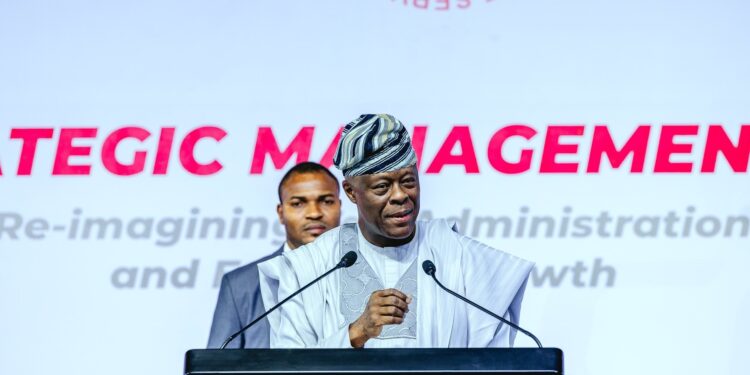
The minister of finance, Wale Edun, has said Nigeria’s financial markets remain stable following the United States’ air strikes on Islamic State (ISIS) terrorists in Sokoto.
On December 25, residents of parts of Sokoto and Kwara states reported explosions around the same time the US carried out the air strikes.

In a statement issued on Sunday, the minister said both domestic and international debt markets are steady and operating efficiently, attributing this to prudent fiscal management.
“Our financial markets remain resilient. Domestic and international debt markets are stable and functioning efficiently, supported by prudent fiscal management,” he said.
Addressing recent enquiries over the joint Nigeria–US security operation conducted in Sokoto on Christmas Day, Edun reassured investors, analysts and multilateral partners “that Nigeria is not at war with itself, nor with any nation”.
“What Nigeria is decisively confronting—alongside trusted international partners—is terrorism. This distinction is important, and it is fundamental to understanding the positive economic implications of recent actions,” Edun said.
“The operation in question was precise, intelligence-led, and focused exclusively on terrorist elements that threaten innocent lives, national stability, and economic activity.”
He explained that such actions do not unsettle markets or undermine confidence, but rather reinforce peace, safeguard productive communities and strengthen the conditions necessary for sustainable growth.
“Security and economic stability are inseparable; every effort to safeguard Nigerians is, by definition, pro-growth and pro-investment,” Edun said.
“Under the leadership of President Bola Ahmed Tinubu, GCFR, Nigeria has made tangible and measurable progress on both security and economic reform. These gains are evident in our macroeconomic performance. In the third quarter of 2025, Nigeria recorded GDP growth of 3.98%, following a strong 4.23% growth in Q2.
“We expect a stronger Q4 2025 GDP performance. Inflation has decelerated for the seventh consecutive period and is now below 15%, reflecting improving price stability and the effectiveness of coordinated fiscal and monetary actions.”
The minister also noted that Nigeria has, within the past year, secured credit rating upgrades from Moody’s, Fitch and Standard & Poor’s, describing them as “clear, independent endorsements of the strength of our reforms and the credibility of our economic direction”.
“We have maintained fiscal discipline, prioritised efficiency, and protected macroeconomic stability—demonstrating resilience in the face of external shocks,” he said.
Referencing President Bola Ahmed Tinubu’s recent address, Edun said the administration’s core objective for 2026 is to consolidate the gains of 2025, deepen economic resilience and continue building a sustainable, inclusive and growth-oriented economy.
“As markets reopen on Monday, 29 December 2025, investors can be confident that Nigeria remains focused, reform-driven, and committed to stability,” he said.
Edun added that Nigeria’s economic fundamentals are improving, policy direction remains clear, and the government’s resolve to protect lives, secure prosperity and grow the economy is unwavering, stressing that the country remains open for business and firmly focused on the future.