

In 2025, Nigeria’s political landscape was marked by heightened tensions, worsened insecurity, a US military threat, the imposition of emergency rule in Rivers State, and unprecedented defections of governors from the opposition Peoples Democratic Party (PDP) to the ruling All Progressives Congress (APC).
Despite these challenges, the country’s democracy endured throughout the year.

Worsening Insecurity
Nationwide insecurity escalated with frequent attacks on military facilities and civilians by terrorists and bandits. In June, herdsmen attacks in Benue State forced President Tinubu to reschedule his Kaduna visit and instead travel to Benue, following the massacre in Yelwata Community, Guma LGA. Tinubu paid a condolence visit on June 18 and directed service chiefs to arrest the perpetrators. He also met with stakeholders—including traditional rulers, political and religious leaders, community leaders, and youth groups—to seek lasting solutions.
In the North-east, Brig. Gen. Musa Uba was killed by ISWAP while in captivity, days after his abduction during an ambush in Borno that also claimed four soldiers’ lives. Meanwhile, banditry surged in the North-west despite ongoing military efforts.
US Military Operation in Nigeria
Among the most significant international developments was US President Donald Trump’s threat of military intervention, later executed as precision airstrikes against terrorists in Sokoto State. Trump had previously labeled Nigeria a “country of particular concern” (CPC) over alleged religious-freedom violations, criticizing the federal government for failing to protect Christians. He claimed the US military executed flawless strikes against ISIS terrorists in collaboration with the Nigerian government. President Tinubu rejected the allegations and dispatched a delegation led by NSA Mallam Nuhu Ribadu to engage US officials.
Rivers State Emergency Rule
On March 18, President Tinubu imposed emergency rule in Rivers State, suspending Governor Siminalayi Fubara, his deputy Prof. Ngozi Nma Odu, and state legislators, appointing Vice Admiral Ibok-Ete Ibas (rtd) as administrator. The move sparked political turbulence as Fubara and PDP governors challenged the action in the Supreme Court. The apex court later upheld the president’s power to declare an emergency under Section 305 of the 1999 Constitution but remained silent on the suspension of the state officials.
Senator Natasha Akpoti-Uduaghan’s Suspension
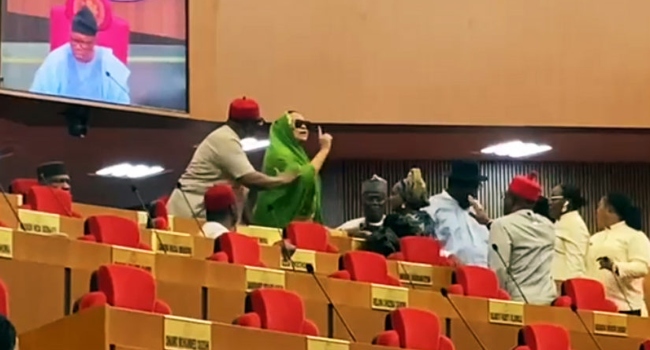
In 2025, the Senate suspended Senator Natasha Akpoti-Uduaghan for six months over a dispute with Senate President Godswill Akpabio, following her allegations of sexual harassment. She returned to office on September 23, 2025, describing the suspension as “illegal.” The Federal High Court later ruled the suspension “excessive,” but did not order her immediate reinstatement.
Joash Amupitan as INEC Chairman
Following the expiration of Prof. Mahmood Yakubu’s tenure, President Tinubu appointed Prof. Joash Amupitan (SAN) as INEC Chairman, entrusting him with overseeing presidential, governorship, and legislative elections, including preparations for the 2027 general election.
Opposition Parties in Disarray
The PDP became further factionalized, while the Labour Party (LP) also split into rival factions, weakening the opposition ahead of 2027. Many opposition politicians joined the African Democratic Congress (ADC), reflecting the growing advantage of the APC.
Defections and Fear of One-Party Rule
A wave of defections saw the PDP lose almost all its governors. Key defections included Delta’s Sheriff Oborevwori, Akwa Ibom’s Umo Eno, Enugu’s Peter Mbah, Bayelsa’s Douye Diri, Taraba’s Agbu Kefas, Rivers’ Siminalayi Fubara, and Plateau’s Caleb Mutfwang. Opposition figures alleged these defections were motivated by EFCC investigations and warned of President Tinubu’s alleged push for a one-party state.
Anambra State Governorship Election
The November 8 election in Anambra State, the first major poll under Prof. Joash Amupitan, saw APGA’s Gov. Chukwuma Soludo re-elected with 422,664 votes, defeating APC’s Prince Nicholas Ukachukwu (99,445 votes) and other candidates, including ADC and PDP contenders.
Ambassadors Appointed
President Tinubu ended a two-year diplomatic stalemate by appointing 64 ambassadors (34 career, 30 non-career), addressing concerns that Nigeria’s non-appointment of envoys contributed to the CPC designation by the US.
Overall, 2025 was a year of heightened political turbulence, insecurity, and shifting alliances, yet Nigeria’s democratic framework remained resilient amid the challenges.