

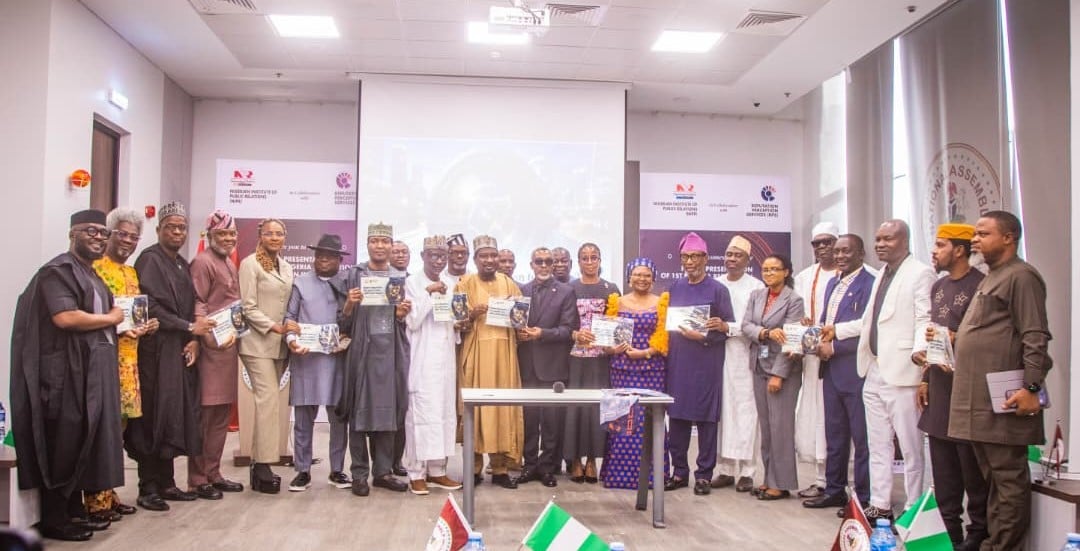
The Nigerian Institute of Public Relations (NIPR) has unveiled the Nigeria reputation perception index (RPI) report, the first comprehensive assessment of the country’s reputation.
Presented at the national assembly library complex in Abuja on Thursday, the report, which took seven years to produce, surveyed 3,911 respondents across 36 countries.

The index assessed Nigeria’s reputation across seven pillars—culture, social equity, leadership, innovation, performance, communication and credibility.
Credibility emerged as the weakest pillar for the country, with an RPI score of 28.1.
The report said Nigeria recorded an overall RPI score of 35.2, placing the country in a low-trust reputation band.
“The overall RPI score of 35.2 places Nigeria in a low-trust reputation band, signalling significant confidence gaps relative to the country’s scale, visibility, and potential,” the report reads.
It said there is a 9.6-point gap between the domestic and international perception of Nigeria.
“The 9.6-point gap between domestic and international perception suggests that external audiences apply more stringent evaluation criteria, particularly around credibility and performance delivery,” the report added.
Culture ranked highest among the seven pillars, with an RPI score of 48.7.
Barau Jibrin, deputy senate president, described the unveiling of the report as a historic step for evidence-based governance.
“How a nation is perceived by its citizens, investors, development partners, and the global community directly influences its economic opportunities, diplomatic leverage, social cohesion, and democratic legitimacy,” Barau said.
He said countries that deliberately manage their reputation are better positioned to attract investment, tourism, and global partnerships.
“It is therefore both timely and commendable that Nigeria has taken this bold step to systematically assess how it is perceived across key dimensions such as governance, economy, security, institutions, culture, innovation, and social trust,” he said.
Barau said the index provides lawmakers with credible data to guide legislation, oversight, and representation.
“Evidence-based reports such as this empower legislators to draft responsive laws, strengthen institutional frameworks, and demand accountability where it matters most,” he said.
He said improving Nigeria’s reputation requires collective responsibility across government institutions and society.
“Reputation is ultimately built from lived realities; it is shaped by the quality of leadership, the integrity of institutions, the consistency of public policies, and the everyday experiences of citizens,” Barau said.
He said the index should be seen as a tool for reform rather than blame.
“Constructive self-assessment is the hallmark of mature democracies, and Nigeria must not shy away from honest conversations about its national image and the underlying realities that shape it,” he added.
Earlier, Ike Neliaku, president of the NIPR, said reputation is a strategic national asset.
“Reputation is the invisible force that shapes investment decisions, borrowing costs, tourism confidence, and global trust,” Neliaku said.
He said the report represents Nigeria’s first measurable and evidence-based reputation baseline.
“For the first time, Nigeria now has a measurable reputation baseline, based on evidence, not assumptions,” the NIPR president said.
“This index repositions reputation as a strategic national asset that should inform public policy, diplomacy, investment attraction and genuine national rebranding.”
Neliaku also defended the federal government’s decision to engage foreign lobbyists amid criticism of a reported $9 million contract with a United States-based firm.
“Lobbying is not a criminal offence,” he said.
“For the World Public Relations Forum, those who we are hiring to lobby for us will now come here from 126 countries, and that is the greatest lobbying because when they return home, they go back with first-hand impressions of what they have seen,” Neliaku added.
Joe Keshi, former Nigerian ambassador to the United States and national president of the Association of Retired Career Ambassadors of Nigeria, was the keynote speaker at the event.
Keshi said national reputation is a critical but often neglected asset.
“In a globalised world where perception travels faster than reality, national reputation matters as much as national resources or military strength,” he said.
“You cannot leave your reputation to chance; it must be deliberately built, protected and managed.”
He said Nigeria’s declining image has weakened its diplomatic influence, citing security concerns, visa restrictions, and global criticism.
He said the inability to maintain world-class infrastructure, including FIFA-approved stadiums, reinforces negative perceptions despite strong sporting performances.
