

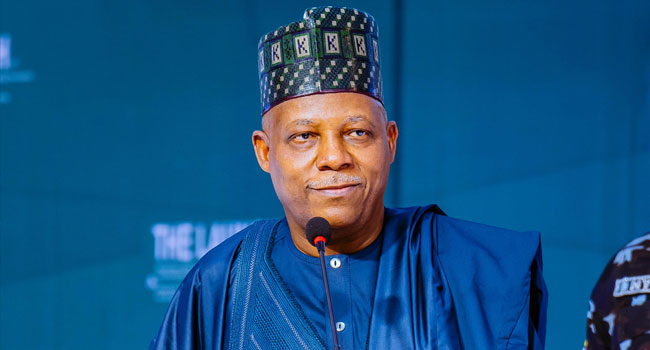
A chieftain of the All Progressives Congress (APC) and security expert, Abayomi Nurain Mumuni, has cautioned against any attempt to replace Vice President Kashim Shettima on religious grounds ahead of the 2027 general elections, arguing that the North currently lacks a Christian candidate with the political influence and following necessary to deliver significant electoral support.
Mumuni, who was part of the intelligence and security team of the Tinubu/Shettima Presidential Campaign Council (PCC) during the 2023 election, said such a move could weaken the APC’s chances of retaining power.

He made the comments on Wednesday in response to controversies surrounding the omission of Vice President Shettima’s photograph from a banner displayed at the North-East Zonal Public Hearing on the amendment of the APC constitution. The incident has sparked speculation about a possible plan to remove Shettima from the party’s 2027 presidential ticket.
According to Mumuni, discussions about replacing Shettima with a Christian vice-presidential candidate, reportedly to address concerns about religious inclusivity, are not strategically viable at this time. He emphasized that the northern region currently lacks a Christian candidate with sufficient grassroots backing and nationwide appeal to complement President Bola Ahmed Tinubu’s electoral strength.
“Any miscalculation in this regard could jeopardise the winning ticket for the current administration,” he warned, adding that electoral arithmetic, rather than sentiment, must guide such high-stakes political decisions.
Mumuni also highlighted Vice President Shettima’s “unwavering loyalty and commitment” to President Tinubu and the administration’s policy objectives, describing it as a key stabilizing factor in governance. He argued that replacing a vice president who has demonstrated consistency and alignment with the president’s vision could create unnecessary uncertainty in the political system.
While recognizing that calls for greater Christian representation in leadership are legitimate and well-intentioned, the APC stalwart urged party leaders to pursue alternatives that would not weaken the existing political alliance. He suggested that inclusivity could instead be strengthened through strategic appointments of credible individuals with proven influence, competence, and commitment to national unity and development.
Mumuni further warned against applying foreign political models, such as the United States under former President Donald Trump, noting that Nigeria’s socio-political context is unique and requires locally tailored solutions.
He outlined several risks of changing the vice president, including threats to political stability, mixed public perception, internal party divisions, and potential loss of electoral advantage. A new vice president, he explained, could face challenges regarding acceptance, loyalty, and alignment with the president’s agenda, all critical to effective governance.
He added that such a transition could also affect policy direction and administrative efficiency, as a new vice president would need time to adapt to the responsibilities of office, potentially slowing governance during a crucial period.
Mumuni maintained that preserving the Tinubu–Shettima alliance remains the most prudent choice as preparations for the 2027 elections advance. He called for constructive dialogue within the APC on enhancing representation and inclusivity without compromising political stability and effective governance.
“Maintaining cohesion and focusing on good governance will best serve Nigeria’s interests,” he said, urging party stakeholders to prioritize unity and strategic thinking over divisive speculation.
