

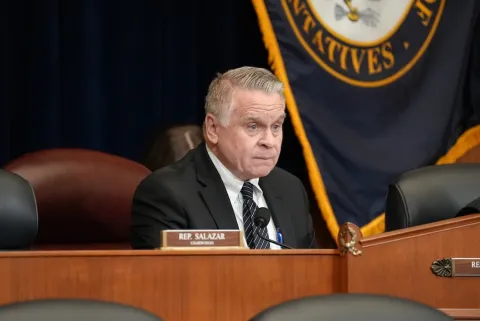
United States lawmakers on Wednesday revisited concerns about religious freedom in Nigeria during a congressional hearing held in Washington DC.
The session focused on countries where lawmakers believe religious freedom is under threat, a description Nigerian authorities have consistently rejected.

Referencing Genocide Watch, Chris Smith, chairman of the House Foreign Affairs Africa subcommittee, described Nigeria as “a killing field of defenceless Christians”.
“That wrong in our foreign policy has been righted with the President’s CPC designation. We commend and thank him for that action,” Smith said.
Although Smith acknowledged that Nigeria has taken “small steps” toward improving religious freedom, he criticised recent lobbying efforts aimed at influencing the US government.
In December, Nigeria engaged DCI Group, a lobbying firm, under a $9 million contract to help communicate its efforts to protect Christians to US officials.
During the same period, Matthew Tonlagha, vice-chairman of Tantita Security Services, hired Valcour Global Public Strategy, a Washington-based lobbying firm, for the “purpose of strengthening the bilateral relationship” between Nigeria and the United States.
Smith argued that the lobbying arrangements showed that “a culture of denial by Nigerian officials persists”.
“I am deeply concerned that Nigeria has hired the K-Street lobbying firm DCI to the tune of $9 million (that’s $750,000 a month) and a Nigerian billionaire has entered into a $120,000-a-month contract with Valcour to influence Congress and the Executive Branch,” he said.
“They hire these firms; they come up with their very well-written talking points to say nothing to see here, and unfortunately, how these firms are just so good at advocating for their client for religious freedom.”
Joaquin Castro, another lawmaker, questioned the impact of US military strikes carried out in Nigeria last year.
He accused the President Donald Trump administration of using “protecting Christians” as a justification for the strikes while “cutting assistance that would actually address discrimination against religious communities”.
Lawmakers also debated Nigeria’s continued CPC redesignation, with some describing it as largely a “name and shame” measure without concrete consequences, while others argued that it has helped refocus “attention on Nigeria”.