

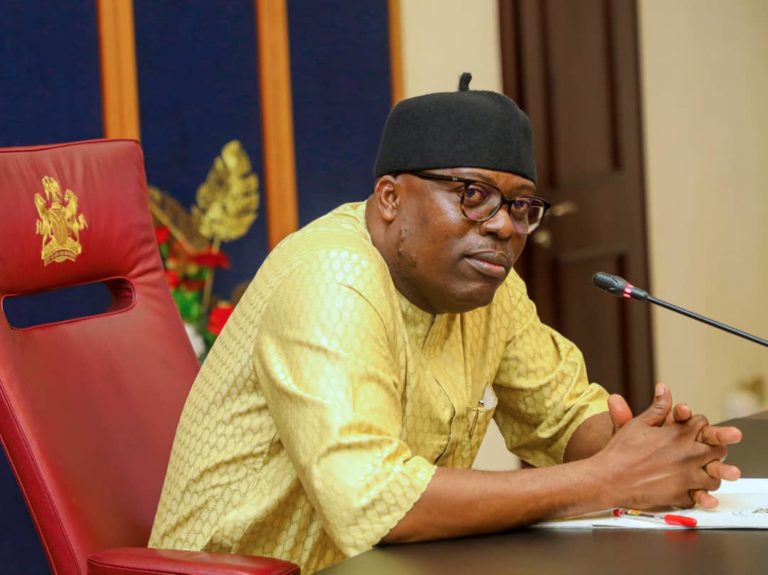
The Rivers State House of Assembly has suspended impeachment proceedings against Governor Siminalayi Fubara and his deputy, Ngozi Odu.
The Assembly reached the decision during Thursday’s sitting after legal and political complications stalled the process, pending the resolution of ongoing court cases and consultations.

In January, lawmakers commenced impeachment proceedings against the governor and his deputy over allegations of gross misconduct.
During plenary, presided over by Speaker Martins Amaewhule, Majority Leader Major Jack presented a notice outlining seven allegations against Fubara under Section 188 of the Nigerian Constitution.
The allegations included demolishing the Assembly complex, engaging in extra-budgetary expenditure, withholding funds allocated to the Assembly Service Commission, and defying a Supreme Court ruling on the legislature’s financial autonomy.
Twenty-six lawmakers endorsed the notice, which they intended to forward to the governor. Deputy Leader Linda Stewart also submitted allegations against Odu, accusing her of unconstitutional spending, obstructing the Assembly’s activities, approving budgets through unauthorised channels, and withholding salaries and allowances.
The impeachment effort, which began in early January 2026, soon encountered judicial hurdles.
Rivers State Chief Judge, Simeon Chibuzor-Amadi, declined the Assembly’s request to constitute the constitutionally mandated seven-member investigative panel, citing an existing interim injunction issued by the Rivers State High Court.
Justice Florence A. Fiberesima granted the restraining order on 16 January 2026, barring the Chief Judge, the Speaker and the Clerk from taking further steps on the impeachment, following suits filed by the governor and his deputy challenging the legality of the process.
Meanwhile, the Rivers State chapter of the All Progressives Congress (APC) rejected the impeachment proceedings, describing the move as “destabilising and unnecessary.” The development also attracted reactions from various political stakeholders and Nigerians.
Brokered Peace
Last week, reports indicated that the President held a closed-door meeting at the Presidential Villa with Fubara and the Minister of the Federal Capital Territory (FCT), Nyesom Wike, the governor’s political mentor. Fubara also reportedly accompanied Wike to his residence in Guzape, Abuja.
Wike later confirmed the meeting and stated that the President initiated it as part of renewed efforts to resolve the political crisis in Rivers State.
He disclosed that the meeting took place on Monday, 9 February. According to Wike, the President intervened to broker peace between the governor and state lawmakers.
Expressing gratitude for Tinubu’s intervention, Wike voiced optimism that the move would restore lasting peace. He noted that it marked the second time the President had stepped into the dispute and expressed “hope it would be the last.”
The discussions followed shortly after lawmakers believed to be loyal to Wike issued a third impeachment notice against Fubara.
Precedent
The crisis has reignited longstanding political tensions in the state.
This represents the second attempt to impeach Fubara and Odu. A similar effort in March 2025, triggered by a rift between the governor and his predecessor, Wike, escalated into a significant political crisis.
That confrontation prompted President Tinubu to declare a state of emergency, suspend the governor, deputy governor and lawmakers for six months, and appoint Ibokette Ibas as sole administrator.
Fubara later resumed office following a political reconciliation involving him, Wike and members of the legislature.
The political landscape shifted further in December when Fubara defected from the Peoples Democratic Party (PDP), the platform on which he secured election in 2023, to the ruling party.