

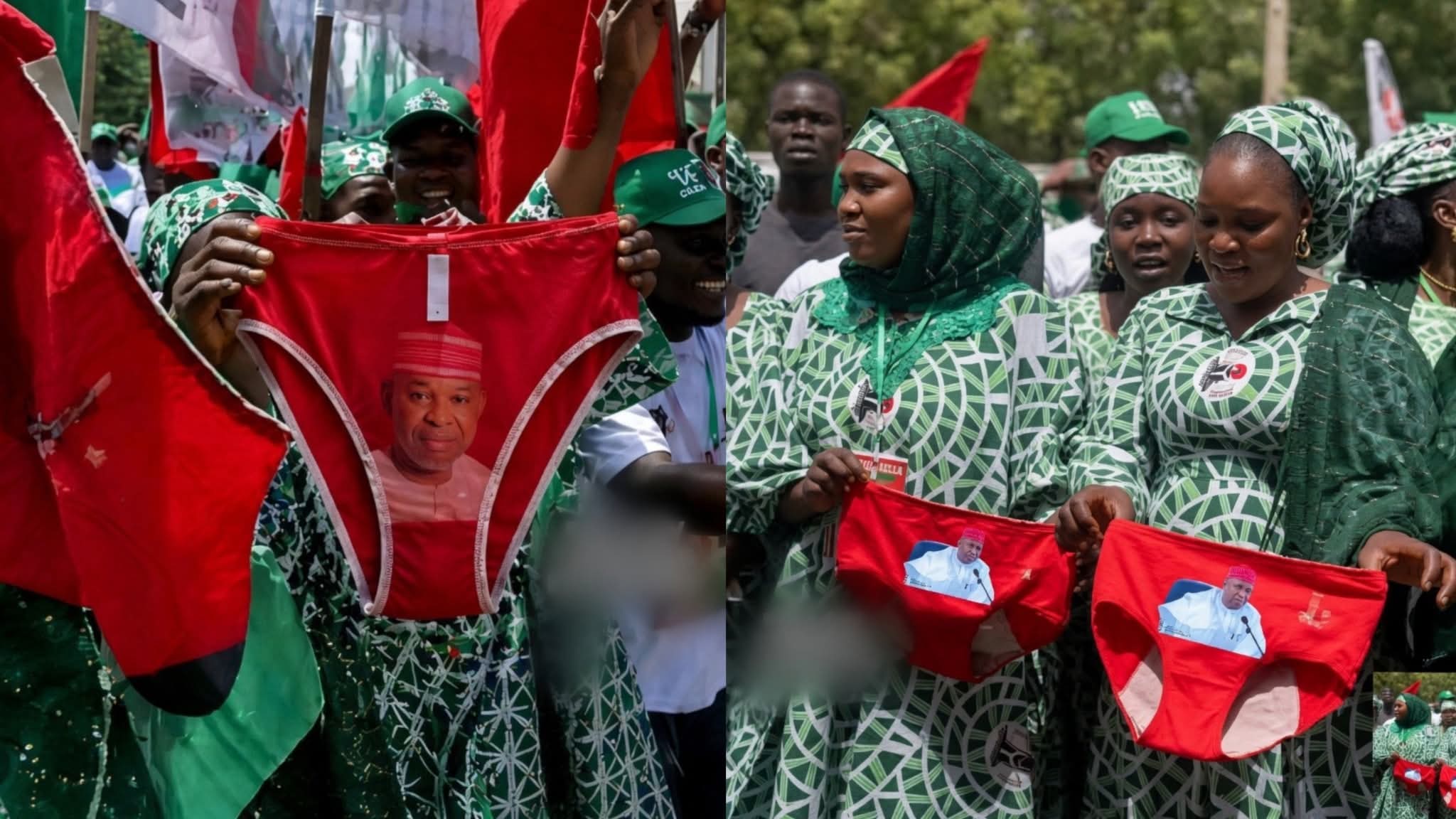
A widely circulated post on social media claims that the Kano State Government distributed pants to women as part of an empowerment initiative or campaign giveaway.
The allegation is supported by images showing women holding red underwear, with captions implying that the items were officially distributed by the government.

Findings
Given the sensitivity of the allegation and the already charged political atmosphere in Kano State, Daily Trust undertook a verification exercise.
FACT CHECK: Did Kano Government Distribute underwear to Women as Empowerment Gifts?
Image Verification (ELA Analysis)
Error Level Analysis (ELA), a forensic method used to identify image manipulation, was applied to the viral images.
In a standard, unedited image, most areas display consistent levels of brightness or “noise” due to uniform compression.
However, in the suspected altered image, a distinctly brighter patch appears on the pants. This irregularity indicates that part of the image may have been edited or inserted separately before recompression.
In contrast, the original version shows more consistent brightness and noise levels across the same area, suggesting no modification.
In simple terms, the bright patch in the viral image raises suspicion, indicating that the photograph was tampered with.
Further forensic examination confirms that the original image was altered to include an image of Governor Abba Kabir Yusuf, thereby creating the false impression that he personally distributed the underwear.
Source of the Viral Content
Investigations reveal that the images were taken from a viral video featuring supporters of Governor Abba Kabir Yusuf, commonly referred to as Gida-Gida TikTokers.
The footage was recorded during the visit of Nigeria’s First Lady, Senator Oluremi Tinubu, to Kano on Thursday.
In the video, the group is seen displaying red pants outside the Kano Government House while singing songs mocking Senator Rabiu Musa Kwankwaso. They repeatedly used the phrase “Dan kamfan tsula” (loosely translated as “Tsula’s pants”).
“Tsula,” a Hausa term for a small monkey, is frequently used as a derogatory expression in local political discourse targeting Kwankwaso. The term gained traction through songs by APC praise singer Dauda Kahutu Rarara.
Narrative Distortion
The video reportedly emerged via a TikTok influencer known as Teemah Cool, a leading figure among the Gida-Gida TikTokers. It quickly sparked criticism, particularly from Kwankwaso’s supporters, who described the act as indecent and indicative of declining political standards.
Teemah later defended her actions, stating she had no regrets about leading the display. She maintained it was a reaction to earlier conduct by Kwankwasiyya supporters, who had publicly waved wrappers while chanting “Falle daya ce” (suggesting Governor Yusuf would serve only one term).
Public Reactions
A Facebook user, Wali Halliru Habib, defended the act, writing:
“We will chant it again, Tsula’s pants… Just because we said Tsula’s pants and you are saying we are wrong? We will continue to say it.”
Another user, Sanusi Yahuza, criticised it, stating: “This is very wrong. Who is Tsula again? What kind of thinking is this?”
Sule Ya’u Tariwa, Special Reporter with the Kano State Government, also condemned the act: “I have never seen such foolishness done in the name of politics. This is madness in its rawest form.
There are different approaches to express political opinions or to send a message to opponents, but this one defies reason.”
Responding to the altered “empowerment” images later, he added: “The damage has been done, and no amount of explanation can convince these people otherwise. God forbid.”
Timeline Insight
Findings indicate that the “pants empowerment” narrative only began circulating on Friday, a day after the original video of the political stunt. This suggests the claim was a later distortion rather than part of the actual event.
Context
Nigeria’s political landscape is often saturated with misinformation, particularly during periods of heightened political tension. Satirical or provocative actions are frequently taken out of context, manipulated, and reshared as factual claims to mislead the public or discredit opponents.
In this instance, a political stunt was repackaged into a false narrative using altered visuals and misleading captions.
Verdict: False.
The claim that the Kano State Government distributed pants to women as empowerment or campaign gifts is untrue. The viral content originated from a political stunt by supporters, and the images were digitally manipulated to misrepresent the situation.