

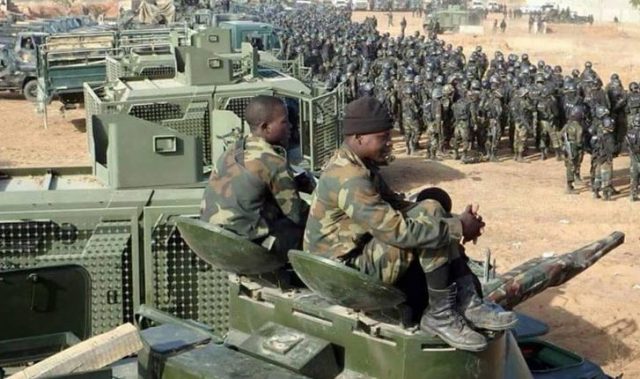
The Theatre Command of the North-East Joint Task Force, Operation HADIN KAI, has dismissed reports alleging poor feeding of troops in operational areas, describing the claims as inaccurate and misleading.
The command was responding to circulating social media posts suggesting that soldiers on the front line were poorly fed within its area of responsibility.

Speaking during a media briefing in Maiduguri, Maj. Gen. Abdulsalam Abubakar, theatre commander of Operation HADIN KAI, said the welfare of personnel remains a top priority and is closely monitored through a structured accountability system.
He stressed that the claims do not reflect the actual situation, noting that feeding arrangements are carefully planned, supervised, and regularly reviewed by soldiers themselves through established food committees.
According to him, each operational base has a food committee largely made up of non-commissioned officers responsible for evaluating rations, overseeing supply chains, and ensuring meals meet approved standards.
“The responsibility of the commander is to provide the resources as given by the government to ensure meals,” he said.
Abubakar added that troops actively participate in monitoring their feeding system, determining menus and ensuring quality control across locations.
“Every location has a food committee. That food committee is made up of mostly non-commissioned personnel. They know the menu of what they want to eat.
“For someone to have been given his meal with soft drinks, he consumed the soft drinks, took out the protein of the food, took out half of your meal, and now made a video. That was a mischief.”
He explained that monthly evaluations are conducted, with committees inspecting supplies, reviewing meal quality, and submitting feedback supported by images and reports from troops.
The commander said that contrary to online claims, soldiers receive complete meal packages, including protein, beverages, and field rations depending on operational demands.
“Every month, the food committee goes around to assess the state of food.
“They take pictures and videos, even based on those videos and pictures from members of the operational personnel,” he said.
Abubakar noted that troops are provided with breakfast, lunch, dinner, water packs, and take-out rations during patrols.
“Even when they go on patrol, they have their cold trip, they have their lunch, they have their water meal pack, and they have their takeout. This is what is obtainable across most of our locations,” he said.
While acknowledging that occasional lapses may occur, he said such issues are not tolerated, adding that any commander found wanting faces strict consequences.
“There are instances where commanders have been found wanting, and they know the stance of the chief of army staff. Where that happens, you lose your command,” he said.
He also cited the directive of the Chief of Army Staff, Lt. Gen. Waidi Shaibu, under the “Soldier First” doctrine, which prioritises troop welfare.
“You cannot take care of the soldiers. The Chief of Army Staff has directed that the commander must lose command. Every commanding officer in the field knows that the Chief of Army Staff does not joke with the welfare of our soldiers,” he said.
Abubakar highlighted recent reforms aimed at improving welfare, including an increase in allowances from N20,000 to N50,000 for personnel from privates to warrant officers.
He added that troops are being prioritised for foreign training and peacekeeping missions, with multiple batches currently undergoing preparation.
The commander also said welfare flight operations have been maintained to ease troop rotation and reduce travel risks, while quick intervention funds have been provided to address urgent logistical needs.
He explained that the introduction of structured food committees has improved transparency and reduced complaints.
“The idea is simple: let the soldiers decide what they eat. This has brought transparency and accountability into the system and has significantly reduced complaints about feeding,” he said.
Abubakar urged the public to rely on verified information, warning that false reports could undermine ongoing operations and affect troop morale.
He reaffirmed that troop welfare remains a central focus alongside efforts to strengthen operational effectiveness across all theatres.