

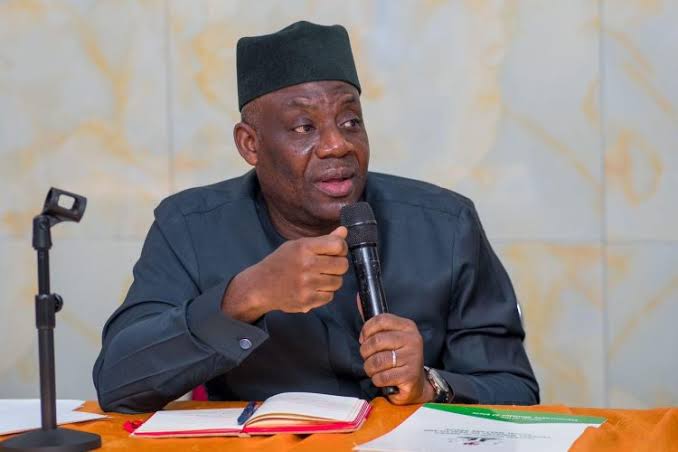
The minister of education, Tunji Alausa, says the exemption of unified tertiary matriculation examination (UTME) requirements for candidates seeking admission into colleges of education and national diploma (ND) agriculture-related programmes will significantly expand access to tertiary education, projecting an increase of about 1.5 million admissions.
Alausa had earlier announced at the 2026 admission policy meeting that the federal government has exempted prospective college of education students from sitting for UTME.

He explained that candidates with at least four credit passes in relevant subjects would now be eligible to apply without writing the examination.
However, he noted that such applicants must still register with the Joint Admissions and Matriculation Board (JAMB), while their documents would be screened, verified, and processed for admission through the central admissions processing system (CAPS) in line with existing guidelines.
Speaking on Politics Today, a Channels Television programme, on Tuesday, the minister defended the reform, saying it was designed to widen access to higher education and reduce unnecessary barriers.
“Let’s give these kids opportunity by removing the restriction,” Alausa said.
He recalled that the government had previously reviewed O’level requirements for tertiary admission, particularly the compulsory credits in English and mathematics.
“Just last year, we had a requirement: to go to university or college of education, you must have five credits,” the minister said.
“That must include English and mathematics. And we said, if you are going to study law, why do you need a credit in mathematics? If you are going to study science, why do you need a credit in English? We abolished that.”
Alausa explained that under the revised framework, candidates applying for social sciences, law, and arts programmes now require only a credit in English, while those in science and engineering need only a credit in mathematics.
He added that the policy changes introduced within a year have already led to a notable rise in admissions.
“For the number of students, there are always between 2.1 and 2.2 million people doing UTME year over year, and about 770,000 people will be admitted, leaving a huge gap,” the minister said.
“So, what happened to 1.2 million people? That gets carried over to the following year.
“But for the first time in the history of our country, last year, with the changes we made to the previously restrictive ordinary level requirement, we increased the number of people from 770,000 to 1.1 million students. We added almost 400,000 more students.”
He said the latest UTME exemptions for NCE and ND programmes would further increase access to tertiary education nationwide.
“This year alone, with the changes we are making, eliminating UTME requirement for colleges of education and UTME requirement for non-technology agricultural and agricultural-related courses in polytechnics and monotechnics, it will increase the number of people being admitted to our tertiary institutions by almost 1.5 million,” he said.
The minister maintained that the reforms are aimed at removing barriers to education while boosting enrolment in key sectors such as teacher training and agriculture.