

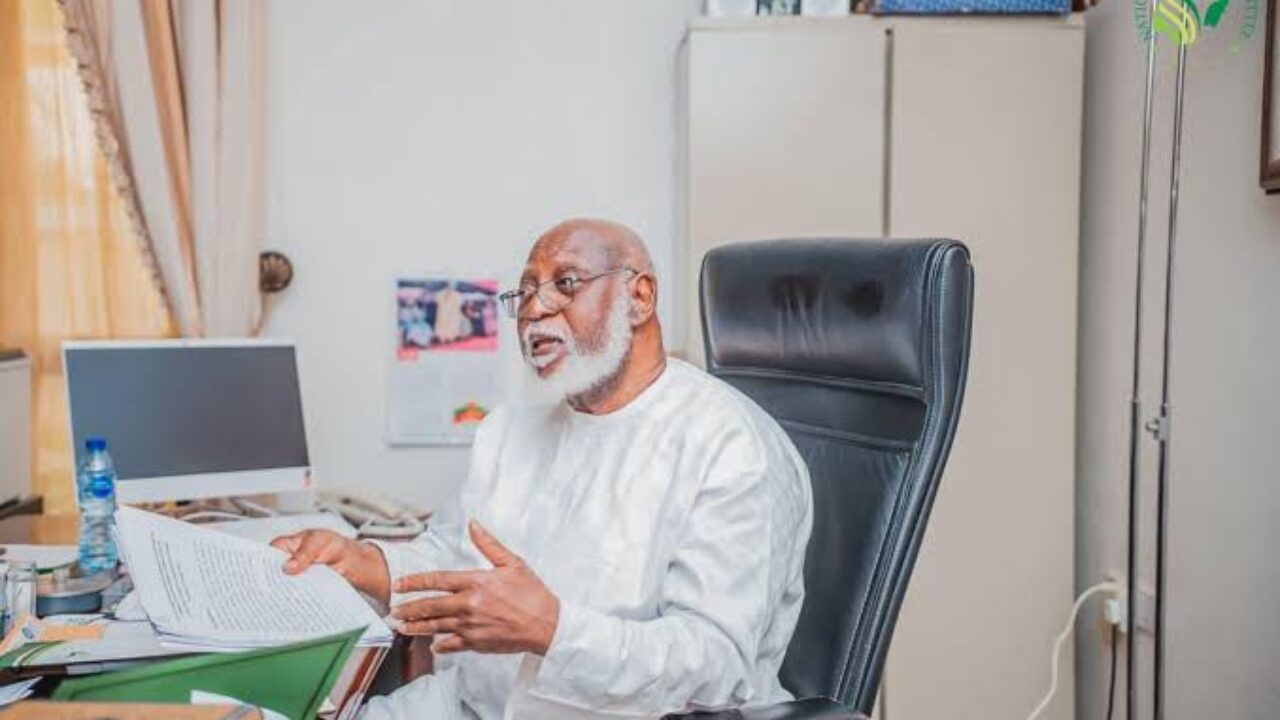
Former Head of State Abdulsalami Abubakar has disclosed dramatic details surrounding the death of Sani Abacha in 1998, an event that eventually led to his emergence as Nigeria’s leader.
In his autobiography, Call of Duty, scheduled for launch today in Abuja as part of activities marking his 84th birthday, the retired general narrated how he was summoned to the Presidential Villa on June 8, 1998, under the impression that Abacha wanted to see him.

According to him, upon arrival at the Villa, he was unexpectedly confined to a waiting room for more than an hour without any explanation until the late Ibrahim Coomassie, then inspector-general of police, arrived and opened the door.
The autobiography, published by Cable Books, an imprint of Cable Media & Publishing Ltd, is available nationwide through Rovingheights Bookstores and can also be purchased on Amazon.
‘THEY SAID ABACHA WANTED TO SEE ME’
Abdulsalami wrote: “On Monday, 8 June, I received a call very early in the morning that he (Abacha) wanted to see me. I quietly prayed that he would not send me to Togo where there was going to be an ECOWAS summit. I was tired of going everywhere.
“By this time, Lt-General Diya, his No 2, was in detention (over an alleged coup plot). I was effectively the No 2 man in government and I was always representing him at events. I told my wife I was not happy with the call because I didn’t want to travel to Togo. I told my orderly to pack my travelling bag and other personal effects.
“As I entered the bathroom, there was another call. I was told again that the Head of State wanted to see me. Out of frustration, I asked if I was travelling to Togo and the caller replied that it was on another issue. Because of the urgency, I didn’t wear my uniform. I wore a tracksuit and slippers and proceeded to the Presidential Villa.
“On getting to his residence, I was told he was in the office. I wondered why he would be that early in the office. As I was climbing the stairs, one of the guards informed me that Abacha said I should stay in the waiting room. What struck me was that anytime I went to see him, regardless of who was with him, I would still go in.”
‘IGP BROKE THE NEWS OF ABACHA’S DEATH TO ME’
The former military ruler said he became suspicious after spending an unusually long time in the waiting room.
“After waiting for about half an hour, I reasoned that it was odd. Major-General Ishaya Bamaiyi joined me shortly after. We waited for about an hour. I decided to go and see Abacha by any means because I could not understand why I should be kept that long. To my greatest surprise, the door of the waiting room had been locked. I asked Bamaiyi if he was aware that we had been locked inside. Something kept telling me that something was wrong but I could not place a finger on it,” he said.
“After some time, the door was opened and the Inspector General of Police, Alhaji Ibrahim Coomassie, came in. He said: ‘Let’s go.’ We walked towards the residence and I informed him that I was told Abacha was at the office. It was at this stage that he informed me that Abacha was dead. I was shocked. I asked him what happened and he insisted we proceed first. He did not tell me anything else.
“When we got to the residence, I asked to see Abacha’s body. I was told it was inside. I entered the room and removed the covering. I was in shock at the sudden development. I prayed for him and left the room.”
Although Abdulsalami did not identify those responsible for locking the room, he suggested that some military officers may have been pursuing “other plans” as events unfolded.
Later that day, the Provisional Ruling Council (PRC) elected him as Abacha’s successor.
He subsequently initiated a brief transition programme that culminated in the handover of power to a democratically elected administration led by President Olusegun Obasanjo in May 1999.