

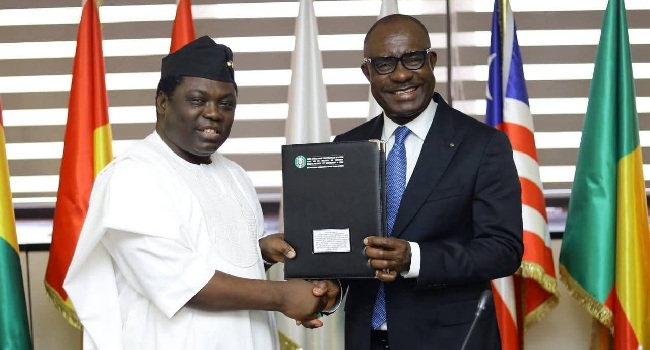
The ECOWAS Bank for Investment and Development (EBID) and the Taraba State Government have signed three loan agreements worth a total of $268 million to finance major industrial, agricultural and renewable energy projects in the state.
The agreements were signed at EBID headquarters by the bank’s President and Chairman of the Board of Directors, George Agyekum, and Taraba State Governor, Agbu Kefas, who led a delegation of government officials, technical advisers and development partners.

The financing package includes $91.23 million for the first phase of an integrated industrial park, which will serve as a multi-cluster logistics and manufacturing hub aimed at attracting private investment, promoting value addition and creating jobs.
Another $79.21 million will fund the development of 10,000 hectares of irrigated rice farms and a modern rice milling and processing facility to strengthen food security and reduce reliance on imported rice.
The remaining $98.19 million will finance the construction of a 50-megawatt solar photovoltaic power plant in Jalingo to improve electricity supply, expand access to clean energy and support industrial development.
The projects align with EBID’s Growth, Resilience and Optimisation (GRO) strategy, which focuses on investments that generate measurable economic, social and environmental benefits across member states.
Governor Kefas described the agreements as a major milestone for Taraba’s development, saying the financing would drive economic transformation by strengthening industry, improving food security and expanding access to reliable and sustainable energy.
EBID President George Agyekum Donkor said the integrated investment in industrial infrastructure, agriculture and renewable energy demonstrates the bank’s commitment to building resilient and competitive economies across West Africa.
The projects are expected to position Taraba as a leading industrial and agricultural hub in Nigeria while supporting the transition to a lower-carbon economy. They also reinforce EBID’s role in promoting sustainable infrastructure and economic transformation across the West African region.