
Beyond Campaigns and Controversies: Why Osun Needs a Different Kind of Election Journalism, By Rasheed Adebiyi

As Osun State prepares for the 2026 governorship election in the next 34 days or thereabout, political activities are gathering momentum. Campaign offices are opening, alliances are shifting, political rhetoric is becoming more strident, and the media is gradually turning its attention to what promises to be one of Nigeria’s most closely watched off-cycle elections.
For journalists, however, this period presents a deeper question beyond simply reporting campaign events. So the question is what kind of election are we helping citizens understand?
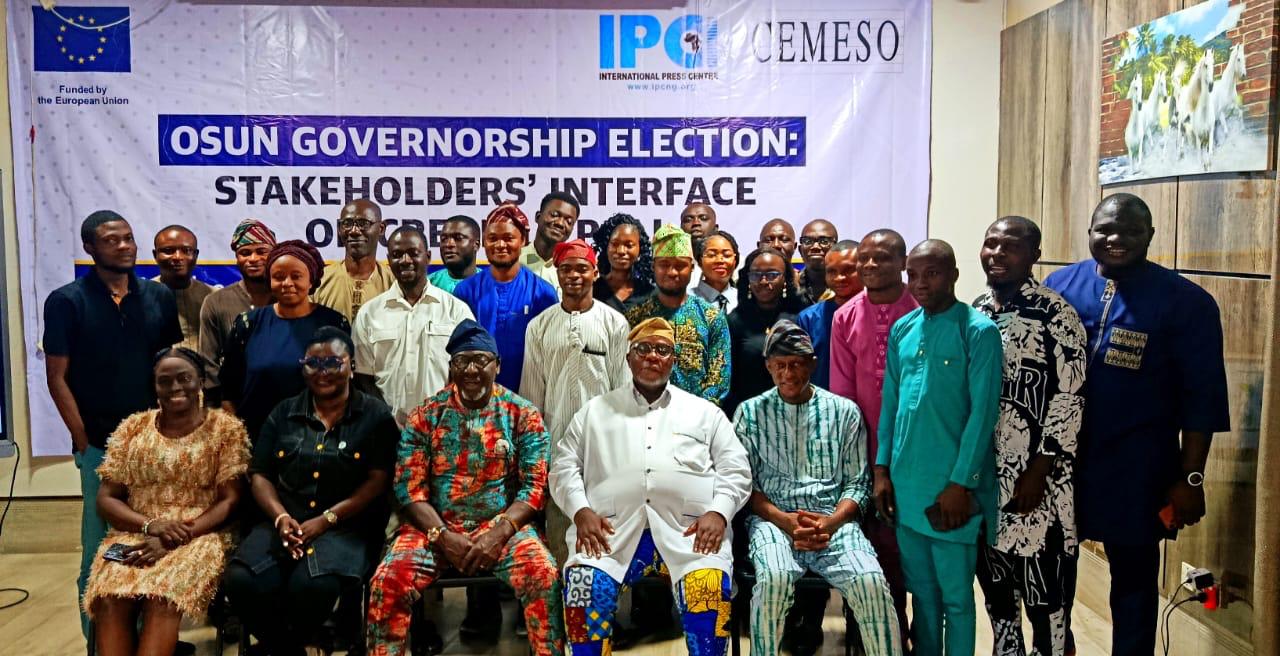
This question occupied my mind during a recent media engagement organised by the International Press Centre (IPC) under the European Union Support to Democratic Governance in Nigeria (EU-SDGN II) programme. Rather than beginning with theories of election reporting, I invited journalists to examine their own work.
Working in groups, participants listed the election stories their respective organisations had published during the previous three weeks. About twenty-five stories emerged from the exercise. We categorised them according to subject matter.The pattern was revealing.
Eight stories focused on security and electoral violence. Seven centered on political activities and party affairs. Five dealt with voter sensitisation. Only two discussed party manifestoes. One addressed mobilisation, another focused on persons with disabilities, while only one centered on activities of the Independent National Electoral Commission (INEC).
The exercise was never intended to criticise journalists. Rather, it was designed to provoke reflection. Collectively, participants reached an important conclusion that although security and politics are legitimate news, the dominant focus of election reporting is not sufficient to help the people of Osun make informed electoral decisions.
That conversation naturally led us to Agenda Setting Theory, one of the most influential ideas in media studies. The theory argues that while the media may not always determine what people think, it significantly influences what people think about. In electoral contexts, this influence is profound.
The issues that receive sustained media attention become the issues citizens discuss. Those same issues become the issues candidates are compelled to address. Eventually, they become the issues on which governments are judged. The progression is straightforward: what the media consistently pays attention to becomes what the public talks about, what politicians prioritise, and ultimately what governments are held accountable for.
This explains why election journalism deserves more careful reflection than it often receives. If media coverage revolves almost entirely around defections, campaign rallies, political quarrels, endorsements and personality contests, public debate inevitably follows the same trajectory. Elections become competitions between political actors rather than conversations about governance.
Yet available evidence suggests that citizens are asking different questions. Findings from the International Press Centre’s voter perception poll in Osun indicate that security, employment, infrastructure, agricultural development and rural development rank among the issues that voters consider most important. These are not peripheral concerns; they are everyday governance challenges that directly affect livelihoods and quality of life.
The implication is clear. There is often a disconnect between what citizens consider important and what dominates election reporting. This disconnect should concern every newsroom.
Journalism performs its highest democratic function not by amplifying every political controversy but by helping citizens evaluate competing visions for governance. Elections should therefore be reported as opportunities to interrogate leadership competence rather than merely document political theatre. This requires a shift from what is commonly called horse-race journalism, coverage that asks who is leading, who defected, who attracted the largest crowd, or who exchanged the sharpest political insults, to journalism that interrogates policies, governance records, implementation capacity and evidence.
When a candidate promises thousands of jobs, journalists should ask where those jobs will come from, how they will be financed, what timeline has been proposed and whether similar interventions have succeeded elsewhere.
When candidates promise improved healthcare, education or agricultural development, the responsibility of the media is not merely to report the promise but to examine its feasibility, costs, implementation strategy and likely outcomes. This is where solutions journalism becomes particularly relevant.
Solutions journalism does not mean advocating for political actors or endorsing policies. Rather, it means rigorously examining credible responses to public problems, the evidence supporting them, and their limitations. It moves reporting beyond exposing problems to helping citizens understand which proposed solutions deserve serious consideration.
For the Osun election, this approach could transform electoral discourse. Instead of repeatedly asking who is winning the campaign, journalists might ask: which candidate presents the most coherent strategy for improving security? What evidence supports competing economic proposals? How realistic are the promises on agriculture, youth employment or rural development? How will success be measured if these promises are implemented?
These are the questions that strengthen democratic accountability. One encouraging outcome of our discussions was the proposal to establish the Osun Collective, an informal collaborative platform of interested media organisations committed to producing issue-based, citizen-centered and evidence-informed electoral content.
The idea is simple but potentially transformative. By collaborating on explanatory journalism, fact-checking, governance reporting, data visualisation and short-form multimedia content, participating media organisations can help simplify complex electoral issues and improve public understanding of governance choices before citizens cast their votes.
The success of the 2026 governorship election will ultimately depend on many institutions: INEC, security agencies, political parties, civil society organisations and the electorate itself.
The media, however, occupies a unique position. It determines, to a considerable extent, the conversations that shape democratic choice. As Osun moves closer to election day, perhaps the most important question every newsroom should ask itself is not whether it has reported every political rally or campaign speech.
It is this: If the people of Osun went to the polls based only on our election coverage, would they have enough information to choose the most competent governor?
The answer to that question may well determine whether election journalism merely chronicles political competition or genuinely strengthens democracy.
Rasheed Adebiyi, PhD is an Associate Professor at the Department of Mass Communication, Fountain University, Osogbo, Nigeria
