

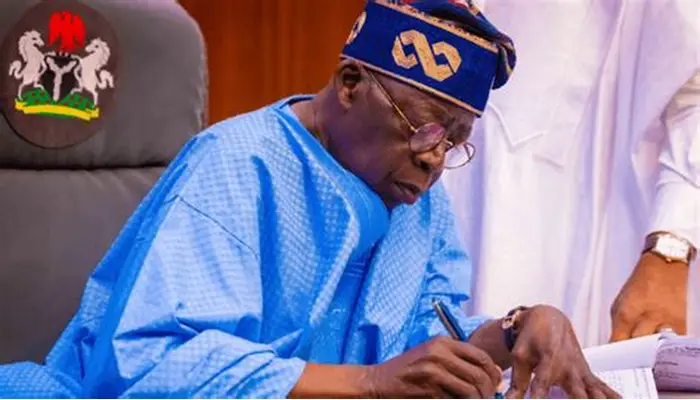
President Bola Tinubu has given the green light to a new investment structure designed to draw up to $50bn into Nigeria’s deep offshore oil and gas industry.
The policy is expected to make it easier for international investors to develop offshore fields by replacing the previous arrangement, which required companies to negotiate separate terms with the Federal Government for individual projects.

Government officials said the new framework could also breathe life into major offshore developments that have been delayed for several years, with Shell’s Bonga South West project, estimated at about $10bn, among those expected to benefit.
The President’s Special Adviser on Information and Strategy, Bayo Onanuga, disclosed the approval in a statement released on Tuesday.
Onanuga said the new approach introduces common requirements for qualifying investments, removing the lengthy process of negotiating individual agreements for different projects.
He said the former system created uncertainty for investors and contributed to delays in taking several deep offshore projects forward.
The statement read, “Rather than pursuing project-specific solutions, the Federal Government transformed that directive into a comprehensive investment framework applicable across multiple categories of qualifying developments.
“Given effect through the Deep Offshore Oil and Gas Projects Incentives (Tax Remission) Order, 2026, the framework replaces project-by-project negotiations with transparent eligibility criteria, clear implementation processes and a durable investment architecture designed to provide greater certainty for investors while safeguarding long-term national value.”
The policy followed a previous meeting between Tinubu and Shell’s CEO, Wael Sawan, where the President pushed for steps to unlock another phase of investment in Nigeria’s offshore petroleum industry.
With the approval, NNPC Limited can begin the necessary adjustments to eligible Production Sharing Contracts to bring them in line with the new rules.
The Special Adviser on Oil and Gas, Olu Arowolo-Verheijen, said the framework would also encourage more work to be carried out within Nigeria where it is technically and commercially possible.
She said, “Projects qualifying under the framework will maximise execution within Nigeria wherever commercially and technically feasible, strengthening domestic engineering, fabrication, marine logistics, technical services and project management.
“The objective is not only to increase investment and production, but also to create skilled jobs, deepen local supply chains and position Nigeria as Africa’s regional hub for deep offshore project execution,” Onanuga quoted her as saying.
Tinubu praised the government agencies and private sector stakeholders that contributed to the development of the framework, saying their input was important to the new investment policy.
He said, “The countries that attract long-term investment are not necessarily those with the greatest natural resources. They are the ones that provide the greatest certainty.
“This reform reflects our determination to build an investment environment defined by clear rules, strong institutions and enduring partnerships.
“We are creating the conditions for capital to flow, for Nigerian businesses to grow, for our people to prosper and for our natural resources to deliver lasting national value,” the President added.
