

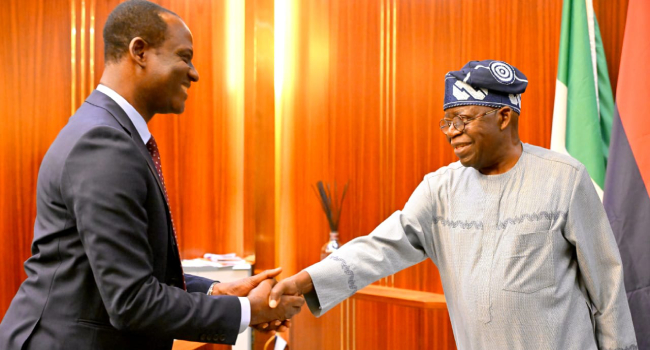
Minister of Finance and coordinating minister of the economy, Taiwo Oyedele has said the federal government will not publish details of how funds drawn from its $5 billion financing facility with First Abu Dhabi Bank (FAB) will be spent.
Oyedele was responding to questions on the government’s borrowing plan and the controversial financing arrangement with FAB during a media briefing in Abuja on Wednesday.

Asked whether the government would make details of the transaction and the deployment of the funds public, the minister said there was no need to treat the facility differently from other sources of government financing.
Oyedele said the transaction had already gone through the required approval process, including consideration by the national assembly.
“We will not publish how we are spending it. We will publish how we spend government money. There’s nothing special about that loan,” he said.
“Nobody has asked us whether we’re going to publish the money we took from the World Bank, whether we publish the one from Eurobond, whether we publish the one from Sukuk. Why is this one special?”
The $5 billion facility is part of a wider $6 billion external borrowing package approved by the national assembly in March.
The government subsequently accessed about $1.5 billion as the first tranche of the FAB facility.
The financing arrangement has attracted scrutiny because it is structured as a total return swap (TRS), rather than a conventional sovereign loan.
At the event, Oyedele said the transaction was approved by the federal executive council (FEC) before being presented to the national assembly.
“The loan was approved not only by the FEC, it was taken to the National Assembly because what some people are doing is comparing it with other countries where they did it under the table,” he said.
“What can be more public than what you gave to the National Assembly?”
‘FG TO DRAW $5BN ABU DHABI LOAN IN PHASES TO CUT BORROWING COSTS’
Oyedele further said the government would draw the facility in phases rather than access the entire sum at once.
“We’re assessing it in phases. You don’t want to take all the money at once because if you don’t spend it at once, you incur costs on the extra amount you’ve taken,” he said.
The minister said the phased drawdown was part of efforts to structure the transaction efficiently and reduce the cost of government borrowing.
He also explained that the FAB facility differs from Nigeria’s traditional fixed-rate borrowing.
According to the minister, most of the country’s bonds and eurobonds were raised at fixed interest rates, meaning Nigeria continues to pay the agreed coupon even when market rates decline.
“You need to understand the transaction. You know, there’s always a textbook analysis, and there’s a real life of what you’re doing,” Oyedele said.
“We’re used to raising bonds on fixed interest rates. I can tell you our Eurobonds, for example, were raised when the coupon was double digits. Today, our yield is down to around seven, seven and a half percent.”
He said the government cannot directly benefit from the decline in yields on its existing fixed-rate debt.
“This First Abu Dhabi Bank transaction is at a flexible rate. It means if rates go up, we pay more. If rates come down, we benefit more,” he said.
Oyedele acknowledged that the floating-rate structure could expose the government to higher financing costs if interest rates rise.
However, he said the government considered the overall cost of the facility to be lower than that of its existing debt portfolio.
“So the objective is to use it to refinance expensive debt so you can save money,” he said.
Oyedele said the government would publish frequently asked questions on the transaction on the websites of the ministry of finance and the Debt Management Office (DMO) to provide further information on the facility.
He expressed the government’s commitment to transparency, but said it would not provide a separate breakdown showing how the FAB proceeds would be spent.
“We are transparent. Information is available,” he said.
The minister’s comments come amid continued scrutiny of Nigeria’s borrowing strategy and the structure of the FAB financing arrangement.
The IMF had earlier advised Nigeria to consider more transparent financing options, including conventional eurobonds and concessional loans, while highlighting the potential fiscal risks associated with complex financing structures.
