

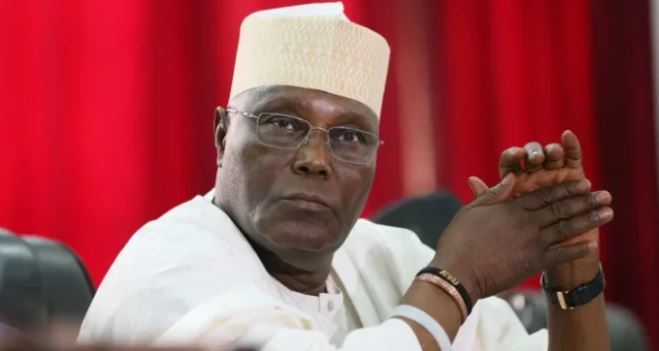
Former Vice-President Atiku Abubakar has called on President Bola Tinubu’s administration to disclose how the $5 billion loan secured from First Abu Dhabi Bank (FAB) will be spent, warning that Nigerians and future generations will ultimately bear the repayment burden.
Atiku’s demand followed comments by Taiwo Oyedele, Nigeria’s finance minister, who said the Federal Government would not release specific details on how funds accessed from the $5 billion financing facility would be deployed.

Oyedele made the remarks on Wednesday during a media briefing in Abuja, where he responded to questions concerning the government’s borrowing plans and the financing arrangement with FAB.
When asked whether the government intended to make details of the transaction and the utilisation of the funds public, the minister said there was no reason to treat the facility differently from other government financing arrangements.
He also said the transaction had passed through the necessary approval procedures, including consideration by the National Assembly.
The $5 billion facility forms part of a broader $6 billion external borrowing package approved by the National Assembly in March. The Federal Government has so far accessed about $1.5 billion as the first tranche of the FAB facility.
In a statement issued on Sunday by his media office, Atiku accused the Tinubu administration of incompetence and financial impropriety, pointing to what he described as a lack of transparency surrounding recent borrowing arrangements.
He particularly questioned the government’s handling of the $5 billion facility, insisting that Nigerian taxpayers have a right to know how the money will be used.
“Since assuming office on May 29, 2023, President Bola Tinubu’s administration has contracted significant new debt,” the statement reads.
“According to the Debt Management Office, the Tinubu administration has added N72 Trillion of fresh debt stock, bringing the total indebtedness to N159.35 trillion as at early 2026.”
Atiku argued that despite the government’s increased borrowing, the economic conditions of many Nigerians had continued to deteriorate.
He claimed that the poverty rate had increased from 56 per cent in 2023 to between 61 per cent and 63 per cent under the Tinubu administration, leaving more than 140 million Nigerians affected by multidimensional poverty.
The former vice-president also criticised Oyedele’s position that the details of the Abu Dhabi loan did not need to be separately disclosed.
“The government is obliged to explain every loan taken on behalf of Nigerians,” Atiku said.
“Every Kobo borrowed matters because citizens — both living and unborn — will bear the burden of repayment. Yet these loans have failed to improve their material wellbeing.”
Atiku further disclosed that the Federal Government is required to provide securities worth approximately 133 per cent of the loan value as collateral, arguing that the arrangement makes transparency even more important.
He also cited concerns previously raised by the International Monetary Fund (IMF) and Fitch Ratings regarding the financing structure, particularly its implications for transparency and the sustainability of Nigeria’s sovereign debt.
Atiku urged Nigerians to demand greater accountability from the government, arguing that borrowing without clearly demonstrating its impact on citizens could erode public confidence and put the country’s economic future at risk.