

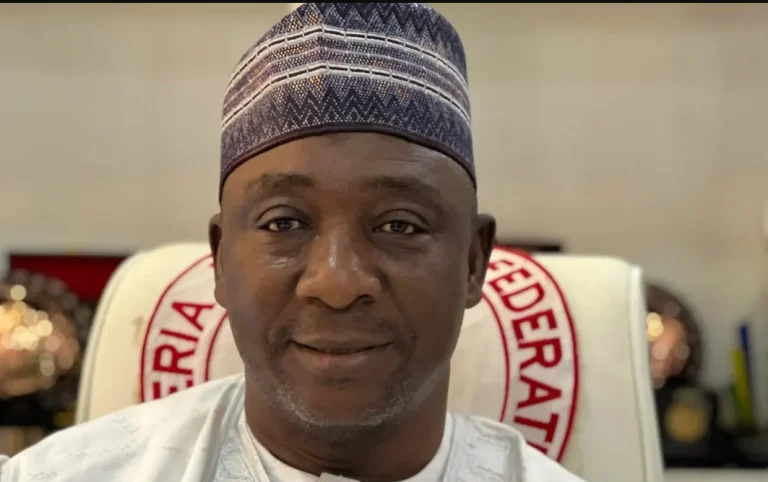
Ibrahim Gusau has confirmed his resignation as President of the Nigeria Football Federation, saying his decision was driven by his love for Nigeria and commitment to the development of football.
Gusau announced his resignation during a news conference in Abuja, bringing his three-year, 11-month tenure as head of Nigerian football to an end.

The resignation followed speculation over his continued stay in office amid mounting concerns about Nigeria’s recent performances in international competitions.
Gusau said he arrived at the decision after consultations with his family and friends and had also advised members of the NFF Executive Committee who wished to follow his decision to resign.
“I have decided to resign my position as the President of NFF, after consultations with my family and friends.
“I have also advised my board members, those who are willing, to resign as well,” he said.
He, however, said he could not immediately confirm the number or identities of board members who had resigned, explaining that those affected had yet to communicate their decisions directly to him.
Gusau’s resignation comes after a series of setbacks for Nigeria’s national teams. The Super Eagles failed to qualify for the 2022 and 2026 FIFA World Cups, while the Super Falcons missed out on qualification for the 2027 FIFA Women’s World Cup.
Nigeria’s age-grade teams have also struggled, with the Golden Eaglets failing to qualify for the FIFA U-17 World Cup in three consecutive editions.
Despite the setbacks, Gusau highlighted achievements recorded during his tenure in coaching education, domestic league administration, refereeing and infrastructure development.
He said the NFF conducted several coaching programmes, including the CAF B Licence, CAF C Licence and Coaching Instructors’ Course, while the CAF A Licence programme is scheduled to begin on September 16.
Gusau also said his administration made progress in stabilising the domestic leagues, which he described as one of the major challenges inherited by the board.
On refereeing, he said the federation introduced young officials into the system and provided opportunities for training and development, resulting in increased Nigerian representation at international competitions.
“At the last Under-17 World Cup and the Women’s Africa Cup of Nations in Morocco, Nigerian referees were among the officials and even handled some of the semi-final matches,” he said.
The outgoing NFF president identified inadequate infrastructure as one of the biggest challenges facing Nigerian football, saying his administration prioritised the development of facilities through FIFA development funds.
He said the board was also working towards providing permanent accommodation and training facilities for Nigeria’s national teams.
Gusau said he would continue contributing to the development of Nigerian football through his experience and relationships within African football.
“For me, I want to make it clear that, by the grace of God, we will continue to give our contribution.
“Our experience, connections and relationships within African football will never go in vain,” he said.