

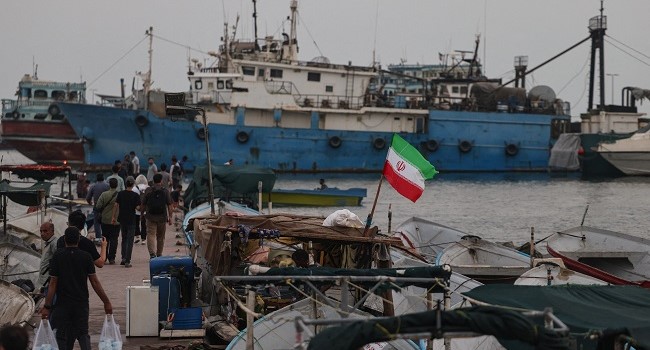
Iran’s top negotiator, Mohammad Bagher Ghalibaf, has threatened a stronger response to any further US attacks after Tehran targeted American warships in the latest round of clashes between the two countries.
The exchanges of fire, which began with US raids last week, came amid a deadlock in the six-month conflict between Iran and the United States.

Iran has maintained its control over the strategic Strait of Hormuz, while Washington continues a counter-blockade of Iranian ports.
The United States has also intensified economic pressure on Iran by imposing sanctions on entities with financial links to the Islamic Republic in an effort to force Tehran into submission.
Ghalibaf, who is Iran’s parliament speaker and has acted as chief negotiator in talks aimed at ending the conflict, said Tehran would no longer respond proportionately to attacks.
“The Americans must have understood that the era of proportionate responses has come to an end,” Ghalibaf said in a speech carried by Iranian state media.
“Any aggression against Iran’s interests and security will receive a faster, more intense and more painful response,” he added.
On Saturday, US Central Command, which oversees American military operations in the region, said Iran had unsuccessfully attacked two US warships — an aircraft carrier and a destroyer.
The Islamic Revolutionary Guard Corps, Iran’s ideological military force, claimed the warships had been “forced to retreat” after suffering damage.
CENTCOM, however, said the vessels successfully evaded the attacks.
The US military subsequently said it had struck three oil tankers linked to Iran’s Revolutionary Guard.
“Following Iran’s failed attacks, CENTCOM permanently disabled the IRGC crude oil carriers M/T Downy off the coast of Kharg Island and M/T Stark 1 near Jask,” CENTCOM said.
It added that American forces also destroyed the unladen crude oil carrier M/T Kylo in the Gulf of Oman after directing its crew to abandon the vessel.
Video released by CENTCOM showed large fireballs and flames after projectiles struck the ships.
The US command said the three vessels were part of a multibillion-dollar “shadow network” allegedly used to fund the IRGC and its regional allies.
Iran quickly retaliated, with the Revolutionary Guards saying its naval forces had targeted three oil tankers using what it described as unauthorised routes through the Strait of Hormuz.
The Guards also claimed to have targeted three vessels affiliated with the United States in other areas.
It warned ships against attempting to transit the strategic waterway through routes that had not been approved by Tehran.
Early Sunday, the Guards also said they had attacked a US naval drone attempting to enter the Strait of Hormuz, according to a statement carried by Iranian state television.
‘Higher economic cost’
CENTCOM commander, Admiral Brad Cooper, said the US response would impose a greater economic cost on Iran.
“If you shoot at two of our ships, we will impose an even higher economic cost — taking out three of yours,” Cooper said.
Iran’s Foreign Ministry condemned the US attacks on its oil tankers, describing them as “illegal and aggressive actions”.
An Iranian state television correspondent in Jask, in the southern province of Hormozgan, reported that one of the targeted tankers was empty while another was carrying oil.
The crews were reportedly taken ashore in lifeboats.
Another state television correspondent on Kharg Island said the attack there caused no casualties.
The administration of US President Donald Trump has sought to downplay the significance of the six-month conflict, which has become increasingly unpopular in the United States as midterm elections approach.
US Vice President JD Vance has said he “wouldn’t call it a war”, while Trump on Friday described the conflict as “small potatoes” for Washington.
Iran’s security chief, Mohsen Rezaei, warned earlier in the week that Tehran had adopted a “new strategy” against Washington that he said “will shatter your foundations”.
The United States has been increasing pressure on Tehran in an effort to gain control of the Strait of Hormuz, through which about one-fifth of global oil supplies previously passed.
A fragile ceasefire between the two countries collapsed in July following attacks on commercial vessels in the waterway.
Trump has repeatedly threatened in recent weeks to claim sovereignty over the strait, including posting a map depicting it as “new US territory”.
Vance has maintained that Washington will not resume negotiations with Tehran until Iran ends attacks on commercial shipping in the Strait of Hormuz.