
[Special Report] How Lagos is gradually turning waste capital of Nigeria [Photos/Videos]
With contributions from Toyibat Ajose, Alagbe Shanayon, Adelani Khadijat, Oyedokun Taiwo and Josiah David

When Governor Babajide Sanwo-Olu in company of his deputy, Hamzat Obafemi and other top officials of the Lagos State Government on Wednesday, September 9 visited the Olusosun waste dumpsite at Ojota, it became clear that repeated media reports about waste crisis in the state in the past months was real and not fictitious or exaggerated as claimed in some quarters.

The governor didn’t mince words when he admitted that Lagos is currently in an ‘unpleasant state’, hinting on the possibility of declaring a state of emergency as part of measures to return the state to a descent, livable and hygienic abode for businesses and teeming residents.
“In the past couple of weeks, we have seen pressure and slow turnaround in waste collection in different parts of the city. We have seen residents throwing waste indiscriminately at undesignated areas in the city.
“We are here to see what the problem is and for us to be able to declare a state of emergency so that we can take the state out of this unpleasant situation.
“At Olusosun dumpsite, we are planning with our development partners to build a 2,400-metric-tonne transfer loading station that will receive compacted waste which will, in turn, be transported to Material Recovery Facilities being built at the moment.
“We are currently building two transfer loading stations of the same size that will receive over 500 trucks of waste daily. The second transfer loading station is at Solous 3 in Alimosho. We need to open up the road, and that should be ready in two to three weeks,”Sanwo-Olu explained.
To set the record straight, Lagos now generates an estimated 17,000 metric tons of solid waste daily, according to recent projections by the state government.
“The government had initially estimated that Lagos generated about 13,000 tonnes of waste daily but subsequently discovered that the volume had risen to approximately 17,000 tonnes. The increase had placed additional pressure on the Lagos State Waste Management Authority (LAWMA) and other waste-management operators, making effective planning and management more difficult,”the Deputy Governor, Obafemi Hamzat explained during a recent stakeholder engagement meeting.
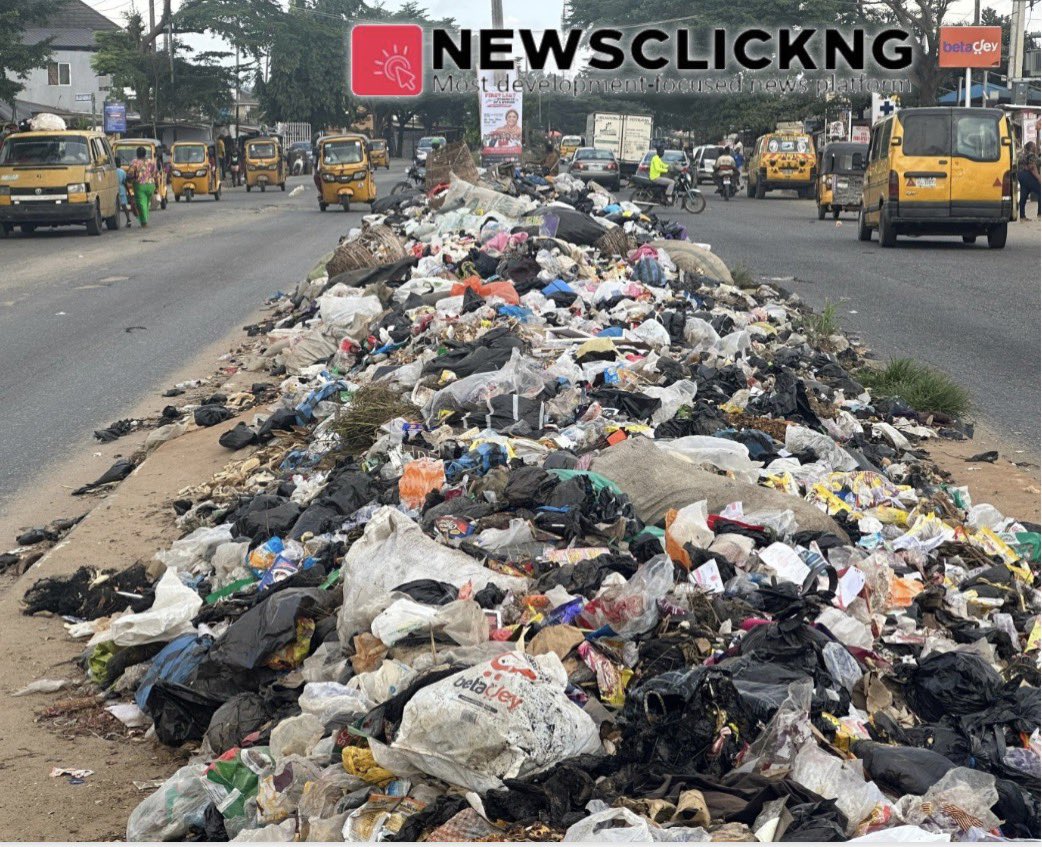
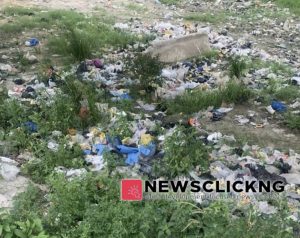
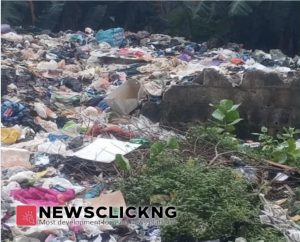
This development has converted almost every available landmass in the state to dumping sites. From streets, to markets, road medians, drainages, open fields, expressways, just name it, some mountainous heaps of refuse are few steps away.
The situation wasn’t any different when NewsClick Nigeria reporters took a quick tour of some places within the city. From Iyana-Ipaja, Ogba, Ayobo, Ikotun, Megida, Ibeju-Lekki, Iju Ishaga and the surroundings of Anchor University, Ayobo, it was all stinking and flooded in dirt.
Residents seek government’s intervention
Meanwhile, residents of the visited communities while admitting poor hygienic and waste disposal habits called on government to intervene before the state erupts in another pandemic.
A resident at Ayobo who identified himself as Mr Alabi said the bad odour from refuse has made passing through some areas uncomfortable, especially for people living, selling and studying around the affected locations. He also raised concerns about injuries caused by sharp objects mixed with the waste.
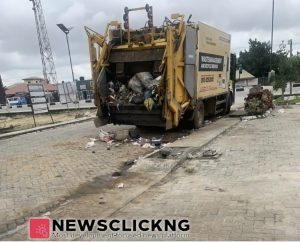
At the Ibeju-Lekki axis of the state, a resident, Mrs Adegoke expressed concern over the growing waste problem in the area. She pointed out that some bus stops are now dump sites oozing in stench therefore making it difficult for passengers and motorists alike to comfortably board and pick. Mrs Adegoke also admitted that some residents still dump waste on roads and inside drainages, thereby worsening flooding during rainy seasons.
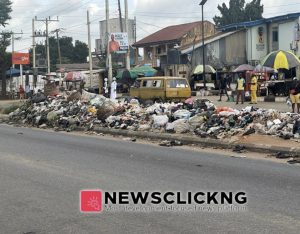
Speaking on the situation, Mr Olumide from Iju Ishaga said the waste around the area has become a daily struggle for residents. According to him, “Sometimes you see people covering their noses while passing, and it is not a good sight. Something needs to be done before it becomes a bigger problem.”
Mrs Okafor from Iyana-Ipaja also shared her concern, saying the waste around bus stops affects both residents and business owners. She urged authorities to improve waste collection while encouraging fellow residents and business owners to stop dumping refuse indiscriminately.
How Lagos is gradually turning waste capital of Nigeria – Our view from Megida-Ipaja road, front of Anchor University. #Lagos #IpajaRd #LagosState #WasteManagement #WasteCrisis pic.twitter.com/7wdnLP6JYl
— NewsClick Nigeria Media (@NewsClickng) September 15, 2026
How Lagos is gradually turning waste capital of Nigeria – Our view from LASU Ojo road. #Lagos #LASU #LagosState #WasteManagement #WasteCrisis pic.twitter.com/3MWGBvQnI5
— NewsClick Nigeria Media (@NewsClickng) September 15, 2026
*How Lagos is gradually turning waste capital of Nigeria – Our view from Opesa, Ipaja*. #Lagos #Ipaja #LagosState #WasteManagement #WasteCrisis pic.twitter.com/dRpdL716w4
— NewsClick Nigeria Media (@NewsClickng) September 15, 2026
*How Lagos is gradually turning waste capital of Nigeria – Our view from Ikotun, Lagos state*#Lagos #Ikotun #LagosState #WasteManagement #WasteCrisis pic.twitter.com/DbDU8g8F3m
— NewsClick Nigeria Media (@NewsClickng) September 15, 2026
How Lagos is gradually turning waste capital of Nigeria, Our view from Akesan, LASU road. #Lagos #LASU #WasteManagement #EnvironmentalHealth #CleanLagos pic.twitter.com/xLdstKr69f
— NewsClick Nigeria Media (@NewsClickng) September 15, 2026
How Lagos is gradually turning waste capital of Nigeria, Our view from Ibeju Lekki, approaching the local government#Lagos #IbejuLekki #WasteManagement #EnvironmentalHealth #CleanLagos pic.twitter.com/pGl9oTMhwk
— NewsClick Nigeria Media (@NewsClickng) September 15, 2026