

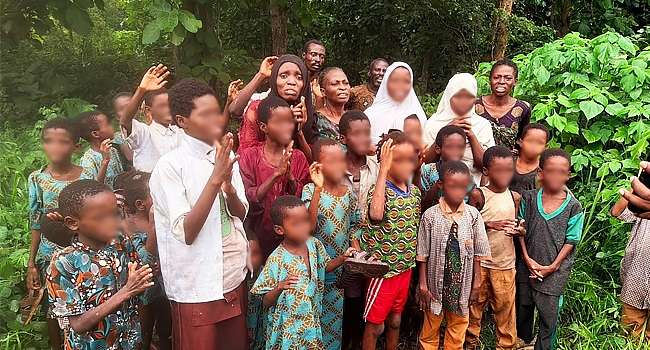
A witness for the Department of State Services has told the Federal High Court in Abuja how 49 students and teachers kidnapped from schools in Orire Local Government Area of Oyo State spent 56 days in captivity.
The witness, identified as “AAA” to protect her identity, testified on Thursday before Justice Salim Ibrahim.

She said the victims were moved between six locations during their captivity. According to her, they were forced to walk barefoot and sleep on grass in heavy rain and under the sun.
The defendants are accused of being members of the Jama’atu Ansarul Muslimina fi-Biladis Sudan terrorist group, also known as ANSARU.
They are Mahmud Muhammad, alias Abu Bara’a and Abbas Mukhtar; Abubakar Abbas, alias Isah Adam and Mallam Mahmuda Al-Nigeri; Abdulrazak Umar, alias Abu Khalifa and Abu Khalid; Yunusa Musa, alias Abu Yunusa Bin Musa; and Shamsu Adamu Sani, alias Abu Itisar.
Led in evidence by the Director of Public Prosecution of the Federation, Rotimi Oyedepo, SAN, the witness said the ordeal was particularly difficult because children as young as one and a half years were among the captives.
She alleged that the kidnappers stormed the schools with 12 motorcycles on the day of the attack.
According to her, the armed men fired shots into the air and prevented the students and teachers from escaping.
She said the kidnappers then took the victims into the bush, with about four people placed on each motorcycle.
A Toyota car belonging to one of the teachers was also allegedly used to transport some of the victims.
Victims allegedly held for negotiations
The witness said the kidnappers’ leader later told them that they were being held to secure the release of suspected ANSARU members in detention.
She said the victims were not being held primarily for ransom.
On two occasions, according to the witness, two teachers, Deacon John Olaleye and Michael Oyedokun, were brought out and openly beheaded.
She alleged that the kidnappers carried out the killings because they believed the government was not taking their demands for the release of their detained members seriously.
The witness also said the kidnappers seized the victims’ phones.
She said the devices were later used to contact relatives and government officials and communicate the kidnappers’ demands.
Hunger, poor water supply
The witness described the conditions in captivity as severe.
She said the victims faced hunger and serious shortages of water, with about four people sometimes sharing a single cup during rationing.
She said they initially received rice, salt and palm oil.
When the salt ran out, according to her, they were given rice and palm oil. Later, when the oil was exhausted, they were left with only white rice.
The witness also alleged that the younger children were flogged while eating to stop them from struggling over the limited food.
She said the food was served in a dirty rubber bucket.
Throughout the 56 days, she said the captives were unable to wash their clothes or bathe.
She added that the poor sanitary conditions left them dirty and exposed to further risks.
According to her, the drinking water provided by the kidnappers was so dirty that the victims had to close their eyes before drinking it.
“We had to drink it just to survive,” she said.
Rescue after gun battle
The witness said the victims were eventually rescued at the sixth camp.
She told the court that security forces reached the location and exchanged gunfire with the kidnappers before freeing them.
Meanwhile, defence lawyer Bala Dakum is expected to cross-examine the witness on September 18.
Justice Salim Ibrahim also ordered that the five defendants remain in DSS custody throughout the trial.