

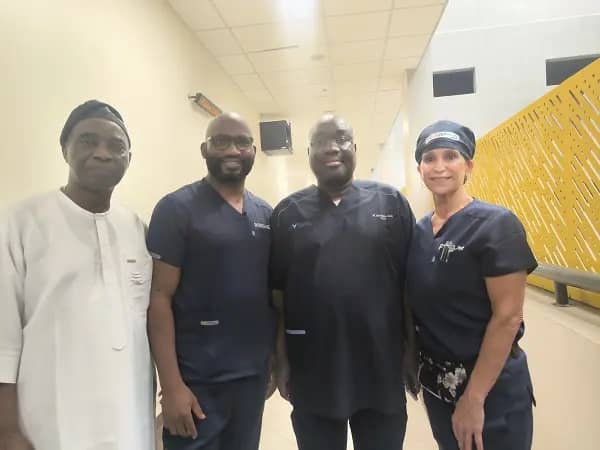
Nigeria has recorded its first tele-robotic surgery after a surgeon in Ogun State remotely operated on a patient in Abuja to remove a kidney affected by a cancerous tumour.
The procedure was carried out on Saturday, September 19, 2026, through a partnership involving Redeemer’s Health Village (RHV) in Ogun State, RoboMed Global and Nisa Premier Hospital in Abuja.

The patient remained at Nisa Premier Hospital in Abuja while Professor Obi Ekwenna-Davis, a professor of urology and transplantation and co-founder of RoboMed Global, performed the operation remotely from a Toumai robotic surgical console at RHV in Ogun State.
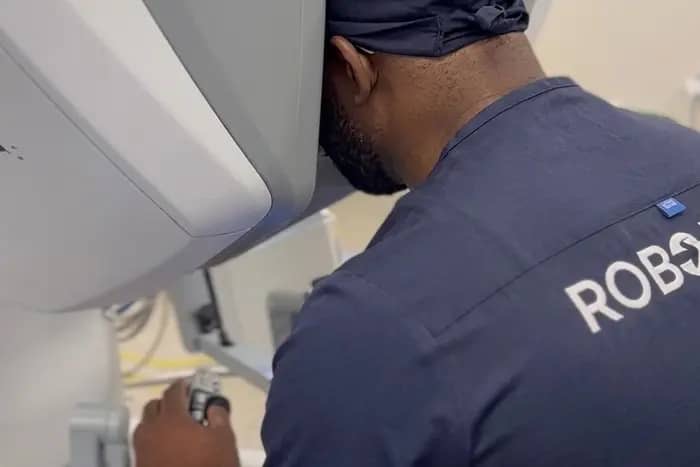
The procedure involved a robot-assisted right radical nephrectomy, which is a surgical operation to remove an affected kidney. In this case, the kidney was affected by a cancerous tumour.
The operation is significant because the surgeon and patient were located in different states. Rather than physically standing beside the patient, the surgeon’s movements at the robotic console were transmitted in real time to the surgical robot at the Abuja hospital.
Tele-robotic surgery, also known as remote surgery, enables a surgeon to operate on a patient from another location using robotic equipment, telecommunications technology and real-time data transmission.
The surgery lasted approximately three hours, with brief pauses to ensure that the equipment and communication systems were working properly. Ekwenna-Davis said the patient was in good condition following the procedure and was expected to be discharged within 24 hours.
The procedure was not carried out autonomously by a robot. The robotic system was controlled by the surgeon, while medical teams were present at both the surgeon’s and patient’s locations.
Ekwenna-Davis said the successful operation demonstrated the potential for telesurgery to be safely conducted between different parts of Nigeria and, potentially, across international borders.
“Distance should never decide who receives safe surgery; this is what safe and trusted surgery looks like,” he said.
The development is notable for Nigeria, where patients often have to travel long distances or outside the country to access certain highly specialised medical services.
According to Ekwenna-Davis, the technology could enable Nigerians to access specialist surgical expertise without travelling abroad. He added that it could also provide opportunities for Nigerian medical professionals living in the diaspora to remotely offer their expertise to patients in the country.
Dr Adedamola Dada, Chief Executive Officer of Redeemer’s Health Village, described the procedure as the first telesurgery in West Africa.
He said the initiative was intended to demonstrate how advanced healthcare technology could expand access to specialised treatment in Nigeria and contribute to efforts to reduce medical tourism.
Reports indicate that Starlink provided connectivity for the operation, while MTN served as a backup. Stable communication was essential because the surgeon’s commands needed to reach the robotic system in Abuja in real time.
Dada acknowledged that connectivity remained one of the issues that would need to be addressed as telesurgery expands. He noted that weather conditions, equipment quality and the availability of trained medical personnel could affect the reliability of the technology.
The achievement builds on Redeemer’s Health Village’s recent investment in robotic surgery. Earlier in September, the hospital announced its first robotic-assisted prostate cancer surgery, with Ekwenna-Davis explaining that robotic systems enable surgeons to operate through smaller incisions while offering enhanced visualisation and precision.
The Federal Government had previously supported RHV’s robotic surgery programme, with the Minister of State for Health and Social Welfare, Dr Iziaq Adekunle Salako, describing the programme as a step towards advancing healthcare delivery and reducing medical tourism.
The ministry said the programme involved an investment of about $4 million and included training for Nigerian medical professionals.
Ekwenna-Davis also said a robotic academy would be established to train surgeons and other healthcare professionals. According to him, the programme aims to train at least 150 surgeons within two years.
Dr Ibrahim Wada, Chief Executive Officer and founder of Nisa Premier Hospital, said the Abuja facility had served as a centre for robotic surgery in West Africa since November 2025.
He described the remote operation as an example of what can be achieved through collaboration between Nigerian medical institutions, noting that the patient received specialist surgical care without leaving Abuja.
The chairman of RHV’s board, Dr Kunle Onakoya, also clarified that robotic surgery does not mean robots independently carry out operations. He explained that the robot remains under the control of a human surgeon, with the technology helping to magnify the surgeon’s movements and improve precision.
Redeemer’s Health Village is a 300-bed multispecialty hospital established by the Redeemed Christian Church of God.
The successful tele-robotic procedure marks a significant development in Nigeria’s healthcare system and the use of remote surgical technology.