

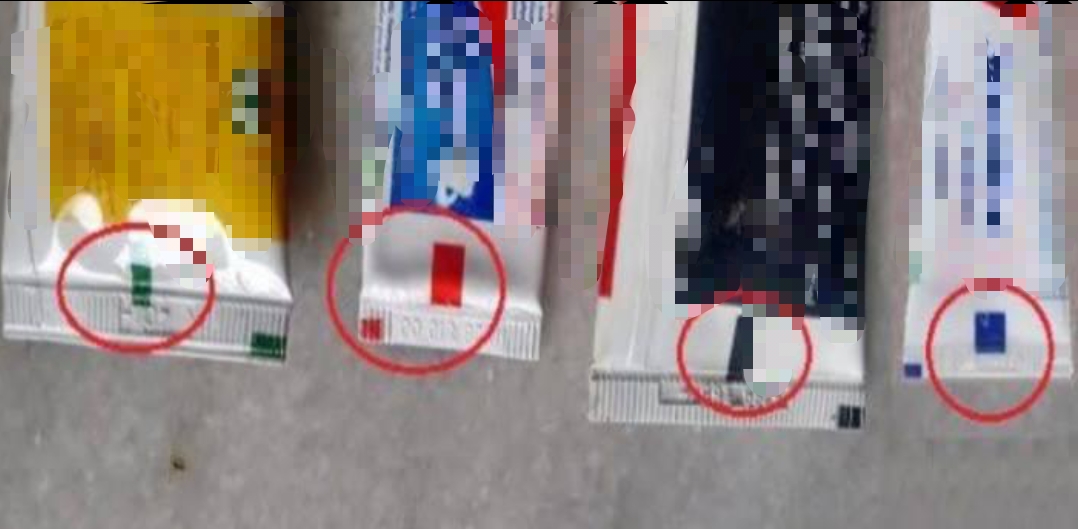
Before squeezing toothpaste onto a toothbrush, there is a tiny detail many people hardly notice. Turn the tube upside down and look closely at the bottom. Near the sealed end, you will usually find a small rectangular mark. It may be green, blue, red or black.
Over the years, different explanations have circulated about what these colours mean.

Green is often said to mean the toothpaste is made from natural ingredients, blue is said to mean it is good for the human body, red is believed to indicate a mixture of natural and chemical ingredients, while black is said to mean the toothpaste contains chemical ingredients.
But the truth is quite different.
The little coloured mark has nothing to do with the ingredients in the toothpaste. Instead, it is part of the manufacturing and packaging process.
During production, machines use the mark as a reference point to know where the tube should be positioned, cut, folded or sealed. In other words, the mark helps the packaging machine do its job properly.
So, whether the mark is green, blue, red or black does not tell you whether the toothpaste is natural, chemical-based or healthier than another one.
The colour can vary depending on the design of the packaging and the colour that can be easily detected by the machine.
What about children?
For parents, choosing toothpaste for a child requires a little more attention.
Young children are still learning how to brush properly and may swallow some of the toothpaste instead of spitting it out. This makes the type of toothpaste, the amount used and supervision during brushing important.

Dental guidance recommends using toothpaste appropriate for a child’s age and controlling the quantity placed on the toothbrush.
For children under three, only a smear about the size of a grain of rice is needed. Children between three and six should use no more than a pea-sized amount.
Parents and caregivers should also supervise young children while they brush and encourage them to spit out the toothpaste rather than swallow it.
The message is simple: children should not be given large amounts of adult toothpaste simply because it is the one available at home.
Parents should check the packaging for the recommended age and use the appropriate amount.
After all, when it comes to children’s oral care, it is not just about having toothpaste. It is about using the right toothpaste, in the right amount and in the right way.
Note: The next time you see a green, blue, red or black mark at the bottom of a toothpaste tube, don’t assume the colour is telling you what is inside.
If you want to know what a toothpaste contains, check the ingredients and other information printed on the packaging.
And when buying toothpaste for a child, pay attention to the recommended age and the amount that should be used.
That tiny colour mark may catch your attention, but what is actually written on the tube and how the toothpaste is used matters far more.
