

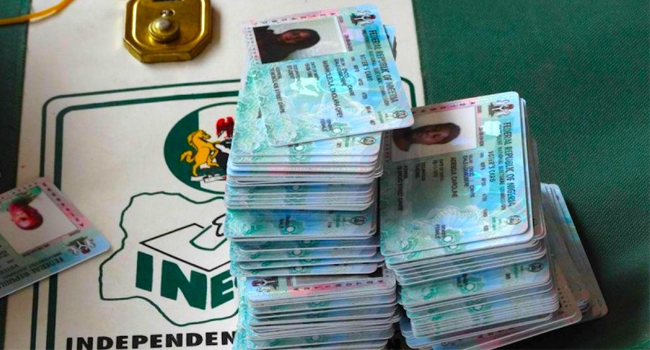
The Independent National Electoral Commission has announced that nationwide collection of Permanent Voter Cards will begin on Friday, October 9, 2026, ahead of the 2027 general elections.
INEC Chairman, Prof Joash Amupitan, announced the date on Monday at a strategic workshop for media executives in Abuja, organised by the commission in collaboration with Development Alternatives Incorporated and the Nigerian Guild of Editors.

The announcement comes as Nigeria’s National Register of Voters has risen to more than 103 million, following the completion of the three-phase Continuous Voter Registration exercise and the final Automated Biometric Identification System cleanup.
INEC records over 10.7 million new registrations
Amupitan said the three phases of the Continuous Voter Registration exercise recorded 10,772,421 new registrations.
The first phase, conducted between August 25 and December 10, 2025, recorded 2,611,266 registrations. The second phase, which ran from January 5 to April 17, 2026, recorded 4,121,835, while the third phase, held from May 11 to July 26, recorded 3,867,997 registrations.
He said the commission had also completed the public display of the Preliminary Register for claims and objections and the final ABIS cleanup of the voter register.
Amupitan said newly produced PVCs would be distributed to Local Government Area collection centres for eligible voters to collect. INEC has also introduced printable PVC technology to reduce the waiting period associated with producing and collecting voter cards.
INEC seeks public trust ahead of 2027
The INEC chairman said the commencement of PVC collection was important as preparations intensify for the 2027 general elections.
He said the commission remained committed to making the electoral process transparent, technology-driven and credible.
Amupitan said INEC would continue improving the Bimodal Voter Accreditation System and the INEC Result Viewing Portal to strengthen the integrity of the electoral process.
“The ultimate arbiter of electoral integrity is public trust,” he said.
He called for stronger collaboration between INEC, media organisations, civil society groups and other stakeholders, saying the commission was prepared to listen to editorial concerns and provide timely information to prevent misinformation from filling communication gaps.
INEC urges media to verify election information
The Director of Voter Education and Publicity Department, Victoria Eta-Messi, identified misinformation and disinformation as major factors contributing to declining citizen participation.
She urged media organisations to provide accurate and timely information to citizens, particularly as PVC collection begins.
The Chief Press Secretary to the INEC Chairman, Adedayo Oketola, said the strategic workshop was aimed at rebuilding institutional trust, strengthening fact verification and promoting shared democratic responsibility among the media, civil society and electoral institutions.
Oketola said INEC wanted to establish “seamless 24-hour fact-verification loops between newsrooms and INEC so that speed would not come at the expense of accuracy.”
Editors seek stronger access to INEC
The Executive Director of the Centre for Media and Society, Dr Akin Akingbulu, said Nigeria was at a critical stage of its democratic journey with the 2027 elections approaching.
He urged editors to take their responsibility as stewards of electoral information seriously, particularly as digital platforms increase the speed at which election-related information spreads.
“Verification is a two-way street,” Akingbulu said.
He added, “Verify before you amplify.”
The President of the Nigerian Guild of Editors, Eze Anaba, said the workshop was timely, given the country’s proximity to another general election.
Anaba urged editors to uphold accuracy, fairness, balance and public interest in electoral reporting while calling for improved access to credible and timely information from INEC.
He said elections were not only about casting ballots but also about ensuring that citizens had confidence that their votes would count and that electoral institutions would act fairly and professionally.