

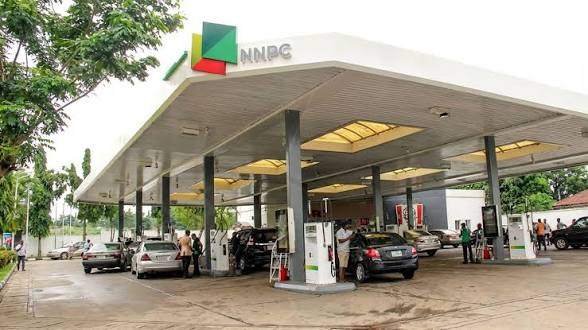
The Federal Government has announced 10 measures aimed at easing the impact of rising petrol prices on households, businesses and transport users.
The measures were announced by the Minister of Finance and Coordinating Minister of the Economy, Taiwo Oyedele, during a press briefing on fuel prices and the subsidy question in Abuja on Thursday.

According to the government, the interventions are designed to reduce the immediate burden of higher petrol prices without reintroducing a blanket fuel subsidy.
Below are the 10 measures announced by the Federal Government.
1. 30-day petrol discount at NNPC stations
The government will introduce a 30-day discount on petrol sold by the Nigerian National Petroleum Company Limited (NNPC), with priority given to public transport operators nationwide.
“We are offering a discount on petrol dispensed by NNPC Limited for the next 30 days, with priority for public transporters nationwide,” Oyedele said.
He explained that the initiative would not amount to a return to fuel subsidy, as petrol would effectively be sold at cost under the arrangement.
2. Forward sales of crude oil to local refineries
The government plans to increase forward sales of crude oil to domestic refineries as production rises.
Oyedele said the move would free up committed crude supplies and help protect local petrol prices from fluctuations in the international market.
3. N1,350 ceiling on petrol landing cost
The government is negotiating a ceiling of N1,350 per litre on the ex-gantry or landing cost of petrol.
Under the proposed arrangement, refiners and importers would absorb any shortfall when costs exceed the ceiling and recover the difference when crude oil prices or the exchange rate become more favourable.
Oyedele said, “The government is negotiating a ceiling of 1,350 naira a litre on the ex-gantry or landing cost of petrol, to keep pump prices stable. Where costs rise above the ceiling, refiners and importers will carry the shortfall and recover it later, when crude prices or the exchange rate allow, without breaching the ceiling.
“This is neither a subsidy nor a price control: it is designed to smooth prices over time rather than suppressing them. The reasoning is simple. 1,400 naira a litre today and 1,400 tomorrow is better than 1,500 today and 1,300 tomorrow, because volatility itself adds to uncertainty and cost.
“And when fares go up sharply, they rarely come down as fast. The ceiling will be reviewed every month, reset where costs require, and the figures published for transparency.”
4. Removal of illegal levies
The Federal Government plans to work with state governments to tackle illegal road taxes and levies that increase the cost of transporting goods and services.
Oyedele said the initiative would be pursued under the 2025 tax reform laws.
5. More direct support for vulnerable Nigerians
The government will increase cash transfers to vulnerable households to help cushion the impact of higher petrol prices.
It also plans to provide subsidised credit to small businesses and consumers.
6. Faster rollout of CNG vehicles
The government intends to accelerate the deployment of compressed natural gas (CNG) vehicles across the country.
Federal and state governments will support the initiative, while transport operators will be encouraged to pass on savings from CNG use to passengers.
7. Excess profit tax
The Federal Government will consider introducing an excess profit tax for operators found to be taking undue advantage of the situation across the energy value chain.
“The proceeds will be used exclusively to cushion the impact of fuel prices, through transport support or vouchers for urban minimum wage earners who are the most vulnerable,” Oyedele said.
The government also plans to work with the National Assembly to introduce enhanced tax relief for low-income earners through the 2027 Finance Bill.
8. Reduction of regulatory costs
The government plans to cut unnecessary regulatory requirements and costs that increase businesses’ operating expenses and ultimately drive up the prices of goods and services.
9. National Strategic Fuel Reserve
The government intends to establish a National Strategic Fuel Reserve to strengthen supply security and minimise the effects of global disruptions.
Oyedele added, “Refined products will be released into the market under clear, published rules whenever a global disruption or hoarding threatens supply and price stability.
“This is not a subsidy and it does not fix prices, rather it secures supply and reduces price volatility. It will prevent artificial scarcity, deter market manipulation and anchor long-term energy security, so that a deregulated market delivers stable growth and not sudden price shocks.”
10. Improved traffic and logistics management
The government will improve traffic management in urban areas to reduce fuel consumption and lower logistics costs.
It also plans to use NIPOST address codes to make logistics operations more efficient and affordable.
The measures come amid rising petrol prices driven by increases in international crude oil and refined-product prices. The government has maintained that it does not intend to reinstate a blanket fuel subsidy.
Instead, Oyedele said the government would rely on targeted interventions to support those most affected while protecting the wider economy.
“To be perfectly clear, none of these measures restores a blanket subsidy. To do so would amount to creating longer-term harm for a short-term cure. Each measure is designed to reach the people who need help, without putting the wider economy at risk,” he said.