

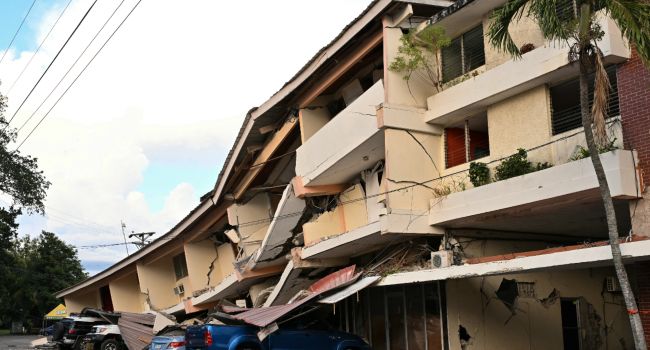
A powerful 7.7-magnitude earthquake has struck Panama, injuring at least 27 people, damaging buildings and roads, and triggering evacuations across the Central American country.
The shallow tremor struck on Friday and was felt across Panama, which has a population of about 4.5 million, according to the National Civil Protection System.

The head of emergency operations, Rene Garcia, told AFP that no deaths had been reported as of Friday.
The earthquake caused panic in Panama City, about 200 kilometres from the epicentre, as residents rushed out of high-rise buildings and sought safety from the shaking.
“I was scared because the shaking was very strong and prolonged,” Salomon Andion, 46, told AFP after evacuating his 15-storey building for the second time following aftershocks.
“Heavy objects like dressers, the bed, and all the kitchen items were shaking,” he added.
Videos shared on social media showed water spilling from the rooftop swimming pool of a building more than 20 storeys high. Another video showed a bridge over the Panama Canal shaking violently while vehicles continued to cross it.
President Jose Raul Mulino described the situation as a major disaster, saying some roads had completely collapsed.
“It was horrible, like nothing we ever experienced. My daughter was trapped in school,” Juana Alveo, a 38-year-old cashier in Penonome, in the central province of Cocle, told AFP.
According to the National Civil Protection System, at least 27 people sustained minor injuries across the country.
The United States Geological Survey said the earthquake struck at 12:56 pm local time, with its epicentre about 10 kilometres from the town of Pitaloza Arriba in central Herrera province.
The USGS initially estimated the earthquake’s magnitude at 8.0 before revising it to 7.7.
A tsunami warning was issued for the eastern Pacific but was later lifted.
Airport closed as rescue efforts begin
Panama City’s international airport, a major regional aviation hub, was temporarily closed following the earthquake.
The Civil Aeronautics Authority said several flights were diverted to other airports as a precaution.
US Secretary of State Marco Rubio said on Friday that he was closely monitoring the situation and that his office was mobilising resources and personnel to assist at the request of the Panamanian Government.
However, the Panama Canal Authority said shipping through the canal, which connects the Pacific and Atlantic oceans, remained unaffected and continued to operate normally.
President Mulino travelled to Penonome to coordinate the emergency response.
Health Minister Fernando Boyd identified Herrera, Cocle and Los Santos as the worst-affected provinces. He said the town of Tonosi, in Los Santos, had been completely cut off.
“We are trying to figure out how to get there by air, because it’s impossible by land,” Boyd said.
The leaders of Colombia, Ecuador and Guatemala expressed solidarity with Panama and offered assistance.
Residents also reported extensive damage to homes and other buildings.
Benjamin Gonzalez, 52, said he was at a farm near La Miel when the earthquake struck. On returning home, he found several houses devastated and residents gathered in a town square without electricity.
His neighbour, David Castillo, said many residents were afraid to return to their homes because they feared another earthquake.
More than 80 aftershocks recorded
Earthquakes are relatively uncommon in Panama and usually occur in the western province of Chiriqui, which borders Costa Rica.
Former president Ricardo Martinelli shared photographs on Instagram showing that his house in Sona, Veraguas province, had collapsed.
A church and a hotel in Penonome also suffered extensive damage, according to images shared by local media.
The country’s geosciences institute recorded more than 80 aftershocks, including one with a magnitude above 6.0.
President Mulino urged residents to remain calm and avoid spreading panic.
“What happened should not be used to generate alarm and disorder,” he wrote on X, adding that he had requested a report on the damage.
The Education Ministry suspended classes in schools nationwide as authorities assessed the impact of the earthquake.
The tremor was among several powerful earthquakes recorded in Latin America in 2026, following major earthquakes in Venezuela’s La Guaira region in June and western Colombia in August.