

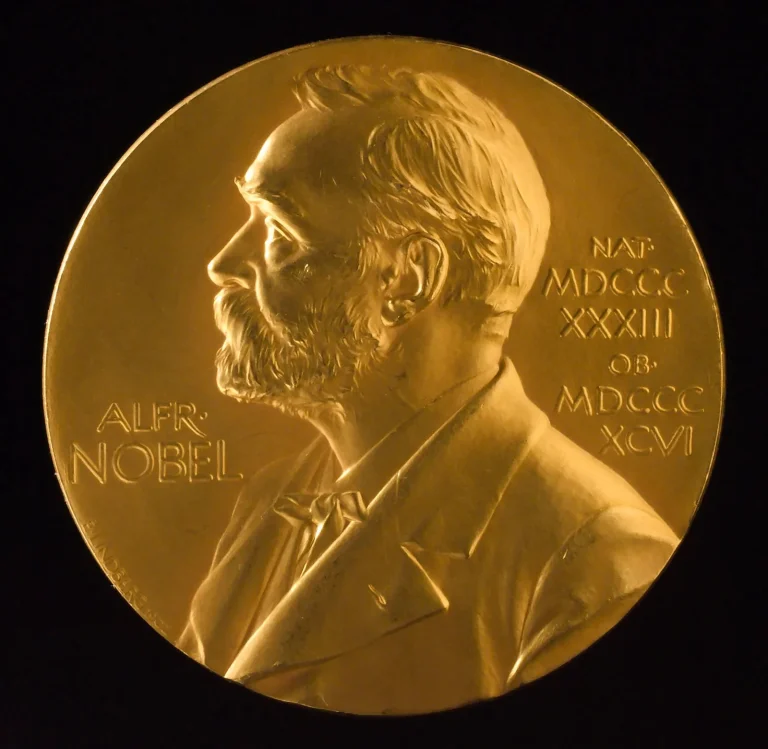
The 2026 Nobel Prize winners have been announced across six categories, recognising contributions ranging from scientific discoveries that allow researchers to control nerve cells in the brain using light to efforts to strengthen international law.
The awards cover physiology or medicine, physics, chemistry, literature, peace and economic sciences.

The annual announcements began on October 5 with the Nobel Prize in Physiology or Medicine and concluded on Monday, October 12, with the economics prize.
The Nobel Prize has been awarded since 1901, following the will of Swedish inventor and industrialist Alfred Nobel, who directed that his fortune be used to reward contributions that conferred the greatest benefit on humanity.
The economics prize was established later by Sweden’s central bank and was first awarded in 1969.
Below is the full list of the 2026 laureates, the reasons for their recognition and brief profiles of the winners, according to information published on the Nobel Prize’s official website.
1. Physiology or medicine: Karl Deisseroth, Peter Hegemann and Georg Nagel
American scientist Karl Deisseroth and German scientists Peter Hegemann and Georg Nagel won the Nobel Prize in Physiology or Medicine for their discoveries concerning light-gated ion channels and optogenetics.
Their research helped establish optogenetics, a technique that enables scientists to control the activity of nerve cells using light.
The development has transformed neuroscience by allowing researchers to investigate how specific brain cells influence memory, emotions and behaviour.
Hegemann and Nagel discovered a light-sensitive protein in algae, while Deisseroth helped transform the discovery into a practical technique for controlling nerve cells with light.
The method has created new opportunities for studying the brain and investigating neurological and psychiatric conditions.
About the winners
Karl Deisseroth: Born in 1971, Deisseroth is an American neuroscientist and psychiatrist at Stanford University, where he serves as the D.H. Chen Professor of Bioengineering and Psychiatry and Behavioral Sciences.
He obtained his MD and PhD from Stanford University.
Peter Hegemann: Born in 1954, Hegemann is a German neuroscientist and Hertie Senior Professor of Neuroscience at Humboldt University of Berlin. He earned his doctorate at the Max Planck Institute for Biochemistry.
Georg Nagel: Born in 1953, Nagel is a German scientist and professor of molecular plant physiology at the University of Würzburg.
His research contributed to the discovery of the light-sensitive proteins that made optogenetics possible.
2. Physics: Francis Halzen
Belgian-American physicist Francis Halzen won the 2026 Nobel Prize in Physics for his decisive contributions to the IceCube Neutrino Observatory and the discovery of high-energy neutrinos originating from astrophysical sources.
Neutrinos are elusive subatomic particles that can travel through matter with very little interaction.
Detecting these particles allows scientists to investigate some of the universe’s most energetic events, including phenomena associated with distant galaxies and black holes.
Halzen’s vision helped establish IceCube, a vast detector embedded in Antarctic ice at the South Pole.
The observatory uses thousands of sensors to detect faint flashes of light generated when neutrinos interact with matter.
About the winner
Halzen was born in Belgium in 1944.
He studied at the Catholic University of Leuven, now known as KU Leuven, where he obtained his master’s and doctoral degrees.
He joined the physics faculty at the University of Wisconsin–Madison in 1972 and became a leading figure in neutrino astronomy.
Halzen has served as the principal investigator of the IceCube Neutrino Observatory.
3. Chemistry: Henri B. Kagan and Kenso Soai
French chemist Henri B. Kagan and Japanese chemist Kenso Soai received the 2026 Nobel Prize in Chemistry for discoveries concerning asymmetric organic synthesis and how chemical reactions can favour one of two mirror-image forms of a molecule.
Many molecules exist in two forms that are mirror images of each other.
Although chemically similar, these forms can behave differently in biological systems, making the distinction particularly important in the development of medicines and other biologically active compounds.
Kagan’s research advanced asymmetric catalysis, which enables chemical reactions to produce a preferred molecular form.
Soai’s work demonstrated asymmetric autocatalysis, a process in which the product of a reaction helps catalyse the production of more of the same form.
His discovery became known as the Soai reaction.
About the winners
Henri B. Kagan: Kagan is a French chemist associated with Université Paris-Sud, now part of Université Paris-Saclay. He is recognised for his influential contributions to stereochemistry and asymmetric catalysis.
His research helped establish methods for controlling the three-dimensional structures of molecules produced during chemical reactions.
Kenso Soai: Born in Hiroshima Prefecture, Japan, in 1950, Soai graduated from the University of Tokyo and obtained a Doctor of Science degree.
He became a professor at Tokyo University of Science, where he conducted the research that led to the discovery of the Soai reaction.
He is now a professor emeritus at the institution.
4. Literature: Anne Carson
Canadian poet, essayist, classicist and translator Anne Carson won the 2026 Nobel Prize in Literature for her distinctive body of work, which draws on classical literature while introducing new forms of contemporary writing.
The Swedish Academy honoured Carson “for her bold and inventive oeuvre that, in playful dialogue with the classical tradition, has created new forms for contemporary literature”.
Her writing frequently connects ancient Greek literature and ideas with modern experiences.
Carson’s work spans poetry, prose, translation and scholarship, making it difficult to classify within a single literary genre.
About the winner
Carson was born on June 21, 1950, in Toronto, Canada.
She earned her bachelor’s and master’s degrees from the University of Toronto in 1974 and 1975, respectively, before completing her PhD at the institution in 1981.
Her notable works include Eros the Bittersweet, Autobiography of Red and If Not, Winter: Fragments of Sappho.
Her honours include a MacArthur Fellowship, Guggenheim Fellowships and Spain’s Princess of Asturias Award for Literature.
She was appointed a Member of the Order of Canada in 2005.
5. Peace: Navanethem ‘Navi’ Pillay
South African jurist and former United Nations High Commissioner for Human Rights Navanethem “Navi” Pillay won the 2026 Nobel Peace Prize for her efforts to promote peace and international law.
The Norwegian Nobel Committee recognised her contributions to advancing an international legal order and ensuring that war crimes, crimes against humanity and genocide can be prosecuted.
Pillay’s career has included defending activists during apartheid, serving in international courts and leading human rights initiatives at the United Nations.
Her award highlights the role of legal institutions in holding perpetrators of serious crimes accountable and supporting the peaceful resolution of conflicts.
About the winner
Pillay was born in 1941 in Durban, South Africa, into a family of Indian Tamil descent.
She became a lawyer during apartheid and established her own law firm in 1967.
She studied at Harvard University, where she earned a Doctor of Juridical Science degree in 1988. In 1995, she became a judge of South Africa’s High Court.
Four years later, she became a judge and president of the International Criminal Tribunal for Rwanda.
Pillay subsequently served as a judge of the International Criminal Court and as the UN High Commissioner for Human Rights from 2008 to 2014.
She also chaired the UN Independent International Commission of Inquiry on the Occupied Palestinian Territory from 2021 to 2025.
6. Economic sciences: Robert E. Hall and Michael Woodford
American economists Robert E. Hall and Michael Woodford won the 2026 Sveriges Riksbank Prize in Economic Sciences in Memory of Alfred Nobel for their work on “microeconomic foundations of macroeconomic stabilisation”.
The Royal Swedish Academy of Sciences announced the award on Monday, marking the conclusion of this year’s Nobel Prize announcements.
The economists developed macroeconomic models that improve understanding of how governments and central banks can stabilise economies during recessions and periods of rapid growth.
Their work builds on the principle that economic policy becomes more effective when models account for how individual households and businesses make decisions about spending, saving and prices, including their expectations about future policies.
Their research has helped establish a theoretical foundation for modern approaches to fiscal and monetary policy.
About the winners
Robert E. Hall: Born in 1943 in Palo Alto, California, Hall obtained his PhD from the Massachusetts Institute of Technology in 1967.
He is a professor at Stanford University in California and is known for his research into macroeconomics, economic fluctuations and consumer behaviour.
Michael Woodford: Born in 1955 in Chicopee, Massachusetts, Woodford received his PhD from the Massachusetts Institute of Technology in 1983.
He is a professor at Columbia University in New York and is recognised for his work on monetary policy, economic expectations and macroeconomic theory.
The economics prize differs from the original Nobel Prizes because it was established by Sweden’s central bank in memory of Alfred Nobel.
It was first awarded in 1969 and is now announced alongside the five original Nobel Prize categories.
When will the 2026 Nobel Prizes be presented?
The laureates are traditionally invited to receive their medals and diplomas at ceremonies held on December 10, the anniversary of Alfred Nobel’s death.
The Nobel Peace Prize ceremony takes place in Oslo, Norway, while the other prizes are presented in Stockholm, Sweden.