


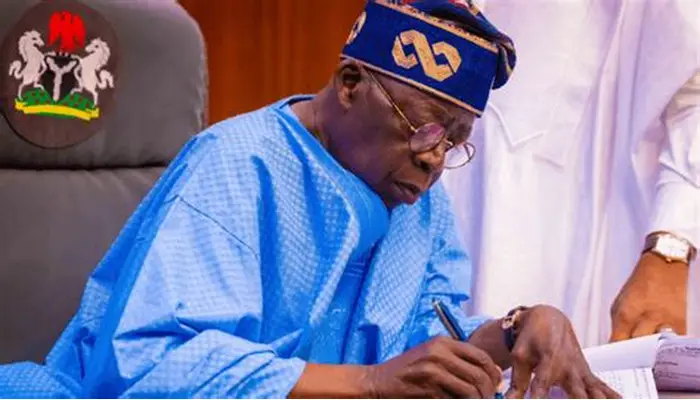
The Presidency has refuted allegations that President Bola Tinubu accumulated ₦120 trillion in loans within three years while simultaneously scrapping the fuel subsidy, describing the claims as misleading.
In a statement shared on X on Sunday, the President’s Special Assistant on Social Media, Dada Olusegun, attributed the figures to what he called “Opposition’s propaganda machines.”
Olusegun argued that the comparison suggesting 16 previous Nigerian leaders collectively borrowed ₦46 trillion over 63 years, while Tinubu secured ₦120 trillion in just three years, failed to provide the complete financial picture.
“Opposition’s propaganda machines claim that in 63 years, 16 past Nigerian leaders borrowed ₦46 trillion combined, while President Tinubu borrowed ₦120 trillion in just 3 years and still removed the fuel subsidy.
“But in reality, the ₦46 trillion figure from late 2022 hid ₦22.7 trillion in Central Bank ‘Ways and Means’ overdrafts that weren’t officially put on the books until May 2023,” Olusegun stated.
He further explained that previous debt calculations relied on an artificial exchange rate of ₦448 to the dollar when the parallel market rate had already exceeded ₦700.

“When the exchange rate was unified in June 2023, the exact same dollar debt instantly looked ₦13.4 trillion larger on paper overnight without a single new dollar being borrowed.”
According to Olusegun, Nigeria’s public debt increased from $113.4 billion in June 2023 to $120.9 billion by June 2026, representing an increase of just $7.5 billion in dollar terms.
Addressing the removal of the fuel subsidy, he said the decision had significantly increased the monthly allocations shared among the federal, state and local governments through the Federation Account Allocation Committee (FAAC).

He disclosed that monthly FAAC disbursements to states and local governments rose from ₦656 billion in April 2023 to ₦2.4 trillion by September 2026.
The controversy followed the circulation of a viral social media graphic comparing the borrowing records of previous administrations with that of the Tinubu government, alongside the removal of the fuel subsidy.
However, fact-checkers have faulted the graphic, explaining that the ₦46 trillion figure represented Nigeria’s outstanding debt as of the end of 2022, rather than the cumulative amount borrowed by 16 administrations over 63 years.
They also pointed to its failure to properly account for exchange-rate adjustments and the formal recognition of financial obligations that were previously excluded from official debt records.
Nigeria’s public debt was approximately ₦87.38 trillion, equivalent to $113.4 billion, in June 2023, shortly after Tinubu assumed office.
By June 2026, the figure had climbed to approximately ₦166.79 trillion, or $120.93 billion, according to data from the Debt Management Office.
Much of the increase in the naira-denominated debt was attributed to the 2023 exchange-rate liberalisation and the securitisation of Ways and Means advances inherited from the previous administration.
The Presidency’s latest clarification comes amid renewed borrowing plans by the Tinubu administration.
The President recently asked the Senate to approve a $7.7 billion external borrowing proposal to help finance the 2026 budget deficit.
The request, estimated at approximately ₦10.79 trillion using the budget exchange rate of ₦1,400 to the dollar, was conveyed in a letter read by Senate President Godswill Akpabio during Wednesday’s plenary.
The latest proposal replaced an earlier borrowing request of $20.52 billion and €1.045 billion, which Tinubu had submitted to the Senate and House of Representatives a week earlier.
Opposition parties, including the Nigeria Democratic Congress, have criticised the proposed borrowing, expressing concerns over Nigeria’s growing debt profile and the financial implications for future generations.
