


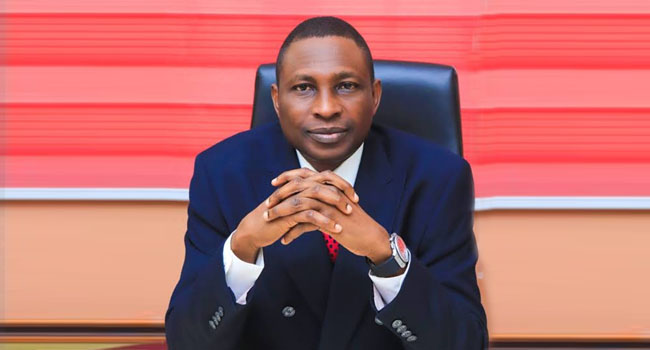
The Economic and Financial Crimes Commission Chairman, Ola Olukoyede, has challenged fresh engineering graduates to build their careers on honesty and accountability, warning that professional misconduct could have deadly consequences.
He gave the charge during the induction of 45 engineering graduates at Bamidele Olumilua University of Education, Science and Technology in Ikere-Ekiti, Ekiti State, on Friday.
Speaking on the theme, “Integrity, Accountability and the Fight Against Economic and Financial Crimes: Building a Culture of Transparency and Responsibility in Nigeria,” Olukoyede said corruption remained one of the major reasons Nigeria had struggled to achieve meaningful economic progress despite its enormous resources.

He urged the graduates to resist the temptation of making quick money through internet fraud, identity theft and other criminal activities, warning that such actions could ruin the opportunities ahead of them.
The EFCC chairman explained that corruption was not limited to stealing public funds, identifying several other practices, including contract manipulation, money laundering, tax evasion, procurement fraud, terrorist financing and cybercrime.
He particularly warned that dishonesty among engineers could result in the execution of dangerous projects, as professionals who compromise standards might expose members of the public to avoidable risks.

“The absence of integrity allows professionals to falsify records, manipulate contracts, divert public funds and compromise the quality of projects meant to serve the public. Corruption in the public and private sectors remains a major obstacle to Nigeria’s development,” he said.
Olukoyede also criticised the growing tendency to celebrate questionable wealth, noting that some individuals with unexplained sources of income were treated as role models and honoured in traditional and religious settings.
He further disclosed that the commission had secured 10,872 convictions and recovered assets worth over N1.288tn in the past three years through its efforts against financial and economic crimes.
On preventive measures, he spoke about the EFCC’s Department of Fraud Risk Assessment and Control, which monitors government agencies, identifies financial weaknesses and examines budget implementation to reduce opportunities for fraud.
He also highlighted the commission’s collaboration with religious organisations through an updated Interfaith Manual unveiled in September 2026.
Other initiatives mentioned included its radio station, Cybercrime Rapid Response Centre and plans to establish a Cybercrime Research Centre at the EFCC academy in Giri, Abuja.
The anti-graft chairman called for stronger involvement from parents, schools, religious institutions, traditional leaders and professional organisations in raising a generation that values integrity.
Meanwhile, engineer and entrepreneur Henrich Akomolafe addressed the growing role of artificial intelligence in engineering, explaining how the technology was transforming design, construction, manufacturing and maintenance.
However, he warned that technological advancement should not come at the expense of professional judgement and accountability.
“AI is a tool that strengthens engineering capability; it is not a substitute for engineering judgement, professional ethics or human responsibility,” he said.
The university’s Vice-Chancellor, Prof. Babatunde Omojola, said the induction was part of the institution’s efforts to prepare graduates for the demands and responsibilities of professional practice.
The Dean of the Faculty of Engineering, S.A. Akinola, also described the ceremony as an important step in preparing the graduates for their responsibilities to society, adding that their professional oath signified a commitment to putting their expertise to public service.
