
CIBN tasks sector players on resilient economy as 19th banking and finance conference gets underway
...Tinubu, Shettima, Oyedele, Cardoso billed to attend

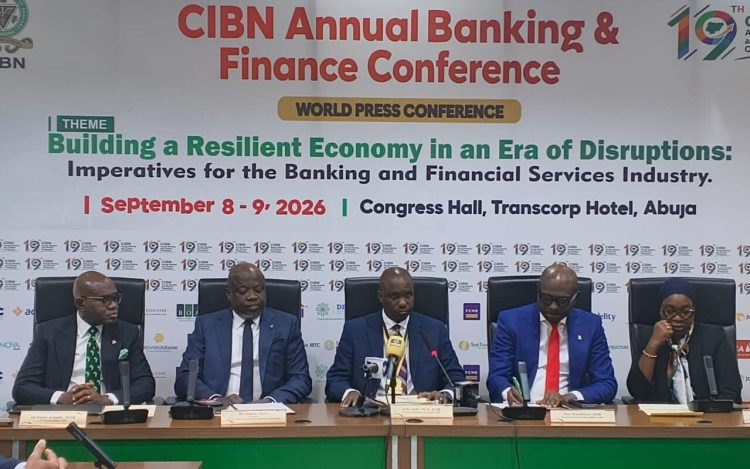
The Chartered Institute of Bankers of Nigeria (CIBN) has tasked the banking and financial services sector on building a resilient economy capable of withstanding anticipated and unanticipated economic disruptions on local and global scale.
The President and Chairman of Council of the CIBN, Dele Alabi, made the call at the world press conference on the institute’s 19th Annual Banking and Finance Conference, scheduled for 8-9 September at the Congress Hall, Transcorp Hilton, Abuja.

According to Alabi, the conference, themed “Building a Resilient Economy in an Era of Disruptions: Strategic Imperatives for the Banking and Financial Services Industry,” will bring together policymakers, regulators, financial institutions, development partners, technology innovators, academics and business leaders to deliberate on the future of the banking and financial services industry.
The Institute also called on Nigerian banks to deploy their recently raised capital towards financing micro, small and medium-sized enterprises (MSMEs), saying increased lending to the sector is critical to achieving stronger economic growth and Nigeria’s ambition of building a $1 trillion economy.
Speaking on the forthcoming institute’s two-day conference in September, Alabi described it as timely amid technological disruption, geopolitical uncertainties, evolving customer expectations, cybersecurity risks, and climate-related challenges confronting the global economy.
According to him, resilience has become a defining attribute of successful financial systems.
He said the conference aligns with the strategic direction of his administration under the Institute’s IMPACT vision, which focuses on Inclusion, Membership Economy, Professionalism and Ethical Conduct, Accountability and Enhanced Financial Performance, Competencies and Skills Development, and Technology, Automation and Innovation.
“Through the Conference, we seek to equip industry practitioners with forward-looking insights, strengthen institutional capabilities, and stimulate conversations that will accelerate innovation while reinforcing the professionalism and ethical standards upon which sustainable banking must be built. In doing so, we also advance our broader objective of positioning Nigeria’s banking profession to compete confidently on the global stage,” Mr said.
The CIBN president said more than 10,000 delegates from Nigeria and across the world are expected to participate in the conference.
He said the expected participants would include banking executives, regulators, government officials, development partners, academics, fintech leaders, investors and other stakeholders in the financial ecosystem.
Also speaking at the briefing, Moruf Oseni, Chairman of the Consultative Committee for the 19th Annual Banking and Finance Conference and Managing Director/Chief Executive Officer of Wema Bank Plc, who was represented by the Director, Southwest and Specialised Business, Wema Bank, said the conference would provide practical insights and actionable recommendations for strengthening institutions and positioning the Nigerian banking industry for sustained growth.
Oseni said the conference would serve as a knowledge-sharing and solution-driven platform where stakeholders would exchange ideas, share experiences, and develop practical solutions to challenges affecting the financial services sector and the broader economy.
“As customary, the resolutions reached at the Conference will be documented and forwarded to relevant stakeholders and policymakers in the form of a communique, to support informed decision-making, policy formulation, and strategic alignment with global best practices,” Mr Oseni said.
The organisers said President Bola Ahmed Tinubu, Vice President Kashim Shettima, Minister of Finance and Coordinating Minister of the Economy, Taiwo Oyedele, and Governor of the Central Bank of Nigeria, Olayemi Cardoso, are among the dignitaries expected at the event.
According to Oseni, other participants will include leaders from government, regulatory institutions, development organisations and the private sector.
The conference will feature three business sessions focused on major challenges and opportunities facing the financial services industry.
The first session, titled “Shaping the New Financial System for Nigeria’s Prosperity: The Role of Recapitalisation, AI and Geopolitical Dynamics,” will examine the implications of bank recapitalisation, artificial intelligence and geopolitical developments for Nigeria’s financial system.
The second session, a women-focused engagement, is titled “Inclusive Leadership, Stronger Systems: The Strategic Role of Women in Building Resilient Financial Ecosystems.”
The third session, titled “Navigating Cyber and Systemic Risks in the AI-Driven Future of Banking: Implications for Financial Stability and Business Resilience,” will focus on cybersecurity, systemic risks, financial stability and business resilience in an increasingly AI-driven banking environment.
Oseni said the sessions were designed to address the most pressing issues facing the banking and financial services industry, while exploring strategies to strengthen financial stability, improve cybersecurity and risk management, and accelerate innovation to support sustainable economic growth.
The CIBN president during the question-and-answer session, said the recent recapitalisation of banks had provided stronger buffers for their balance sheets, arguing that the additional capital should now be deployed towards productive sectors of the economy rather than remaining concentrated in government securities and large corporate borrowers.
“Capitalisation provides a buffer for shocks. It insulates banks’ balance sheets, but it does not stop there,” he said.
According to him, the banking landscape has changed significantly, particularly as declining interest rates and tighter borrowing margins among top-tier companies reduce the attractiveness of the traditional approach to deploying bank funds.
“Smart bankers, smart bank CEOs have to think of a more ingenious way of utilising this capital. Capital is not cheap. Capital is the most expensive source of funds. It’s more expensive than debt. Equity capital is more expensive than debt capital,” Alabi said.
The CIBN president said banks should therefore look further down the economic ladder by increasing financing to MSMEs, which he described as critical drivers of economic growth, particularly in emerging markets.
