

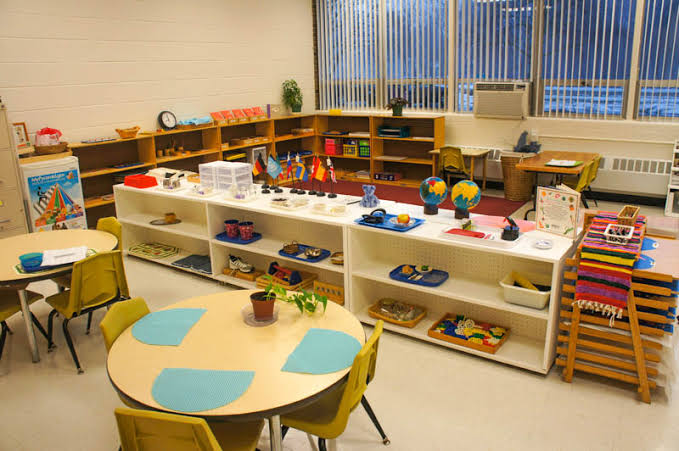
A Montessori school is an environment with plenty of materials for hands-on learning, and children are encouraged to focus on – and often stick with – activities that pique their interest.
This stands in contrast to traditional school, where students in the same grade generally move through a structured and scheduled curriculum.

Peek into an early-grade classroom at a Montessori school and you are likely to see children of different ages moving around and talking, free to explore a variety of activities. Each activity will advance learning and development, but may not include instructions on exactly what to do and when.
Below are nine ways to spot a good Montessori school for your children.
1. Check For Accreditation And Affiliation
Check if the school is accredited by recognised Montessori organisations such as the Montessori Accreditation Council for Teacher Education (MACTE).
These organisations set standards for the kind of education and ensure that the school follows authentic Montessori principles.
Before considering a Montessori school, conduct thorough research to gather information about its history, reputation, and educational philosophy.
Visit the school’s website, read testimonials, and explore online forums for parents’ experiences.
Additionally, check if the school is affiliated with recognised Montessori organisations and has qualified teachers trained for this level of education.
2. Trained Montessori Teachers
Teachers should have specific training from a reputable institution in Montessori education.
Ask about the qualifications and experience of the teachers at the school and if they hold Montessori certifications.
Qualified and trained teachers are crucial in creating a nurturing and stimulating learning environment.
A good school will have teachers who understand the Montessori philosophy, respect each child’s individuality, and guide their learning journey.
4. Prepared Environment
Montessori classrooms should be carefully prepared to foster independent learning and exploration.
Look for a well-organised and orderly environment with materials and activities that are easily accessible to the children.
5. Mixed-Age Groupings
The classrooms for this level of education typically have mixed-age groupings, allowing children to learn from and interact with peers of different ages.
This fosters a sense of community, promotes cooperation, and allows older children to mentor younger ones.
6. Child-Centered Approach
This level of education emphasises individualised learning and tailoring instruction to each child’s unique needs and interests.
Observe if the school focuses on child-led activities, encourages independence, and allows children to learn at their own pace.
7. Focus On Hands-On Learning:
Montessori education emphasises hands-on learning experiences and the use of manipulative materials.
Check if the school provides a wide range of materials that suit that level of education and encourage children to engage in practical life activities, sensory exploration and concrete learning experiences.
8. Respectful And Nurturing Environment
This level of education emphasises respect for each child, their individuality, and their developmental needs.
The school should provide a supportive and nurturing environment where children feel safe, valued, and encouraged to express themselves.
9. Observations And Visits
Before deciding, try to visit the school and observe the classroom in action.
Pay attention to the interactions between the teachers and children, the atmosphere of the school, and the overall learning environment.
Choosing a very nice school for your child requires careful consideration and research.
By identifying a good Montessori school, you provide your child with a solid foundation for lifelong learning, independence, and personal growth.
