

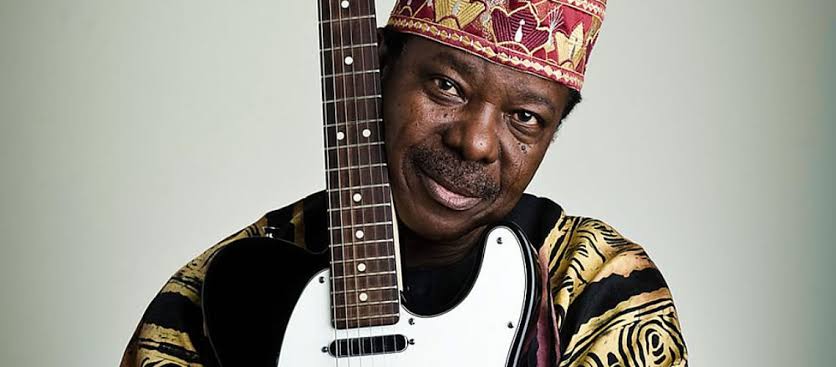
King Sunny Adé, whose real name is Chief Sunday Adeniyi Adegeye, is one of Nigeria’s most internationally recognised musicians and a major figure in the development and global spread of jùjú music.
He celebrated his 80th birthday on 22 September 2026.

Quick facts
| Detail | Information |
|---|---|
| Full name | Chief Sunday Adeniyi Adegeye |
| Stage name | King Sunny Adé |
| Born | 22 September 1946 |
| Age | 80 years |
| Nationality | Nigerian |
| Ethnicity | Yoruba |
| Music genre | Jùjú, African pop |
| Profession | Singer, songwriter, guitarist, bandleader, multi-instrumentalist |
| Years active | 1960s–present |
| Major band | King Sunny Adé and His African Beats |
| Record label | Sunny Alade and other labels |
| International label | Island Records/Mango |
| Grammy nominations | 2 |
| Notable albums | Juju Music, Synchro System, Aura, Odu, Seven Degrees North |
| Also known as | KSA, The Chairman |

Early life
Sunny Adé was born Sunday Adeniyi Adegeye on 22 September 1946. Sources differ on the exact description of his birthplace: some give Ondo, while biographical accounts describe him as being born in Osogbo to a family with royal connections from Ondo and Akure.
He comes from a Yoruba royal family. His father was a church organist, while his mother, Maria Adegeye, was a trader. His maternal family was connected to the Adesida dynasty of Akure.
He eventually left formal education to pursue music and moved into the Lagos music scene.
How his music career began
In the 1960s, Sunny Adé performed with Moses Olaiya’s Federal Rhythm Dandies, a highlife band. He later established his own group, initially known as the Green Spots, in 1967. The group eventually became associated with the name African Beats.
By the 1970s, he had become a major name in Nigerian music. He also established his own record label, giving him greater control over his recordings and business activities.

Why King Sunny Adé is important to jùjú music
Jùjú is a Nigerian popular music tradition particularly associated with the Yoruba cultural environment. Sunny Adé helped develop the genre into a large-scale band sound incorporating:
- Electric guitars
- Steel guitar
- Talking drums
- Percussion
- Keyboards and synthesizers
- Bass guitar
- Traditional Yoruba rhythms
- Layered vocals
- Dance and stage performance
His music combined traditional Nigerian musical elements with modern instruments and production techniques. His use of multiple guitars and extensive percussion became an important characteristic of his sound.
His international breakthrough
A major turning point came in 1982, when he signed with Island Records’ Mango label and released Juju Music internationally.
The album introduced his music to a much wider audience in Europe and North America.
His follow-up album, Synchro System, was released in 1983. It earned him a Grammy nomination, making him the first Nigerian artist to receive a Grammy nomination.
The album was nominated in the Best Ethnic or Traditional Folk Recording category at the 26th Grammy Awards.

King Sunny Adé has received two Grammy nominations:
- 1984 – Synchro System
Category: Best Ethnic or Traditional Folk Recording - 1999 – Odu
Category: Best World Music Album
He has not won a Grammy. The Recording Academy currently lists him with two nominations and zero wins.
Major albums
Some of his best-known albums include:
- Juju Music — 1982
- Synchro System — 1983
- Aura — 1984
- Live Live Ju Ju — 1988
- E Dide (Get Up) — 1995
- Odu — 1998
- Seven Degrees North — 2000
- Omo Wunmi — 2003
- Bábá Mo Túndé — 2010
His discography extends across decades and includes a very large number of Nigerian releases.
Juju Music
Released internationally in 1982, Juju Music was particularly significant because it brought Sunny Adé’s established Nigerian sound to a global audience.
The album incorporated traditional jùjú instrumentation with electric guitars, percussion and newer studio technology. It was produced by Martin Meissonnier.
Synchro System
Released in 1983, Synchro System continued his international success.
The album incorporated multiple guitars, talking drums, percussion and synthesiser elements. It also received his first Grammy nomination.
Odu
Odu was released in 1998 and drew heavily on traditional Yoruba musical material. The album received his second Grammy nomination in 1999 in the Best World Music Album category.
King Sunny Adé and Stevie Wonder
Sunny Adé also worked with international musicians. Stevie Wonder played harmonica on Aura. In a contemporary interview, Sunny Adé explained that much of the recording had already been completed before Wonder’s contribution was added.
Business interests
Sunny Adé has also been involved in business outside music. Sources have documented interests associated with areas including:
- Record production
- Film and video production
- Entertainment
- Nightlife
- Mining
- Oil-related business
He became known in Nigeria by the nickname “The Chairman”, reflecting his extensive business activities.
King Sunny Ade Foundation
He established the King Sunny Ade Foundation, which has supported musicians and performers.
The foundation has been associated with a performing arts centre, recording facilities and accommodation for young musicians and performers.
Copyright advocacy
Sunny Adé has also been involved in efforts to protect musicians’ intellectual property. He served in leadership roles with the Musical Copyright Society of Nigeria, an organisation concerned with copyright protection and royalties for Nigerian musicians.
Awards and honours
Among the honours associated with King Sunny Adé are:
- Two Grammy nominations
- Member of the Order of the Federal Republic (MFR)
- International recognition for his contribution to African/world music
- Numerous Nigerian and international music honours
Nigeria’s National Institute for Cultural Orientation and other Nigerian institutions have also recognised his contribution to Nigerian culture and music.
His influence
King Sunny Adé’s influence extends beyond Nigeria. His international recordings helped introduce Nigerian jùjú music to audiences outside Africa, particularly during the 1980s.
His music also demonstrated how traditional African musical forms could incorporate electric instruments and modern studio technology without abandoning their cultural foundations.
King Sunny Adé at 80
On 22 September 2026, President Bola Ahmed Tinubu publicly congratulated King Sunny Adé on his 80th birthday, describing him as an icon of Nigerian and African music and highlighting his contribution to the international recognition of jùjú music.
At 80, Sunny Adé’s career spans roughly six decades, from his early years in the Nigerian highlife and jùjú scenes to international tours, Grammy nominations and continued recognition as an important figure in Nigerian music.
Some notable songs associated with King Sunny Adé
His extensive catalogue includes songs such as:
- “Synchro System”
- “Ja Funmi”
- “Merciful God”
- “E Dide”
- “Mo Ti Mo”
- “Odu”
- “Ase”
- “Jigi Jigi Isapa”
His catalogue is considerably larger than this selection, with recordings spanning several decades.
In summary: King Sunny Adé is a Nigerian Yoruba musician, guitarist, songwriter and bandleader who played a major role in taking jùjú music from Nigeria to international audiences. His 1980s international breakthrough, two Grammy nominations, extensive recording career and cultural activities have made him a significant figure in Nigerian and African music.