

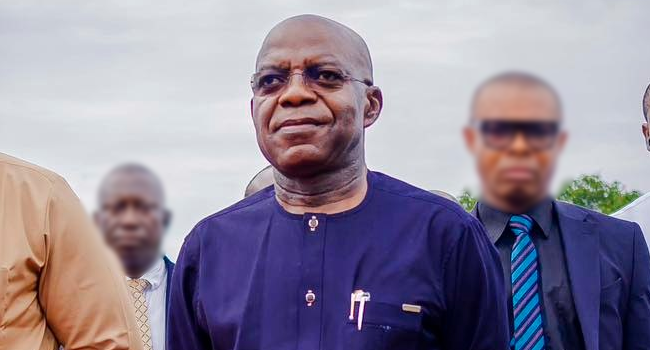
The Governor of Abia State has announced that the state is no longer affected by power outages linked to repeated collapses of the National Grid, following his administration’s investment in generating electricity from organic waste.
He made this known while speaking to journalists at the Government House on Thursday.

According to the governor, waste materials are now being processed into biogas and converted into renewable energy for residents, noting that Abia is no longer under the regulatory control of the Nigerian Electricity Regulatory Commission (NERC).
He further revealed that the new power arrangement had been negotiated and agreed upon by the Enugu Electricity Distribution Company (EEDC), which oversees electricity distribution in the state.
“This is a pilot programme. Instead of throwing away waste, we can turn it into clean energy, and we will be able to power a lot of places, particularly the Umuhaia in-farms.
“I had reported earlier that our offers to EEDC have been accepted, and we are in the process of raising the funds to pay off EEDC.
“On the 24th of December, the Abia state electricity regulation authority took over the regulation of power from the Nigerian Electricity Regulatory Commission. So everything about distribution, generation, and transmission is going to be regulated within the state.
“The whole idea is to ensure regulation of efficiency and independence in the state, just like the Aba Power provides power for the Aba in-farms.
“I am sure you would have been aware that some of the disasters (national grid collapses) that happened recently, our state was not affected, because a whole part of our power assets is within our authority.
“That is the whole idea of acquiring the whole Umuahia in-farms.
“I am happy we are making a lot of progress in that regard,” he said.
The disclosure comes amid ongoing challenges with Nigeria’s National Grid, which recorded its second collapse in 2026 on Tuesday, plunging large parts of the country into darkness.
The repeated grid failures have been attributed to technical issues, poor maintenance of transmission infrastructure, and fluctuations in generation capacity.
During the latest incident, electricity generation reportedly fell from over 4,500 megawatts to 0 megawatts by 11:00 a.m., as all 23 power generation plants connected to the grid lost output, leaving the 11 distribution companies without power allocation.
Reacting to the persistent outages, former Labour Party presidential candidate, Peter Obi, described the situation as a continuation of a worsening national crisis.
In a post on X titled “2026: The Collapse Continues”, Obi said the January 2026 collapse mirrored the pattern of 2025, which also began with a January failure followed by multiple disruptions.
“In January 2025, we witnessed the first grid collapse of that year, which was followed by several other collapses. Now in January 2026, the national shame has commenced with Saturday’s collapse,” he said.
He lamented Nigeria’s low electricity access rate, noting that nearly 100 million citizens remain without power and that the country has ranked lowest globally in electricity access for three consecutive years.
“It is utterly disappointing that for three consecutive years, from 2023 to 2025, our nation has been ranked as having the least access to electricity globally, with nearly 100 million citizens left without power,” Obi said.
Obi also compared Nigeria’s power generation capacity with other African nations, describing the disparity as alarming.
“Meanwhile, Nigeria, the giant of Africa and its most populous nation with over 240 million people, produces a mere 5,000 megawatts, an absurdly low figure that severely hampers our productivity,” he said.
According to him, the persistent power crisis is largely a result of governance failures, stressing the need for competent leadership in the sector.
“This power crisis is a direct result of continuous leadership failures. The power sector is critical and requires competent and committed leadership to thrive,” Obi added.
Meanwhile, the Nigeria National Grid (NNG) has identified metering and grid expansion as key long-term solutions to the recurring system failures.
“Metering is a huge part of the long-term solution,” the NNG said, adding that proper metering would improve revenue collection, reduce estimated billing, strengthen maintenance, and build investor confidence across the power value chain.
Experts have maintained that Nigeria requires over 30,000 megawatts to achieve stable electricity supply for its population of more than 240 million, far above the current generation level of about 5,000 megawatts.