

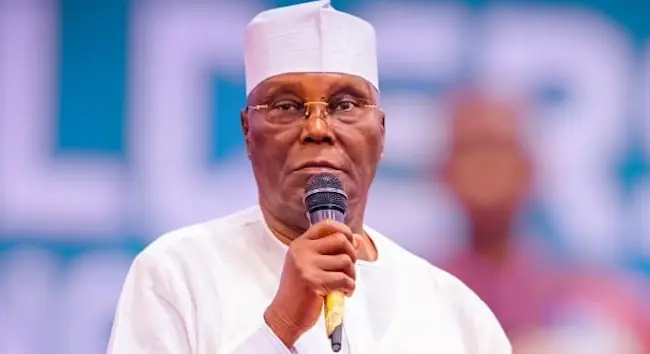
Former Vice-President Atiku Abubakar has urged the immediate suspension of the newly introduced tax laws, citing alleged changes made after their passage by the national assembly.
The call followed claims by Abdussamad Dasuki, a member of the house of representatives from Sokoto, who alleged last week that the gazetted tax laws are not the same as those approved by the national assembly.

In response to the allegation, the house of representatives set up a seven-member ad hoc committee to probe the reported discrepancies in the legislation.
However, on Monday, the minister of information and national orientation, Mohammed Idris, insisted that only one version of the tax laws exists, noting that the matter now falls within the jurisdiction of the national assembly and that the executive would await the outcome of the investigation.
Despite this, in a statement released on Tuesday, Abubakar called on the Economic and Financial Crimes Commission (EFCC) to probe the “illegal and unauthorised alterations made to Nigeria’s tax legislation after passage by the national assembly”.
He described the alleged changes as “a brazen act of treason against the Nigerian people and a direct assault on our constitutional democracy”.
The former vice-presidentformer vice-president accused the executive of what he termed a “draconian overreach”, which he said undermines legislative authority and places revenue generation above citizens’ welfare.
According to him, provisions allegedly inserted without legislative approval grant powers of arrest, property seizure, and enforcement sales without court orders.
He said such provisions “transform tax collectors into quasi-law enforcement agencies” while removing due process safeguards intentionally preserved by lawmakers.
Abubakar further alleged that the changes impose additional financial pressure on citizens through mandatory security deposits, compound interest on tax liabilities, tougher reporting obligations, and foreign currency computation for petroleum operations.
He argued that the measures limit Nigerians’ ability to challenge tax assessments and significantly raise compliance costs for businesses.
The former vice-president also claimed that accountability provisions — including reporting requirements to the national assembly and ministerial oversight — were removed from the laws.
He warned that eliminating oversight while expanding executive authority is “a hallmark of authoritarian governance”.
Abubakar said the controversy reflects a government more focused on imposing tax burdens than tackling poverty, unemployment, and inflation.
He maintained that sustainable revenue generation should come from empowering citizens and broadening the tax base, not from “punitive taxation and erosion of legal protections”.
He therefore called on the executive to halt the implementation of the tax laws pending a full investigation and urged the national assembly to reverse the alleged alterations through proper legislative procedures and ensure accountability.
Abubakar also appealed to the judiciary to invalidate the disputed provisions and uphold the integrity of the legislative process, while calling on civil society organisations and Nigerians to resist what he described as an attack on democratic principles.
He further demanded that the government abandon policies of “extraction and oppression” in favour of initiatives that allow citizens and businesses to thrive.
The former presidential candidate warned that “what the national assembly did not pass cannot become law”, stressing that failure to defend this principle could lead to arbitrary governance and the erosion of constitutional safeguards.