

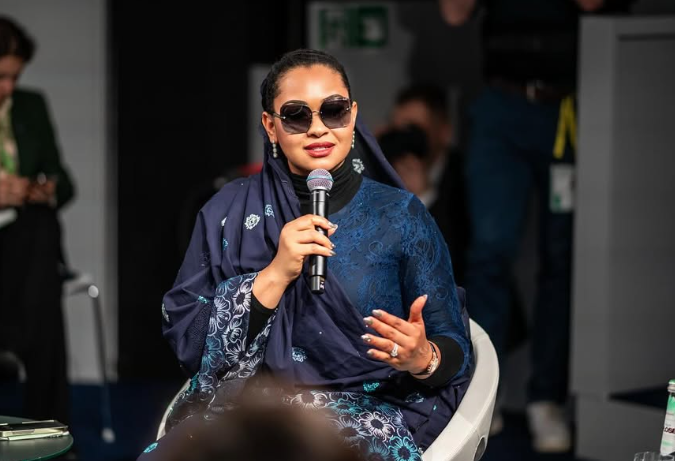
A Federal High Court in the Federal Capital Territory has issued an interim injunction barring a UK-based activist, Dr. Sandra Duru—popularly known as Prof. Mgbeke—and Meta Platforms Inc., owners of Facebook, from continuing to circulate materials alleged to be defamatory against the Senator representing Kogi Central, Natasha Akpoti-Uduaghan.
The order was granted by Justice I. Mohammed in Suit No. FCT/HC/CV/229/2025 after the court considered a motion on notice filed by the claimant, who sought urgent legal relief over what she described as ongoing online attacks on her reputation.

In a Certified True Copy of the ruling sighted on Saturday, the court held that the application raised “a serious question to be tried” and that immediate intervention was required to prevent irreparable damage to the claimant’s reputation, pending the determination of the substantive suit.
Justice Mohammed consequently ordered that the first defendant, Sandra Duru, “either by herself, her agents, privies, or howsoever called, is restrained from further publishing, posting, sharing, disseminating or promoting on Facebook or any other social media platform any material containing defamatory, scandalous, inciteful or injurious content against the Applicant, pending the hearing and determination of the substantive suit.”
In a related order, the court directed Meta Platforms Inc. to “immediately take down and/or disable access to all offending publications, posts or broadcasts made by the 1st Defendant against the Claimant, whether in her personal name or under the pseudonym ‘Prof Mgbeke,’ pending the determination of the suit.”
The court further ordered the social media company to preserve all electronic evidence relevant to the dispute, stating that the second defendant must “preserve, secure, and archive all content, metadata and digital footprints associated with the offending posts and user accounts operated by the 1st Defendant, for the purpose of aiding this Honourable Court in the fair determination of the substantive suit.”
Justice Mohammed emphasised the preservatory nature of injunctions, noting that such orders are designed “to prevent irreparable harm, maintain the status quo ante bellum, and ensure that the subject matter of the dispute is not altered before final judgment.”
The judge stressed that the reliefs granted were protective rather than punitive.
“Senator Akpoti-Uduaghan established a clear prima facie case of ongoing defamation, with irreparable harm to reputation that cannot be adequately remedied by monetary damages alone,” he noted.
The judge added that “the balance of convenience overwhelmingly favours the Applicant,” particularly in view of the alleged sustained publications and the risk of continued reputational injury.
The court also took cognisance of the claimant’s allegation that the first defendant embarked on “a sustained and malicious campaign of cyberbullying, harassment and defamation,” allegedly publishing no fewer than 30 posts between May and October 2025.
These publications, the court observed, were said to have gone viral, exposing the claimant to hostility, security threats and emotional trauma.
In addressing Meta’s role, Justice Mohammed noted that the claimant had placed the platform on notice through formal complaints identifying specific links and content.
The judge observed the allegation that Meta’s failure to act “enabled the continued accessibility of the defamatory materials and facilitated further attacks,” an issue the court held raised serious questions for trial.
The ruling is widely regarded as a significant judicial intervention in Nigeria’s evolving digital rights and media accountability landscape, reinforcing the responsibility of individuals and social media platforms to curb online abuse while safeguarding constitutional rights to dignity, reputation and privacy.
The development comes eight months after Duru released what she described as evidence from exclusive phone conversations, which she claimed showed that the then-suspended lawmaker lied against the President of the Senate, Godswill Akpabio, over a controversial sexual harassment allegation.
The activist, who made the claims during a Facebook Live session monitored by our correspondent, alleged that Akpoti-Uduaghan also attempted to induce her with N200m to falsely accuse the former Akwa Ibom State governor of organ harvesting.
While insisting that call logs and recorded conversations in her possession were sufficient to disprove the sexual harassment allegation against Akpabio, Mgbeke described it as wicked for Akpoti-Uduaghan to attempt to link him to the death of a young girl who died several years ago.
In the one-hour, eight-minute broadcast, the activist further claimed that the suspended senator was out to destroy men, alleging that she had no actual evidence to support her sexual harassment claim against Akpabio.
