

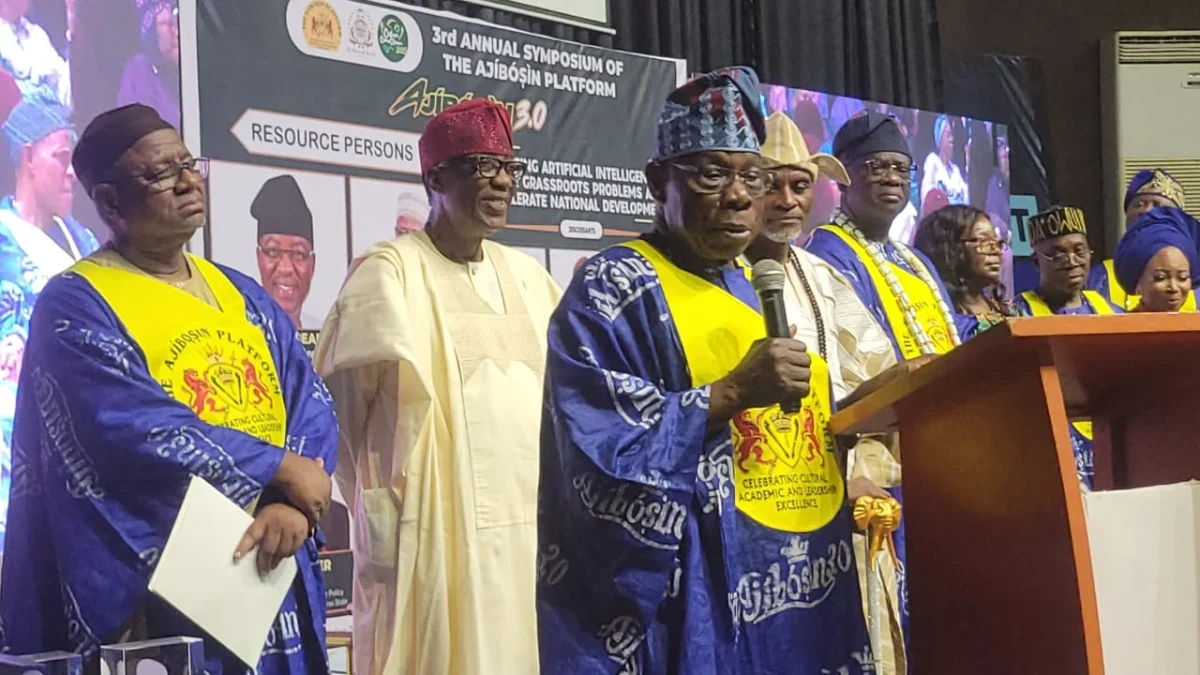
Former President Olusegun Obasanjo has taken a swipe at President Bola Tinubu over his defence of government borrowing, warning that Nigeria’s growing debt could have devastating consequences for future generations.
Obasanjo maintained that excessive borrowing was more dangerous than leprosy, arguing that its impact goes beyond the present generation and could leave an economic burden for Nigerians yet unborn.

He made the remarks on Friday while speaking at the third Ajibosin Annual Symposium at the Olusegun Obasanjo Presidential Library in Abeokuta, Ogun State. The symposium focused on how artificial intelligence could address grassroots challenges and promote national development.
Tinubu had recently defended borrowing as a necessary part of governance, insisting that taking loans was not leprosy as long as the government remained committed to repayment.
Reacting to the president’s position, Obasanjo rejected the argument, describing it as absolute nonsense and questioning the country’s increasing debt profile.
The former president, who negotiated Nigeria’s $30bn Paris Club debt relief during his time in office from 1999 to 2007, also criticised the influence of international financial institutions on Nigeria’s economic policies.
He argued that the World Bank and the International Monetary Fund often promote policies that may not reflect the country’s peculiar needs, particularly in areas such as agricultural development and subsidies.
Obasanjo questioned why Nigeria should depend on economic recommendations from foreign institutions without considering its own circumstances.
He said, “I was sitting with the former Prime Minister of Britain, Jimmy Callaghan. Callaghan was a sheep farmer. He was being paid four euros per annum on every sheep he owned, and they say we must never subsidise agriculture, and if we subsidise agriculture, we won’t get money from the World Bank or from the IMF.
“World Bank and IMF were not designed for us. They were built before we became independent, and that’s the people who will determine what we do. They are brilliant boys and girls; they went to Ivy League universities, Oxford, Cambridge, and all that. My children went to some of them, including Iyabo. She went to one of those schools; she went to Cornell.
“How can Iyabo be the one who will tell me how I will run my home? These brilliant boys will package everything very well academically. They tell us, and we take it, lock, stock, and barrel, and we use it. For a country of 250 million people, it is boys and girls who are not even married, let alone manage a home, who will tell us what we will do to manage our people, our country, and we swallow it, and we destroy ourselves.”
He equally expressed dissatisfaction with the continued decline in the value of the naira, comparing its performance against the dollar when he established his farm decades ago with its current exchange rate.
Obasanjo questioned the economic decisions and leadership failures responsible for the currency’s depreciation.
He said, “When I started my farm 47 years ago, one naira to the dollar was one naira to one dollar 85 cents. What has Nigeria done in 47 years that we now have N1,500 naira to the dollar? What have we done?
“What do our leaders know, and what do they not know? From what they know, what can they do for us? For anybody to say debt is no leprosy is absolute nonsense. Debt is worse than leprosy, because leprosy destroys only one person. Debt destroys generations.”
On artificial intelligence, the former president warned that Nigeria and other African countries must understand and control emerging technologies rather than depend entirely on foreign powers.
He cautioned that technologies developed elsewhere could be turned against countries that lack the capacity to regulate and manage them.
Obasanjo also pointed to the spread of misleading AI-generated materials as evidence of the need for proper safeguards before embracing the technology.
He said, “I don’t know too much technically about AI. But I know that anything that is not in your control can be abused against you.”
Also addressing participants, historian and political commentator, Dr Umar Ardo, warned that Africa could experience another phase of economic exploitation if it failed to control its data, technological resources and intellectual property.
Ardo acknowledged the potential of artificial intelligence to transform economies but said African countries risk remaining dependent on foreign interests if they adopt the technology without developing local expertise and infrastructure.
He compared the situation to previous periods when Africa supplied human labour and natural resources while foreign powers controlled the systems used to generate wealth.
According to him, the continent must avoid repeating that history by ensuring that the economic benefits of artificial intelligence are not concentrated outside Africa.
He warned that data generated by Africans through businesses, hospitals, farms, languages and public institutions could become another resource exploited by foreign technology companies if proper ownership structures were not established.
