

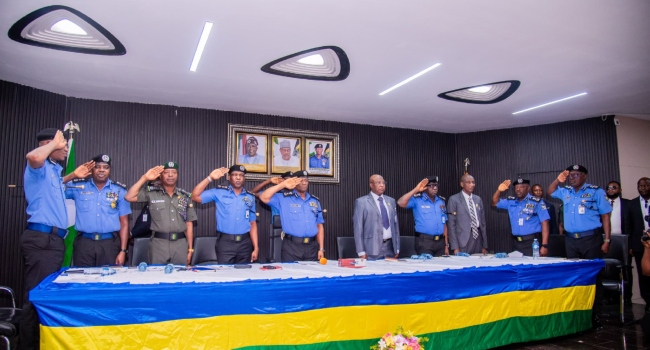
Nigeria’s Inspector-General of Police (IGP), Olatunji Disu, on Wednesday inaugurated a seven-member committee on state police as part of efforts to strengthen the country’s security architecture.

The event took place during his inaugural conference with senior police officers at the Peacekeeping Conference Centre, Force Headquarters, in Abuja.
Mandate of the Committee
Disu described the assignment as “both significant and timely,” noting that the committee’s work would shape the framework through which state policing may operate in Nigeria.
He urged members to approach their task with professionalism and objectivity, especially given the complexities of policing a diverse nation.
The committee is expected to:
-
Review existing policing models within and outside Nigeria.
-
Assess community security needs and emerging risks nationwide.
-
Propose an operational framework for the establishment and coordination of state police structures.
-
Address recruitment, training, standards, and resource allocation.
-
Develop accountability and oversight mechanisms to ensure professionalism and public trust.
According to the IGP, if properly designed and implemented, state policing could bring law enforcement closer to communities, deepen local intelligence, and enable faster, more targeted responses to security threats.
Committee Leadership and Members
The committee is chaired by Olu Ogunsakin, Director-General of the National Institute for Police Studies, while Bode Ojajuni serves as secretary.
Other members include:
-
Emmanuel Ojukwu (Rtd), Provost, Police Public Relations School
-
Okebechi Agora
-
Suleyman Gulma
-
Ikechukwu Okafor
-
Tolulope Ipinmisho
The inauguration is one of the first major steps taken by Disu since his appointment as IGP by Bola Tinubu.
The debate over state police has gained renewed momentum amid rising security challenges across Nigeria. President Tinubu has already asked the National Assembly to begin constitutional amendment processes to enable the creation of state police.
For many stakeholders, decentralised policing is seen as a potential pathway to improving responsiveness, accountability, and local security coordination across the country.