

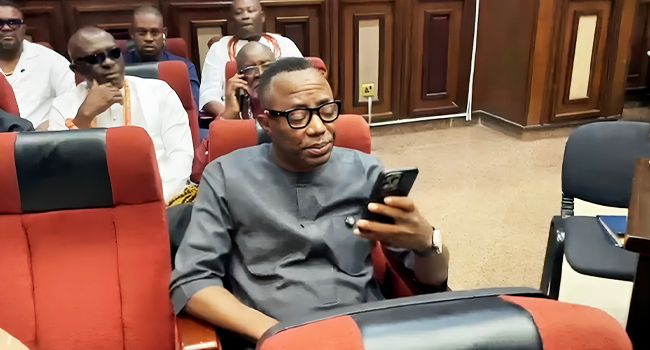
The Department of State Services (DSS) has asked the Federal High Court in Abuja to stop Omoyele Sowore from presenting further evidence in his ongoing cyberbullying trial, accusing him of frustrating the proceedings with repeated requests for adjournments.
The request was presented on Tuesday by the agency’s lawyer, Akinlolu Kehinde (SAN), before Justice Mohammed Umar.
The DSS argued that the African Action Congress presidential candidate had exhausted the number of adjournments permitted under the Administration of Criminal Justice Act, 2015.
Kehinde told the court that the agency had filed its application on November 23 and served copies on Sowore’s legal representatives.
He claimed that the defendant had been responsible for at least 14 adjournments since the case began, against the five allowed under Section 396(4) of the ACJA.
“Before we finally draw the curtain on the proceedings, I want to bring to your lordship’s notice the application we filed and served on the defendant.
“The application is that there must be an end to all these. The defendant has since exceeded the number of adjournments as required by law,” he said.
In its application, the DSS wants the court to end the defence’s presentation of witnesses and direct both sides to exchange their final written submissions before adopting them.
Recounting the history of the case, Kehinde said Sowore was brought before the court again on January 19, 2026, on a two-count charge, which he denied.
He explained that the prosecution completed its presentation of evidence in March, while the court, on May 8, rejected Sowore’s no-case submission and directed him to enter his defence.
However, the agency alleged that proceedings had been repeatedly interrupted since then, with eight of the 14 adjournments occurring after Sowore was asked to defend himself.
The prosecution also complained that the defence had made little progress since July 6, when it began calling witnesses, with only two witnesses having testified.
“Since the defendant/respondent opened his defence on 6th July 2026, the trial has not progressed beyond the evidence of two defence witnesses,” he said.
The DSS further accused Sowore of employing several court applications and legal processes that it claimed had slowed down the trial. One of the issues raised involved a subpoena directed at the lead lawyer to the complainant.
Kehinde also told the court that previous warnings had been issued to the defendant over conduct allegedly contributing to delays.
He argued that the constitutional protection of fair hearing should not be used to justify repeated adjournments, particularly where an accused person has already been given adequate opportunity to present a defence.
The prosecution maintained that the relevant provisions of the Constitution and the ACJA require criminal cases to be handled without unnecessary interruptions.
However, Sowore’s lawyer, Reuben Adakole, opposed the DSS request, arguing that the court should first resolve other outstanding applications connected to a subpoena issued to the Chairman of the Independent National Electoral Commission, Prof. Joash Amupitan (SAN).
Although he confirmed receiving the DSS application, Adakole insisted that the court needed to determine Amupitan’s request to have the subpoena cancelled, alongside the defence’s preliminary objection and ex-parte application.
“Inasmuch as the application tends to foreclose us, there is our application which the court ought to pronounce on first. Until after the ruling, we can look at it. The application is unripe, my lord,” he said.
Counsel to Amupitan, Alex Iziyon (SAN), subsequently informed the court that the matter had earlier been postponed because the defence had not filed its response to the application.
He confirmed that Sowore’s team had now submitted the required documents and that he had also filed a response.
Adakole explained that the subpoena was intended to compel the INEC chairman to produce specific documents rather than appear in court to give oral testimony.
“It is just strictly to come and tender the documents, and that was why we filed a motion to amend the application.
“We ask that we be allowed to move our motion ex parte, so that it will lay to rest all these issues.
“So the intent was just for the INEC chairman to tender the documents and not to testify,” he said.
Iziyon rejected the defence’s position, accusing the lawyers of attempting to avoid complying with an earlier court directive.
“The defendant cannot take this court for a ride. I submit with all sense of responsibility,” he said.
He reminded the court that Justice Umar had previously directed the defence to file a formal motion on notice, allowing the affected parties to respond.
The judge also reaffirmed that instruction, telling Adakole that the defence could not proceed through an ex-parte application after the parties had already joined issues.
“Before the last adjourned date, I told you that since you have issued that subpoena and they have been joined, anything you want to do now will be by motion on notice; serve them, and they will respond,” the judge said.
The court subsequently heard arguments on the pending applications. Iziyon adopted three processes filed on behalf of Amupitan and urged the judge to cancel the subpoena.
He relied on an earlier decision by the court concerning its authority to set aside subpoenas, as well as a previous case in which a subpoena was cancelled because the person named had no connection to the subject of the proceedings.
Adakole, however, urged the court to reject Amupitan’s request after adopting the defence’s processes.
He also presented an ex-parte application filed on November 11, seeking four reliefs. The lawyer argued that the requested documents were public records held by a public officer and were important to Sowore’s defence.
He maintained that the relevance of the materials could only be established after they had been produced before the court.
“It is not for the applicant to say so. That will be preemptive,” he said.
After hearing arguments from the parties, Justice Umar adjourned the matter until December 7 for a ruling on Amupitan’s application seeking to set aside the subpoena.
The judge also fixed the date for hearing the DSS application seeking to close Sowore’s defence, alongside other outstanding applications.
