

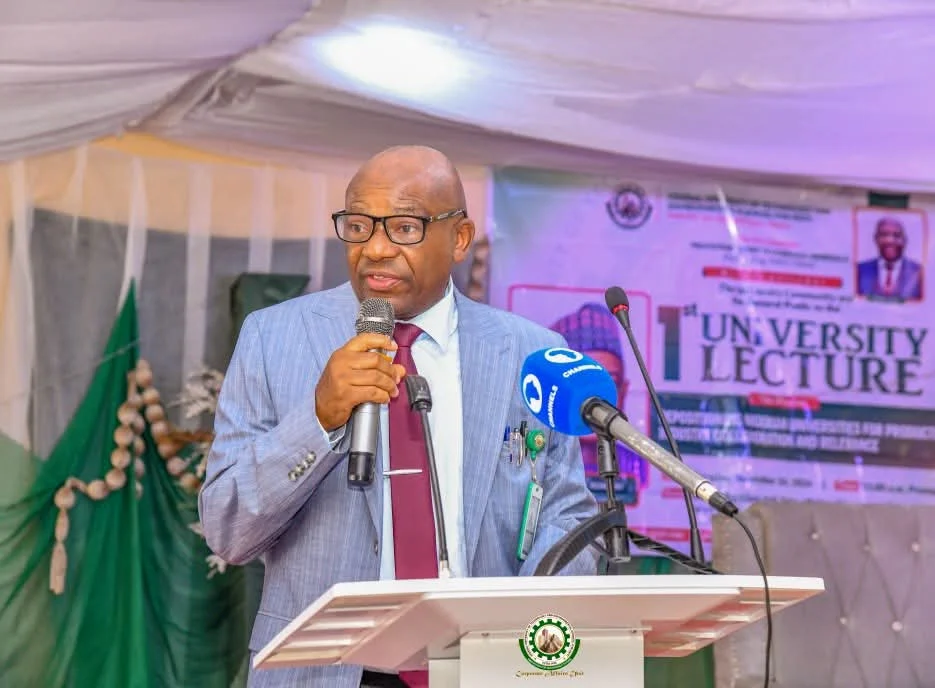
The Federal University of Technology and Environmental Sciences, Iyin-Ekiti, has called on the Tertiary Education Trust Fund (TETFund) to increase its financial support to enable the institution to develop its permanent campus and provide more facilities.
The university’s Vice-Chancellor, Prof. Gbenga Aribisala, said additional investment was necessary to meet the institution’s growing infrastructure needs and strengthen its academic operations.
He made the appeal on Thursday at the university’s maiden lecture in Iyin-Ekiti, Ekiti State. The event featured TETFund Executive Secretary, Sonny Echono, who delivered a lecture titled ‘Repositioning Nigerian Universities for Productive Industry Collaboration and Relevance’.
According to a statement issued by the institution in Ado-Ekiti on Saturday, Aribisala acknowledged the support already received from TETFund but maintained that more assistance was needed to move ongoing projects forward.
“We commend TETFund for its various interventions in FUTES-IYIN. But the young university needs more of such interventions, particularly towards the ongoing development at its permanent site and other areas requiring critical infrastructure support.”
The vice-chancellor also took Echono’s delegation around the university to showcase ongoing construction and development projects, pointing out areas that required further investment.
He explained that expanding the institution’s facilities had become important as its academic programmes and administrative responsibilities continued to grow.
Aribisala also praised Echono for honouring the university’s invitation, describing his experience in the education sector and involvement in strengthening tertiary education as valuable to the institution.
Delivering the lecture, Echono, who was represented by TETFund’s Director of Strategic Planning, Erivwo Inene, challenged universities to produce graduates whose knowledge and skills could address real-world challenges.
He argued that Nigerian institutions needed to place greater emphasis on practical education, research and innovation rather than relying mainly on traditional classroom teaching.
“The relevance of our universities must, therefore, also be seen in the extent to which their teaching and research activities contribute to national development.”
Echono said closer relationships between universities and businesses would help bridge the gap between academic training and the demands of the labour market.
He also outlined TETFund’s ongoing investments in technology, research and digital education, noting that these programmes were designed to prepare students and lecturers for emerging opportunities.
Among the projects, he disclosed that the fund was establishing six specialised centres focusing on Artificial Intelligence, Robotics and Cyber Sciences across Nigeria’s six geopolitical zones.
He added that six pilot ICT Experience Centres and another 12 centres were included in the fund’s 2026 projects.
The programmes also cover the transformation of existing ICT laboratories into AI-enabled learning facilities to improve digital knowledge and expose students to modern workplace technologies.
Other initiatives include online academic libraries, electronic journals and books, digital literacy training, staff development and student capacity-building programmes.
He further identified the Diaspora Digital Bridge Platform as one of the initiatives connecting Nigerian universities with experts outside the country to encourage research partnerships and exchange of knowledge.
