

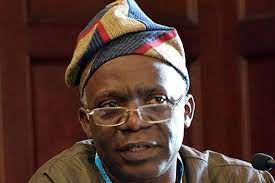
Human rights activist Femi Falana has urged Nigeria to collaborate with other nations to mount diplomatic pressure on the United States over its actions in the ongoing conflict involving Iran and Israel.
The Senior Advocate of Nigeria (SAN) made the appeal during an interview on Politics Today, a programme aired on Channels Television on Thursday.

According to him, the Nigerian government should work alongside other countries to promote respect for international law and encourage global powers such as Russia and China to intervene in the escalating crisis.
Falana criticised the actions of US President Donald Trump, accusing him of disregarding international law and United Nations resolutions.
“President Trump has no regard and shows contempt for international law. Hence, he has pulled the United States out of about 66 resolutions of the United Nations. To him, the resolutions of the United Nations mean nothing,” Falana said.
The senior lawyer said Nigeria should revive its tradition of multilateral diplomacy, similar to its role during the era of the Non-Aligned Movement, by partnering with other nations to call for restraint.
“Our duty as a country, as we used to do in the past, is to collaborate with other countries. When you talk of the days of non-alignment, we must now move very speedily to collaborate with other countries to mount pressure on Mr Trump,” he said.
Falana also emphasised the need to persuade major global powers such as Russia and China to step in diplomatically, noting that they have significant influence over Iran.
“We need to persuade China and Russia to intervene because those are the two countries that Iran will listen to,” he added.
Beyond the international dimension of the conflict, Falana urged Nigeria to strengthen its internal security structure and reduce dependence on foreign powers for national stability.
“Nigeria must wake up. We must learn from Iran that unless you reorganise your own country, unless you equip your armed forces and your police force, there is no way an imperialist country like America will guarantee law and order in your country,” he said.
He also called on the federal government to reassess its approach to strengthening security institutions, pointing out that Nigerian troops have historically performed well in international peacekeeping missions, including operations under the United Nations and the ECOWAS Monitoring Group (ECOMOG).
Falana further criticised the management of Nigeria’s refining sector, questioning why the country’s four state-owned refineries are no longer functioning despite billions of dollars spent on their rehabilitation.
“If we say we have four refineries, nobody is talking about them any longer. The NNPC now solely relies on the Dangote Refinery. Is that how to run a country? After carrying money down the drain, about $2.9 billion was spent on the maintenance of our four refineries,” he said.
His remarks come amid escalating hostilities involving the United States, Israel, and Iran, which have heightened geopolitical tensions worldwide and raised concerns about the economic and security implications for countries such as Nigeria.
Iran tension
A large-scale conflict involving the United States, Israel, and Iran began on February 28, 2026, following joint US–Israeli airstrikes on Iranian targets.
The strikes reportedly targeted key leadership and infrastructure in Iran and led to the death of the country’s Supreme Leader, Ali Khamenei, who was succeeded by his son Mojtaba Khamenei.
The war has now entered its second week, with continued air raids on Iranian territory and retaliatory missile strikes by Iran on US bases and targets in Israel and several Gulf countries.
The conflict has caused significant humanitarian damage, with more than 1,300 civilians reported killed in Iran and about 3.2 million people displaced. In Lebanon, Israeli strikes against Hezbollah have resulted in over 600 deaths, while at least seven US soldiers have also been reported killed.
Impact, oil surge
The war has also disrupted global markets. Iran has blocked the Strait of Hormuz, a vital route for global oil shipments, pushing crude prices above $100 per barrel.
In response to the supply shock, the International Energy Agency has announced plans to release about 400 million barrels of crude oil in an attempt to stabilise the market.
Diplomatically, both sides remain far apart. Iran’s president, Masoud Pezeshkian, has said the war will end only if Iran’s rights are recognised, reparations are paid, and guarantees are given against future attacks.
Meanwhile, US President Donald Trump has demanded Iran’s “unconditional surrender,” while Israeli officials have indicated that their military operations will continue for as long as necessary.
The conflict is also affecting Nigeria. Rising global oil prices have pushed petrol prices locally to around ₦1,000–₦1,300 per litre, before settling between ₦1,075 and ₦1,165, raising concerns about transport and food costs.
Nigeria has also begun evacuating its citizens from the region. The Nigerians in Diaspora Commission said Nigerians in Iran are being escorted across the Armenian border, and so far no casualties have been reported among them.
However, many others remain stranded in Middle Eastern transit hubs due to widespread flight cancellations and airspace closures.