

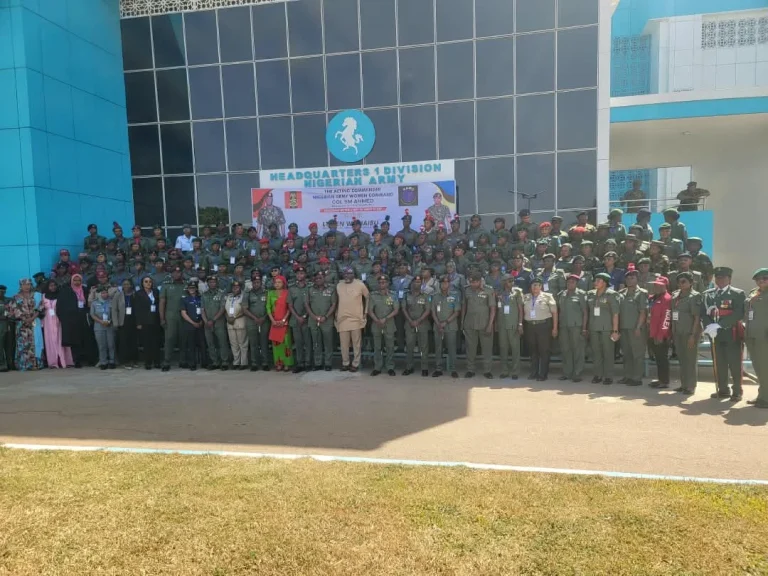
The Chief of Army Staff, Lt.-Gen. Waidi Shaibu, has emphasised the importance of female soldiers in strengthening the Nigerian Army’s operational capacity and addressing the country’s security challenges.
Shaibu said the professional skills of female personnel, especially in intelligence gathering, community engagement and specialised military operations, remained crucial to the success of the Army’s engagements.
He made the remarks on Tuesday in Kaduna at the Nigerian Army Women Command’s Fourth Quarter 2026 Workshop, themed, “Harnessing the Professional Capabilities of Nigerian Army Female Personnel in Support of Nigerian Army Operational Engagements in a Joint and Multi-Agency Environment.”
The COAS, represented by the Commander, Command Engineering Depot, Maj.-Gen. Oladele Arogundade, said the growing complexity of the security environment required a professional, adaptable and resilient military capable of responding effectively to emerging threats.
He described female officers and soldiers as valuable components of the Army’s workforce, noting that their professional development and effective deployment would improve the military’s capacity to accomplish assigned missions.
“Their effective development and employment are therefore essential to strengthening our institutional capacity to accomplish all assigned missions,” he said.
Shaibu observed that counter-insurgency operations, the protection of vulnerable communities, internal security assignments and humanitarian interventions required more than military force.
He explained that these operations also relied on intelligence, cultural awareness, effective communication, discipline and constructive engagement with civilians.
According to him, female personnel could facilitate access to communities where cultural and religious sensitivities might prevent male soldiers from interacting freely with women.
The Army chief highlighted the contributions of female soldiers during stabilisation operations in Jos North, Plateau State, in April, following a breakdown of law and order in the Angwan Ruba area.
He said the personnel helped facilitate the restoration of peace and security, adding that their resilience, professional conduct and competence attracted commendation.
Shaibu maintained that female soldiers were eligible for all operational duties like their male counterparts, stressing that their deployment and career progression should be determined by competence, merit and established military standards.
“The Nigerian Army remains committed to advancing professionalism, meritocracy and operational competencies across all its formations and units,” he said.
He said the workshop would explore ways to identify and develop female personnel’s professional capabilities, expand their access to combat, specialist and leadership appointments, and strengthen mentorship and career progression.
Other areas to be discussed included critical thinking, decision-making, peace support operations, humanitarian assistance and civil-military relations.
The COAS urged participants to come up with practical recommendations for improving the professional development and effective deployment of female personnel.
Earlier, the Acting Commander of the Nigerian Army Women Command, Col. Sule Ahmed, said the workshop was aimed at strengthening the contributions of female soldiers to contemporary military operations.
Ahmed said the programme was in line with the United Nations Women, Peace and Security Agenda, particularly United Nations Security Council Resolution 1325 of 2000, which promotes women’s participation in conflict prevention, resolution, peacebuilding and security processes.
He added that the workshop would also address drug and substance abuse and mental health management, given their implications for personnel welfare and operational efficiency.
A retired major-general, Adeniyi Oyebade, who delivered a lecture at the event, said effective collaboration between male and female personnel was essential to the success of military operations.
He argued that the increasing sophistication of modern warfare made it necessary for the Army to provide female soldiers with the same training and operational opportunities as their male counterparts.
“The women cannot do it alone, that is the truth, but when you have the men there, it enhances the operational capacity and they can deliver effectively on the outcomes,” he said.
Referring to the ongoing war in Ukraine, Oyebade said the growing use of drone technology had demonstrated that modern warfare was no longer determined by physical strength alone.
“Look at what is happening in Ukraine, the use of drone technologies. Many of the drone operators are women,” he said.
He added that female personnel could make significant contributions to specialised military operations requiring technical expertise, precision and attention to detail.
“Once you start moving away from physical effectiveness and strength and start seeing what women can bring, you will achieve more,” he said.
Oyebade praised the Army leadership for organising the workshop and urged the Women Command to include male officers in future programmes to encourage collaboration and the exchange of professional experiences between both sexes.
