

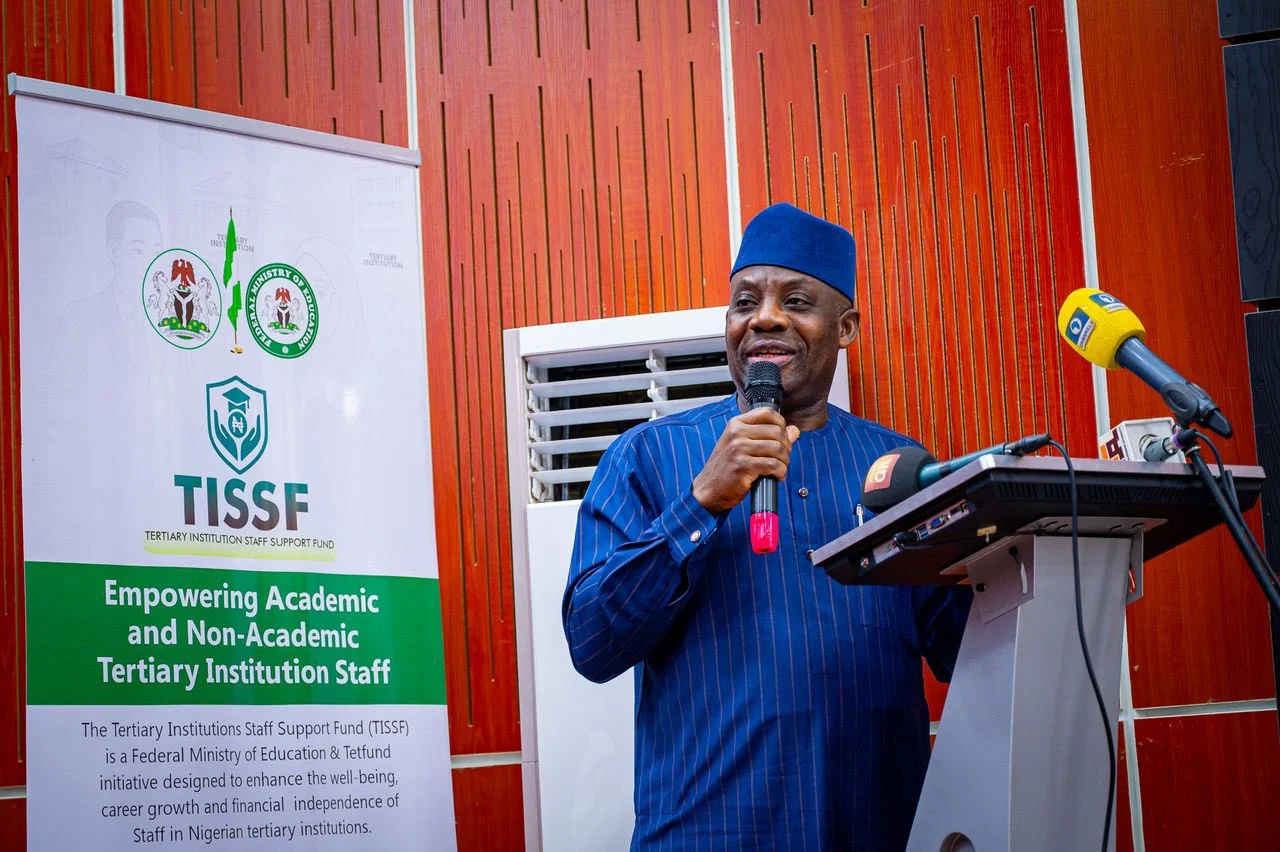
The Minister of Education, Dr. Tunji Alausa, on Wednesday presented 82 academic textbooks authored by Nigerian scholars to enhance teaching and learning in tertiary institutions across Nigeria.
Speaking at the public presentation in Abuja, Alausa said the books were developed under the Higher Education Book Development Intervention Project of the Tertiary Education Trust Fund. He added that the fund also secured an additional 10 academic textbooks for distribution to tertiary institutions nationwide.

“This initiative underscores the Federal Government’s commitment to quality education and the promotion of academic excellence in Nigeria’s higher education system,” Alausa said.
He explained that the project aims to address the shortage of locally authored textbooks and reduce reliance on foreign publications. According to the ministry, Nigerian tertiary institutions have increasingly depended on foreign textbooks, placing “pressure on foreign exchange and discouraging indigenous authorship.”
Alausa stressed the importance of supporting Nigerian scholars in “producing quality academic textbooks to ensure the availability of relevant learning materials across diverse disciplines, particularly in science, technology, and engineering, which are critical to national development.”
Addressing the authors, he said, “We can liberalise the use of these books so that they become available worldwide. I assure the authors that this is not about money; you have not undertaken this work for profit, but for the pursuit of academic excellence. Therefore, we must find a way to make these books accessible beyond tertiary institutions.”
The Executive Secretary of TETFund, Sonny Echono, explained that the initiative is aimed at tackling the persistent shortage of quality tertiary-level textbooks in Nigeria while strengthening teaching, learning, and research. He noted that 72 of the titles were newly authored under the TETFund project, while 10 others were written by reputable scholars and secured for beneficiary institutions.
“The persistent shortage of high-quality tertiary-level textbooks in Nigeria has long posed a major challenge to teaching, learning, and research. Beyond the issue of limited quantity, there has also been a compelling need to improve the quality of locally produced academic textbooks. It was this concern that led to the establishment of the TETFund Higher Education Book Development Intervention Project, a strategic initiative designed to bridge this gap and promote the development of credible, locally authored academic resources,” Echono said.
He further revealed that the fund has published 202 academic textbooks to date, with several others under evaluation. “At the end of today, we shall commence the distribution of over 400,000 of these books to our Beneficiary Institutions across the country,” he added.
Echono also stated that, to ensure prudent management of resources, authors will now receive monetary honoraria based on the content and number of pages in their books, along with 20 complimentary copies, instead of the previous practice of providing 1,000 copies of their publications.
Earlier in the event, participants observed a minute’s silence in honour of Valerie Young Harry, one of the authors who recently passed away. The Chairman of the Board of Trustees at TETFund, Aminu Masari, described the late author’s work as a lasting legacy and stressed the importance of applying knowledge practically. He also encouraged strategies to commercialise the books so that authors and their families can benefit from their intellectual contributions.
