

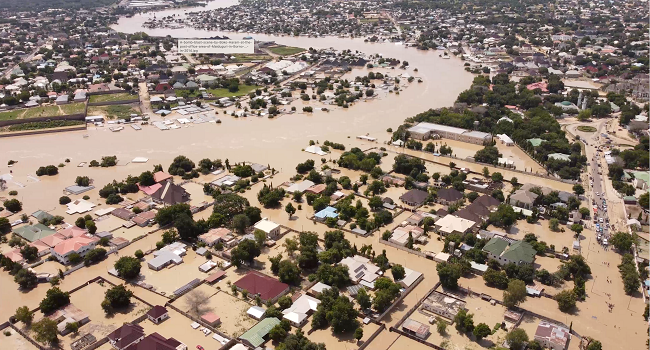
The Federal Government has announced an interest-free loan package worth ₦6.3 billion for 21,000 Nigerians affected by recent flood disasters across the country.
The Minister of State for Humanitarian Affairs and Poverty Reduction, Dr Yusuf Sununu, made the announcement on Monday during a roundtable event in Abuja to mark the International Day for Disaster Risk Reduction. The gathering was attended by Vice President Kashim Shettima, Deputy Speaker Benjamin Kalu, Zamfara State Governor Dauda Lawal, lawmakers, and development partners.

Dr Sununu explained that the initiative aims to ease the hardship caused by flooding and strengthen food security in affected areas. He added that the Federal Government, through the Conditional Cash Transfer scheme, has supported 8.1 million households with over ₦300 billion under President Tinubu’s Hope Agenda.
“The Ministry, through the National Social Investment Agency, has significantly improved local resilience. So far, more than 8.1 million households have benefited from conditional cash transfers totalling over ₦300 billion, which has boosted their health and education. In the coming weeks, we plan to give out interest-free, collateral-free loans of about ₦300,000 each to 21,000 Nigerians to help farmers recover from the impact of flooding,” he said.
Sununu also revealed plans to empower internally displaced persons (IDPs) through a programme that guarantees a market for their produce. “In partnership with the Federal Ministry of Agriculture, we are supporting IDPs by ensuring that they retain 30% of their harvest while the government buys 70%. The proceeds will be paid directly to the displaced persons as cash,” he added.
In her remarks, the Director General of the National Emergency Management Agency (NEMA), Zubaida Umar, said Nigeria continues to face increasing disasters caused by climate change, conflicts, pandemics, and technological hazards. She called for a shift from reactive responses to proactive and well-funded disaster management strategies.
Umar announced the launch of two key policy frameworks — the NEMA Strategic Plan (2025–2029) and the National Disaster Risk Reduction Strategy (2025–2030) — designed to promote risk-informed development, innovative financing, and stronger institutional partnerships.
She further stated that NEMA is developing a National Risk Monitoring and Information Platform to enhance early warning systems and guide risk-based investments. Umar urged stakeholders to explore new financing models, including catastrophe bonds, insurance pools, climate funds, and blended finance, to ensure sustainable disaster risk reduction across sectors.