

The Osun State governorship election will hold on Saturday, August 15, across the state’s 30 Local Government Areas (LGAs).
The election will be the seventh governorship poll conducted in Osun since the return to democratic rule in 1999. Previous elections were held in 1999, 2003, 2007, 2010, 2014, 2018 and 2022.

The poll is one of Nigeria’s off-cycle governorship elections. This followed a court ruling that removed a sitting governor and installed his opponent after several years of legal proceedings.
According to the Independent National Electoral Commission (INEC), voting will begin at 8:30am and end at 2:30pm.
Since the creation of Osun State in 1991, 10 people have served as governor or military administrator. They include Leo Segun Ajiborisha, Isiaka Adeleke, Anthony Udofia, Anthony Obi, Theophilus Bamigboye, Bisi Akande, Olagunsoye Oyinlola, Rauf Aregbesola, Gboyega Oyetola and the incumbent governor, Ademola Adeleke.
The incumbent governor, Ademola Adeleke, is seeking re-election after winning the 2022 governorship election under the Peoples Democratic Party (PDP). He has since defected to the Accord Party, under which he is seeking a second term.
Here are five key things to know about Saturday’s election:
1. Number of registered voters
INEC Chairman Joash Amupitan said a total of 2,339,233 eligible voters are expected to participate in the election across 3,763 polling units and 332 wards in the state’s 30 LGAs.
INEC has also increased the number of Bimodal Voter Accreditation System (BVAS) machines for the election from 4,427 to 5,130.
The commission also doubled its backup BVAS devices from 664 to 1,328 to facilitate quick replacement in case of equipment failure.
On security, Amupitan said INEC was adopting a proactive approach through the Inter-Agency Consultative Committee on Election Security (ICCES) to identify potential flashpoints across the state.
The commission also said it had engaged traditional rulers and transport unions as part of efforts to ensure a peaceful and smooth election.
2. Why is Osun’s governorship election an off-cycle poll?
Governorship elections in Osun have historically been closely contested, with several of the state’s elections ending in tribunals or prolonged legal battles.
The development that eventually made the state’s governorship election an off-cycle poll followed the 2007 election.
INEC had declared Olagunsoye Oyinlola of the PDP winner, but after about three years of legal proceedings, the Court of Appeal nullified his election and declared Rauf Aregbesola of the Action Congress of Nigeria (ACN) the winner.
Aregbesola subsequently assumed office, while his tenure was calculated from the date he took office, despite Oyinlola having spent three years as governor.
The change in government altered Osun’s electoral calendar, causing its governorship election to be held separately from the regular election cycle in most other states.
Whoever emerges victorious on Saturday will govern Osun from 2026 to 2030.
3. Fourteen candidates are contesting
Fourteen political parties have fielded candidates for the governorship election, although the contest is largely expected to be dominated by three major candidates.
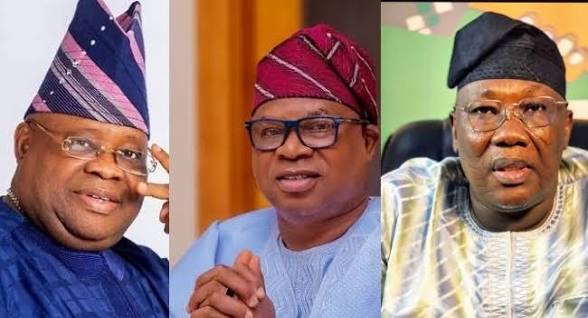
The leading contenders are incumbent Governor Ademola Adeleke of the Accord Party, APC candidate Asiwaju Bola Oyebamiji and African Democratic Congress (ADC) candidate Dr Najeem Folasayo Salaam.
Adeleke is seeking to retain his position by highlighting the achievements of his administration since taking office in 2022.
Oyebamiji, a former Commissioner for Finance in Osun, has the backing of former Governor Gboyega Oyetola, who is now the Minister of Marine and Blue Economy, as well as the ruling APC.
Salaam, meanwhile, has received the backing of former Governor Rauf Aregbesola.
The three major candidates therefore enter the election with significant political structures and influential supporters behind them.
4. How the new Electoral Act may affect the election
The 2026 Osun governorship election will be the third election conducted by INEC since President Bola Tinubu assented to the 2026 Electoral Act.
It will also be the last major election before Nigeria’s 2027 general election, making the Osun poll an important test of the new electoral rules.
Some of the provisions include:
- Voter registration requirements have been narrowed to three documents: a birth certificate, Nigerian passport and National Identification Number (NIN).
- Voters can download their voter cards from the INEC website.
- Electronic transmission of results to IReV is compulsory. However, where network failure prevents electronic transmission, the physical result sheet, EC8A, becomes the primary document for collation and declaration.
- Political parties can use direct primaries or consensus to nominate candidates, eliminating indirect primaries.
- Government is required to release election funds to INEC at least six months before a general election, compared with the previous 12-month requirement.
- Political parties must submit their candidates’ names 120 days before election day, instead of the previous 180-day deadline.
- INEC must publish the final list of candidates 60 days before election day, rather than the previous 150-day requirement.
However, the provision in Section 60(3) recognises network failure as an exception, allowing EC8A forms to serve as the primary means of collating and declaring results where electronic transmission is affected.
5. Rules voters and political parties must follow
As voters head to the polls, the authorities have warned against conduct capable of disrupting the election.
Voters and political actors are expected to:
- Avoid snatching or destroying ballot boxes.
- Avoid campaigning or canvassing at polling units.
- Refrain from violence and intimidation.
- Avoid buying or selling votes.
- Avoid interfering with the electoral process.
- Comply with restrictions on unauthorised movement of people.
The newly deployed Osun State Commissioner of Police, Samuel Etaifo, has also assumed duty ahead of Saturday’s election.
The police said adequate security measures had been put in place to protect voters, electoral officials and other stakeholders and ensure that the election is conducted peacefully.
With more than two million registered voters, 14 political parties and three major contenders, Saturday’s Osun governorship election is expected to be closely watched as the state prepares to choose its governor for the next four years.