

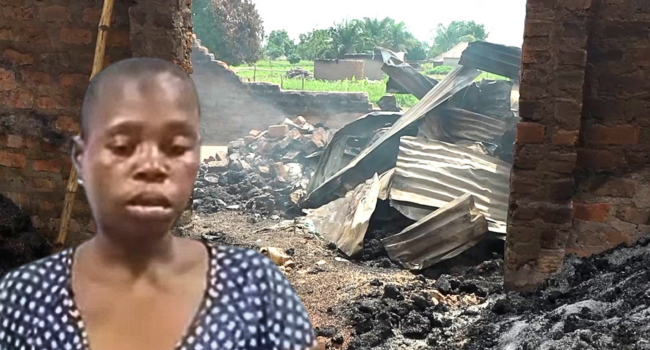
A survivor of the Yelwata attack in Benue State, Msurshima Apeh, has shared her harrowing experience before the United States Congress, describing how she witnessed the killing of her five children during the incident.
She testified on Thursday before the House Subcommittee on Africa, which reviewed President Donald Trump’s decision to return Nigeria to the Country of Particular Concern (CPC) list.

Apeh recounted how armed men invaded the camp where hundreds of displaced families were sleeping.
“When we went to sleep that night around 9 pm, the Fulani terrorists attacked us where we were sleeping. We were locked inside the camp, Yelwata, and they were butchering them with cutlasses and shooting guns as well. When the torture had finished at some point in time, they poured petrol on the building and the majority of them were set ablaze,” she said while testifying virtually from Benue State.
She narrated how she climbed a tree in an attempt to save her life as her children cried beneath her.
“In the course of this action, I saw a tree when I lifted my eyes. I raised my hands on the tree and climbed up where I was able to hide myself. My five children that I left below were crying, and in my presence, they were being slaughtered by the terrorists,” she recounted.
Apeh added that she later escaped into the bush until rescue workers located her and moved her to safety.
“I ran out into the bush at some point, and those who came for rescue will now bring me out of that place at some point, and I was able to witness the whole drama. When the people came, we were now relocated to a new camp,” she explained.
The Yelwata attack occurred in June 2025 in the Guma Local Government Area of Benue State. Reports estimated that more than 100 to 200 people were killed, and over 3,000 others were displaced, many of whom were relocated to camps in Nasarawa State.
Civil rights groups challenged official figures, claiming up to 200 people may have died in the attack. Security sources described the assailants as suspected armed herdsmen.
The killings drew nationwide condemnation. President Bola Tinubu denounced the incident, visited injured victims in hospitals, and ordered a security intervention.
Emergency agencies later warned that displaced families were struggling with shortages of food, medical care, and shelter materials. The Police later announced the arrest of 26 suspects in connection with the attack.
The tragedy again underscored the long-standing farmer–herder conflict in Nigeria’s Middle Belt and heightened concerns over violence with religious dimensions.
Apeh’s testimony came after Trump placed Nigeria back on the CPC list in October, accusing the country of systematic Christian persecution and stating that military options were being considered.
The allegations drew criticism of Nigeria’s management of Islamist violence, but the Nigerian government rejected the claims. President Bola Tinubu maintained that Nigeria safeguards religious freedom and is not “religiously intolerant” toward its people.