

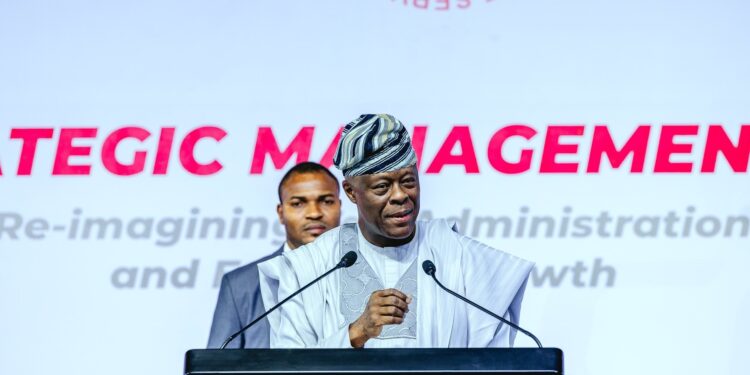
Minister of Finance, Wale Edun has said weak regulatory frameworks and multiple taxation hinder growth in the telecoms sector.
Edun spoke at a business roundtable on investments in broadband connectivity and safeguarding critical national information infrastructure held on Wednesday in Abuja.

The two-day programme was organised by the Nigerian Communications Commission (NCC) to address issues related to the right of way and protection of broadband infrastructure.
Edun, represented by Ali Mohammed, the director of the home department at the ministry of finance, urged the private sector to increase investments in the telecoms industry.
He said the federal government would solve the challenges through stakeholder engagements.
“This sector is virtually vulnerable; it is compact, therefore, we are calling on our local and international investors to come forward so that we can invest in this particular sector,” Mohammed said.
“The problems have been identified in terms of connectivity and broadband infrastructure development in Nigeria. The government alone cannot do it.
“We need the cooperation and collaboration of the private sector. There is a need for stakeholders to come together and deal with these particular problems.”
Chairman of the Nigerian Governors Forum (NGF), Abdulrahman Abdulrazaq said broadband connectivity is an essential part of infrastructure and the backbone of Nigeria’s social and economic future.
Abdulrazaq, represented by Abdulateef Shittu, the director-general of the NGF, called on state governments to accelerate reforms that protect broadband infrastructure and align with the federal target of 80 percent broadband penetration by 2027.
He warned that states that fail to act risk being “economically disadvantaged” in the digital era.
“Connectivity empowers our digital economy and sustains the service sector,” Shittu said.
“Achieving 80 percent penetration by 2027 will require an additional 5,000 kilometres of fibre, and that means closer collaboration among states, federal agencies, and private operators.”
Abdulrazaq said 19 states have already capped right-of-way (RoW) charges at N145 per metre, while others have introduced tax and tenancy incentives to attract investors.
He said many states now process infrastructure applications within five to 21 working days, with a plan underway to fully digitise approvals to improve transparency and accountability.
“We are steadily transforming states into digital powerhouses,” Abdulrazaq said.
“The next step is protecting this infrastructure — without which investments and services will collapse.”
Abdulrazaq said the NGF has directed states to establish local security frameworks and conflict-resolution mechanisms to prevent fibre vandalism and ensure real-time intelligence sharing with telecoms operators.
