

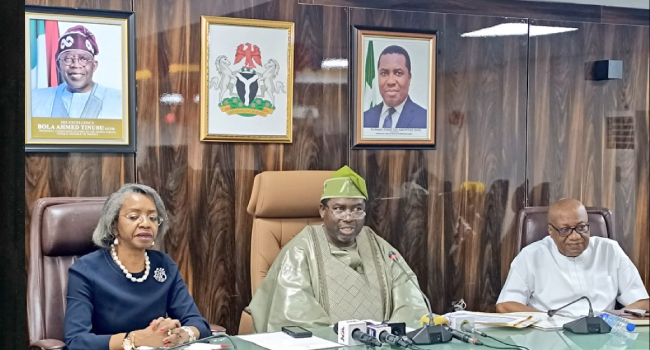
The chairman of the Independent National Electoral Commission (INEC), Joash Amupitan, has cautioned that misinformation spread through the media may become the biggest danger to Nigeria’s 2027 general election.
Speaking on Wednesday at the 81st general assembly of the Broadcasting Organisations of Nigeria (BON) in Abuja, Amupitan said elections are increasingly being shaped in the “information space,” making broadcasters central to safeguarding democracy.

He described the airwaves as “the primary infrastructure of our democracy” and warned that false information, hate speech, and unequal media access could weaken the true will of voters.
“In the 2027 General Election, the most dangerous weapon will not be a ballot-snatcher’s gun, but a smartphone-user’s lies amplified by an uncritical broadcast station,” he said.
Amupitan pointed to provisions in the Electoral Act 2026 designed to curb such threats, including compulsory equal airtime for all political parties and strict penalties for breaches.
“The Act mandates fairness and balance. You must provide a level playing field,” Amupitan said.
He explained that under the law, media outlets that fail to grant equal airtime could face fines of up to N5 million, while responsible officers may also face imprisonment.
The INEC chairman also highlighted restrictions on campaign messaging, including a 24-hour “media blackout” before election day to prevent last-minute voter manipulation. He added that the law criminalises hate speech and inflammatory content, requiring campaigns to avoid “abusive language likely to injure religious, ethnic, tribal or sectional feelings”.
Despite these safeguards, Amupitan said challenges remain, including weak enforcement, the commercialisation of airtime, and the dominance of incumbents in media coverage.
He noted that “political actors with greater financial resources dominate broadcast space,” weakening the principle of equal opportunity.
To tackle these issues, he called for stronger cooperation between INEC, BON, security agencies, and the judiciary, while urging media organisations to strengthen editorial standards.
“Fact-check in real-time, mobilise voters’ turnout and choose professionalism over profit,” he said.
“Elections are no longer just contested at the polling units, they are contested in the information space.”