

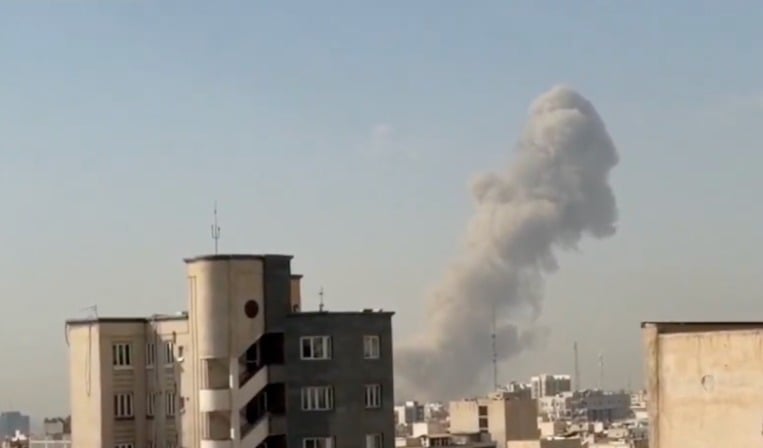
In a message marking 30 days since the start of the conflict involving Iran, a senior Iranian official has outlined concerns widely shared by residents across the tense Gulf region and beyond regarding what United States may do next.
“The enemy signals negotiation in public, while in secret it plots a ground attack,” reads the statement from Iranian Parliament Speaker, Mohammad Bagher Ghalibaf.

His remarks come as Washington continues to maintain that diplomatic talks with Iran are ongoing, even as it deploys thousands of troops to the region, including about 3,500 personnel who arrived from Asia over the weekend and have begun assembling.
Speculation has intensified over the possibility of US forces attempting to seize Kharg Island, Iran’s primary oil export terminal in the Persian Gulf. Capturing it could disrupt a major source of revenue for the country by cutting off oil exports that fund its military operations.
There are also discussions about US troops securing coastal areas to reopen the Strait of Hormuz, a crucial global energy route that Iran has effectively blocked since US and Israeli strikes began at the end of February, triggering shocks in global oil and gas markets.
In addition, reports suggest potential plans for US forces to raid nuclear facilities within Iran to secure sensitive materials, amid fears they could be used to develop nuclear weapons.
However, launching a ground operation carries significant risks. Preparations have been visible for weeks, and without the advantage of surprise, such a move could lead to severe casualties despite superior US firepower.
Ghalibaf warned that Iranian forces are already “waiting for American soldiers to enter on the ground so they can rain fire upon them”, signalling readiness for a fierce confrontation.
The situation also raises serious concerns for neighbouring Gulf Arab states, which are already experiencing economic losses and population outflows due to the ongoing conflict. Iran has continued missile and drone attacks targeting regional countries that host US military bases and has threatened to escalate further.
Tehran has warned it will intensify strikes and “punish their regional partners forever” if the war worsens, potentially targeting critical energy infrastructure across the region, which could have long-term consequences for both regional and global economies.
In mid-March, Iranian ballistic missiles struck the Ras Laffan Industrial City in Qatar, the world’s largest gas production site, causing limited damage but sending shockwaves through global markets. Further attacks of this nature could result in widespread economic disruption.
Desalination plants, essential for water supply in the arid Gulf region, have also been identified as potential targets, although Iran’s Islamic Revolutionary Guard Corps has denied any intention to strike such facilities for now.
“The lying, terrorist and child killing president of the US has claimed that the IRGC intends to target the region’s desalination plants and cause hardship for the people of the region,” it said.
“The IRGC has not done such a thing so far,” the IRGC statement added ominously.
While there remains a possibility of negotiations bringing an end to the conflict, both sides appear far from reaching common ground. Washington has proposed a 15-point plan demanding sweeping concessions from Iran, including halting nuclear activities and limiting missile capabilities — conditions Tehran has long rejected.
“With a 15-point list, the US is setting out its wishes and pursuing what it failed to achieve in the war,” Ghalibaf said, adding that Iran would not accept “humiliation”.
Iran’s own five-point proposal, which includes demands for war reparations, control of the Strait of Hormuz, and the removal of US bases from the region, has also been viewed as unrealistic.
Although both sides may have reasons to seek an end to the costly conflict, there are currently no clear signs of compromise, with tensions continuing to rise.
Despite sustaining heavy losses, including damage to its leadership and military infrastructure from sustained US and Israeli strikes, Iran has demonstrated resilience and continues to challenge expectations of a swift resolution.
Its control over the Strait of Hormuz remains a major leverage point, posing ongoing threats to global energy supplies.
The involvement of Iran-backed Houthi forces in Yemen, including missile launches towards Israel and threats to key shipping routes in the Red Sea, has further complicated the situation.
As the war enters its second month, hopes of a quick resolution appear increasingly distant, with the conflict showing signs of further escalation rather than de-escalation.