

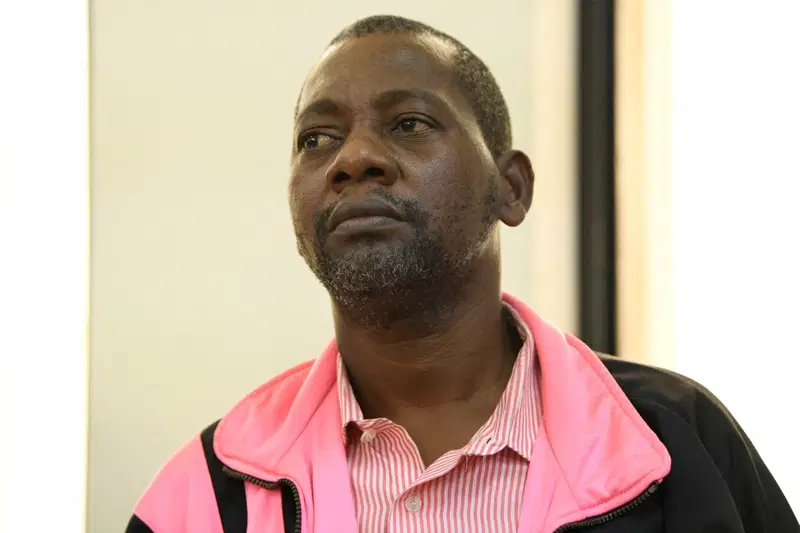
A Kenyan court has convicted pastor Paul Mackenzie of murdering 191 people, including 190 children, after he allegedly instructed members of his religious group to starve themselves and their children to death to “meet Jesus”.
The BBC reported on Monday that 28 other leaders of the group were also convicted of murder. All the defendants had pleaded not guilty, insisting that nobody had been forced to die.

Delivering an eight-hour judgment in the coastal city of Mombasa, Justice Diana Mochache said Mackenzie’s followers viewed him as “Jesus’s mouthpiece”.
According to the report, one of Mackenzie’s co-accused told the court that the pastor had directed his followers to use violence against anyone who refused to fast.
The co-accused said anyone who “resisted the directive to fast must be forced to go to heaven through kicks and blows”.
The judge also disclosed that burials in the forest where the group operated were described as “weddings”, while those who died were said to have “were celebrated as having wedded with Jesus”.
The court heard that 17 men from a nearby town were employed to dig shallow graves in the forest, with some reportedly earning as little as $8 (£6) daily.
One of the gravediggers, identified as James, recounted the disturbing discoveries made during the exercise.
“Every grave we found had at least three bodies,” James told the BBC. “Some of the remains were of children as young as a few weeks old.”
He added, “We once found 12 bodies of children in a line inside a grave. It was massive, the bodies were arranged like clothes. One on top of another.”
The workers also reported discovering children whose “hands and legs tied and bodies wrapped in bedsheets”.
Another gravedigger, Salim Karisa, said some of the victims were known to residents of neighbouring Shakahola town, as members of the group regularly visited to buy supplies and fetch water from the River Galana.
“We would sometimes carry people on our motorbikes into the forest. But it was so planned and secretive that nobody could tell what was happening inside,” Karisa said.
Mackenzie founded Good News International Ministries in 2003 and attracted thousands of followers over the next 16 years through church branches across Kenya.
The church also operated a television station, Times TV, which broadcast his sermons from Malindi. His teachings reportedly described education as “evil”, healthcare as “against the doctrine” and digital identity cards as “the mark of the devil”.
Mackenzie’s son, Dan Paul Mackenzie, who worked as a cameraperson for the church, recalled how worship services were conducted.
“The children would sit at the back, adults in the middle, and everyone would sing worship songs all morning,” he said.
The pastor usually began preaching at noon, with some sessions involving what was described as “casting out demons”.
Following the closure of the church’s main branch in 2019, Mackenzie relocated to Shakahola forest and encouraged his followers to join him there.
Among those who moved to the forest was 23-year-old Peter Shukrani, who went with his mother. He had joined the church at the age of eight and regarded Mackenzie as his “spiritual father”.
Despite his experiences, Shukrani said he would “never say a bad word about him”.
However, he fell ill while living in the forest, where medication was prohibited. His condition deteriorated after his mother discarded the medicines he needed.
“My mother would throw away all the medicine I was supposed to take because she believe that only God could heal me,” Shukrani said.
He described the living conditions in the forest, where members stayed in mud houses scattered across the expansive area.
“We lived a quiet normal life, fasting for a few days then having a small meal,” he said.
The first bodies were discovered by local herders in March 2023, by which time hundreds of people had reportedly died.
Karisa said some victims were so weakened by starvation that they died while being transported out of the forest.
“We would carry someone out of the forest but they were so frail that they would die in our arms,” he said.
Shukrani was among those rescued. He said he had been bedridden for weeks before his rescue and believed he would not have survived without intervention.
“My mother believed Pastor Mackenzie’s doctrine that medicine was evil. I would have died if I wasn’t rescued from Shakahola forest,” he said.
Many of the recovered bodies remain unidentified because of decomposition. Court records reportedly identify several victims as “unknown male child”, distinguishing them by the locations of their graves and the dates they were discovered.
Despite accounts of starvation, strangulation and bludgeoning among the victims, Shukrani continued to defend Mackenzie before the verdict.
He described the pastor as “a good person who cares for me”.
“Mackenzie didn’t force anyone to fast. People made those choices by themselves because of their beliefs. I still love him and he is still my pastor,” Shukrani said.
Dan Mackenzie, however, argued before the ruling that his father should be held responsible for the deaths because of his leadership role within the group.
“He was the leader, he was someone who they were looking [up to]. So he is a murderer of mass killing,” he said.
